
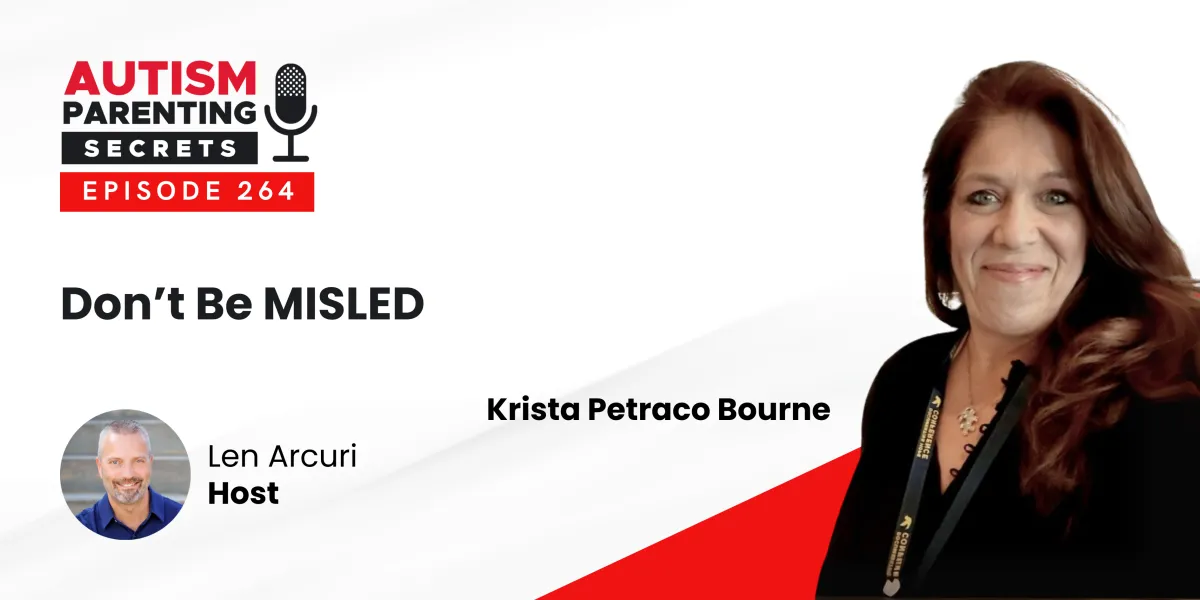
Episode 264 — Don’t Be MISLED
Guest: Krista Petraco Bourne • Date: July 15, 2025
Episode Overview
Krista Petraco Bourne’s journey is one of heartbreak, awakening, and bold action. In this episode, she shares how being misled early on led to unnecessary suffering—and why trusting your gut, asking hard questions, and assuming competence in your child changes everything.
About Krista Petraco Bourne
Krista Petraco Bourne is a licensed speech-language pathologist and the mother of a non-speaking adult son with severe autism and autoimmune challenges linked to vaccine injury. With over 30 years in the field, Krista’s personal experience led her to question mainstream narratives and seek out innovative approaches to communication, including becoming a practitioner-in-training for Spelling to Communicate. She’s a board member at Autism Health, working to connect families with groundbreaking biomedical and therapeutic resources.
You’ll Discover
Krista’s Story of Regression (2:26)
The Approach That Gave Krista’s Son His Voice (17:59)
Why Aggression is Often Misunderstood And Preventable (21:38)
How Autism Health Provides Resources and Scholarships (33:06)
Referenced in This Episode
Full Transcript
Len Arcuri (00:01.326)
Hello and welcome to Autism Parenting Secrets. If you've ever felt overwhelmed, confused, or like you're not getting the full truth, this episode's for you. I'm joined by Krista Petracko-Born, a mom, a speech language pathologist, and someone who's walked a long hard road with her son, Joey. Joey regressed, lost speech, and developed a serious autoimmune disorder linked to vaccine injury. And for years, Krista
Oops, I'm gonna start over.
Krista Petraco Bourne (00:31.586)
Okay.
Len Arcuri (00:36.728)
Hello and welcome to Autism Parenting. What was that?
Krista Petraco Bourne (00:37.812)
I'm sorry, no good?
Len Arcuri (00:42.798)
All right. I got to hold on a second. Let me just, I just realized I didn't. That's the beautiful thing is we can start late. And by the way, if you're talking and something just doesn't come out right, just stop and rewind. Um, and then we can just take that piece out. That's why I like this. This no worries. All right, here we go.
Krista Petraco Bourne (01:00.043)
Okay, great.
Len Arcuri (01:07.064)
Hello and welcome to Autism Parenting Secrets. It's Len. If you've ever felt overwhelmed, confused, or like you're not getting the full truth, this episode is for you. I'm joined by Krista Petracko-Born, a mom, a speech language pathologist, and someone who's walked a long, hard road with her son, Joey. Joey regressed, lost speech, and developed a serious autoimmune disorder linked to vaccine injury. And for years, Krista stayed silent.
even when her gut told her something was deeply wrong. That silence kept them both stuck, but everything changed when she decided to trust herself and speak up. Today, Krista is a fierce advocate, a board member at Autism Health, and she's wanting to help families like yours cut through the noise and find real hope. This conversation is all about tuning in, waking up, and reclaiming your role as the leader your child needs. The secret this week is...
Don't be misled. Welcome, Krista.
Krista Petraco Bourne (02:09.078)
Thank you. Nice to be here, Lynn. Thank you.
Len Arcuri (02:11.822)
Great, well I'm excited to hear more about your perspective, how you're powerfully wanting to show up for the families who are listening. And I know part of that is your backstory, which we all have one and they're all incredibly unique. So I'll hand it off to you in terms of to provide more details on the high level summary I shared. And again, I'm excited to hear all about the ups and downs of your journey with your son.
Krista Petraco Bourne (02:40.194)
Great, thank you for giving me the opportunity to share my son's story. means a lot to me. I guess I will start with just my background. Like Len said, am a speech pathologist. I've been practicing since 1993. When I first began speech pathology, I honestly, the first few autistic individuals I had, I really didn't know what to do with because it was so rare. We didn't really know that much about it then. Fast forward about seven years into my career,
My son was vaccine injured. He regressed at a year old, a little, about 13, 14 months, just after the MMR and varicella shot at 12 months. He also at that time developed idiopathic thrombocytopenia, which is an autoimmune disorder in which his body is attacking his own platelets. making antibodies that think his platelets are foreign.
So we've had many hospital stays over the years and all when his platelets go down, he's at risk of having bleeding issues. So it's been pretty demanding as far as his medical needs go in addition to the neurological and social needs and everything else that he has. So I guess my background also includes I come from a family of very medical. have two brothers who are docs, a sister who's an ER nurse and the mindset of vaccines being safe and effective was something I
genuinely accepted as fact. And in hindsight, I saw the damage that happened that would cause Joey's regression. had previously those families that I had prior to Joey's birth told me it was vaccine injury. I guess when I think about being misled, it was just accepting that safe and effective narrative that made me think, of course, I'm going to vaccinate my kid because I want to do what's best for him.
In hindsight, clearly I didn't do anything intentionally to harm Joey, but I did promise to protect him. And had I done a little more research and known that that was just a narrative, you know, if I trusted my God at the time and didn't do those vaccines, where would we be today? I'm not saying it because I want to say, what if, or have regrets. I love my son with all of my heart and I'm here to support him.
Krista Petraco Bourne (04:58.05)
But as a career speech pathologist seeing, you know, when Joey first regressed, it was very rare. And I had a few kids on my caseload that had similar stories. When I, I guess about 20 years ago, I started working in the public school setting. And even then it was still quite rare. We had a few small, you know, small class of severely autistic kids. And over the past 20 years, it has grown from two classes to three classes to four classes.
in a public school setting where these are supposed to be gen ed kids, right? So it really is showing, know, RFK recently talked about the epidemic numbers and it's absolutely true when I look over my career or even when I look over Joey's, you know, personal, his timeframe, when he was two and three years old and he was, you know, having a tantrum in the supermarket, people would look at me like, you know, either I'm a bad parent or I have a bratty kid and they didn't know that this was all coming from his, you know, his spectrum disorder.
Now, Joey's six foot tall, 240 pound man, and I have to bring him into the women's bathroom when I go out in public because I can't send them in there by himself. So when I look at the difference in acceptance, and I genuinely believe I want to have faith in humanity, and it's kind of been restored by that, the fact that people are so accepting of his differences now and see it's because there's such an impact. Like everywhere I go,
When I say I have a non-speaking severely autistic 26 year old, people have nieces, nephews, cousins, grandchildren, you know, they're so impacted that people don't bat an eyelash when I had bring a six foot tall man into the women's bathroom because they know that everyone has been impacted by this and everyone has a family member or an extra neighbor or whatever that has this. So I think now when you talk about acceptance, yeah, there is more acceptance because
people are more aware because it is, the numbers have exponentially risen over the years. So my feel is, you for the last few years, I look back and I know that I was misled. And even though I knew what I knew, I was completely, I mean, censorship and stuff aside, mean, clearly I was blocked whenever I tried to say anything anyway, but you know, the pushback was just so overwhelming that I'm like, okay.
Krista Petraco Bourne (07:23.298)
but I can't sit here in good conscience and watch another generation of this. I see so many young couples starting a family that don't know, that aren't aware. I think now in the last, unfortunately the last few years, some of what happened with the COVID vaccine, people are opening their eyes and questioning it more, thankfully, and are holding back on doing that. there's a lot out there that...
I think as parents, we kind of question it and have this gut instinct. And unfortunately, the powers that be make you think it's okay and you go against what your intuition and your gut are telling you to do. So my biggest role in the last few years is I'm really trying to advocate for families, both those that have been injured to get the help they need.
and also those who are starting a family to become more aware of the dangers so that they can avoid it. The Autism Health Summit, the nonprofit Autism Health, and you can go to www.autismhealth.com, is a tremendous resource. Last year, I actually borrowed from my retirement to go to the Autism Health Summit in San Antonio so I can get some of the information from, there's a lot of great biomedical, real groundbreaking therapies out there now.
And I went there to learn more and I was completely blown away. And Tracy Slupsivic and Steve are amazing. got just what they put together for San Antonio was incredible. Then again, this year in San Diego. But this year she started up the nonprofit as well. And that was really so that we could bring these resources to families that need it. Unfortunately, families like mine.
that have severely impaired individuals or loved ones, whatever, know, they're caregivers, they're the people who least can pick up and go to these conferences, right? Because their child requires 24-hour care. So what the nonprofit is aiming to do is, and in fact, for the San Diego conference this past year, a lot of the parents that were there were there on scholarships. We were able to provide, you know, tickets so that these parents can attend and get
Krista Petraco Bourne (09:44.278)
get the information there. you know, the people we had presenting, I mean, it was just amazing. The other thing that I really loved both about this and last year is the change in just the vibe, right? The tide is turning. And I think one of the big things that prevented me besides the logistics of getting the information initially was just it's so challenging.
because of all of the difficulties I had with my son, it's very easy to become the victim. poor me. And well-intended, people say, I'm so sorry for your situation. And it basically feeds into this like helpless long-term prognosis, where people get trapped in the victim. And believe me, no one is gonna underestimate what we go through more than, like I completely understand. But I think...
the things I was hearing unfortunately was validating like, yeah, there's this hopeless situation there, there's no positive outcome. And what I've learned in the past couple of years is that that couldn't be further from the truth. And if you follow, you know, what your gut is telling you and you look with hope towards, okay, what could we do step by step to get the supports to recover them as much as possible. And some people, you know, then question, you know,
If you're doing it, are you not really accepting? Listen, I unconditionally love my son. Families I speak to, you know, we want what's best for our children. And unfortunately, sometimes the difficulties that we have, and Joey's been very self-injurious and very aggressive with me over the years. I mean, I completely understand, you know, families that are struggling. It's very real. But it's so important that
we actually get the word out there and start empowering these families to do what they need to to help, you know, really support the family as best they can.
Len Arcuri (11:49.858)
Yep. Great. Well, thank you for sharing more expansively a lot of what you've learned. And again, I'm understanding it all and tracking with it all. in many ways, think, you know, a similar early part where, you know, what my wife and I witnessed with our son was similar, you know, kind of right at that 12 month checkup. And we know there are a lot of factors.
Krista Petraco Bourne (12:01.27)
Yes.
Len Arcuri (12:14.048)
that were going on and with vaccines being one of them for my son for sure. you know, this, we go back not as long as you, but like it's hard for people to appreciate how wildly different things are now versus 20 years ago, let's say, because it's almost where now, like your son, it's kind of normalized where people aren't so shocked about that.
Krista Petraco Bourne (12:32.437)
Yes. Yes.
Len Arcuri (12:42.13)
and, and again, that's where I just look at it. And when you talk about being misled, you know, it's really the key learning, I think that you, you honed in on, I'll just put it in, you know, RFK junior speak. talks all the time about critical, critical thinking, right? And it's, it's being able to not just blindly follow some guidance or, you know, it's really to, to own what's going on, become more aware to make.
in more informed decisions. And that's where, from your standpoint, you feel like based on your influences or where you went to for information early on, that it wasn't giving you the full picture. And I fully agree with that. My wife and I, when she became pregnant, was like, we divided and conquered in terms of getting ready. And the vaccine thing came up and I raised my hand and said, okay, I'll research it. I researched it. It's been about literally 10 minutes. Got to the CDC's website that said all is well.
and vaccines do not cause autism. And I'm like, okay, it's done, it's settled. And I wish I would have done dug deeper then. So that's where again, I don't think Chris and I are here like saying, listen, you have to believe what we believe and have our worldviews on things. But it's just so important to really do your own research to become informed as best you can. That doesn't mean buying into all kinds of conspiracy theories just because they sound exciting.
It means doing your own research and it may be a little bit more time than you might want to spend, but it makes all the difference to be able to make great decisions for our children. They're counting on us and I know I wish I would have dug deeper when I had the opportunity.
Krista Petraco Bourne (14:28.886)
Yeah, for sure.
Len Arcuri (14:31.48)
So, yeah, so I think it's just noteworthy how different things are, but even though things have shifted, the role of the parent to be that decision maker in chief is as important now as it ever was. And even though things are shifting maybe with more real science being done and more questions being more thoroughly researched, given the change in administration and the like.
as you're standing here now in terms of your role and how you want to support parents, how uniquely are you looking to pay this forward based on your experience with Joey?
Krista Petraco Bourne (15:11.586)
Well, I am, like I said, just getting on board with Autism Health when Tracy and Steve approached me to get on. If I wanted to be a board member, I was like, I couldn't be more honored. know, we're doing a lot of reaching out. You know, we've started up blogs and parent information, the conference itself, of course. So, you know.
My affiliation with Autism Health, you know, I think is a really great way to get a hold of a lot of these families. In addition to that, I have my own website and I'm trying to put out there. I'm actually, I didn't mention to you before, I am what's called a communication regulation partner for my son, Joey, who is a non-speaker. And I'm currently finishing up, hopefully in the next couple of months with my practitioner training to become a spelling to communicate practitioner.
So, you know, in addition to what I do with in speech pathology with a lot of these families, which I of course will continue to do, there are a lot of non-speaking families that I would really like to, you know, refer to spelling to communicate. It's an incredible modality to help these kids really literally regain their voice. So I'm kind of, I'm trying to get into advocacy. I mean, I feel like I...
My experience both personally and professionally has really prepared me that I can't sit by and watch families continue to suffer this way. Like I need to be able to get to them and advocate for them and help inform them. You know, that there are a lot of good modalities out there that you can to help improve their quality of life as well as, you know, to help prevent those that have not been injured from going down that same path that we.
unfortunately it went down. I really just, I feel like it's so important to me that I reach these families however I can. So I'm out here. Call me, let me up, whatever I
Len Arcuri (17:16.082)
Great. Well, you mentioned spelling to communicate and for anyone who listens to this podcast, we've covered that modality a few times with some amazing guests. again, I think if you're a regular listener, you're aware of this where, you know, many parents are kind of just being introduced to their child for the first time of what, you know, but they had no indication of because
Krista Petraco Bourne (17:31.105)
Yes.
Len Arcuri (17:45.486)
because of the lack of communication and with spelling to communicate or RPM or the Spellers Method. There's a number of modalities out there. But honestly, it never gets tiring for me, but it's amazing how many stories after story where you hear that same refrain where the parents like, I had no clue what was going on with my. And so my guess is with Joey, that was the same for you. Can you talk about some of your ah-hahs?
Krista Petraco Bourne (17:52.983)
Yes.
Krista Petraco Bourne (18:01.303)
Yes.
Krista Petraco Bourne (18:11.68)
Yes, you know, and yeah, like I said, a lot of times Joey has been very self-interested and very aggressive with me over the years. And I really think it was like, he's frustrated. He's got to tell me something and he has no way to communicate that to me. Particularly, like I said, all the long hospital stays where they were literally, you know, pounding them with Thorazine, trying to sedate them because he was, know, four grown men, at each limb holding him down. I mean, you're talking.
Even when he was little, when you get an adrenaline dump like that, it's unbelievable the strength that he has, much less now at six foot tall, 240. I mean, I literally can overpower you. So I just see what he's been through. And I know that for a long time, even until a year or so ago when I first found out about it, I was kind of.
and part of it is my training in speech pathology. I've been led to, again, being misled by my, I've never been so happy to be wrong about what I thought I was an expert in. So many years I heard how so-and-so was low functioning or they have auditory processing difficulties. And that is true for many of my speech cases, but for these non-speaking population, is,
purely motor planning. They understand everything. They have the same cognitive capabilities that you and I have. It's really just their bodies won't comply with what they want to do. So imagine the frustration. They absolutely know what they want to say. They absolutely understand everything you're saying. Again, unfortunately, my training taught me, even when I first found out about spelling and years before that, I found out about RPM,
When I first got out of grad school, my first supervisor told me about facilitated communication from 30, 35 years ago and how it was all disproven. It was a farce. And so even when I went into RPM and then spelling to communicate or listening to the speller's method, I still went into it with such cynicism because I was taught that, yeah, this is, know, they're moving the board and you know, it's not, the, it's the prompter's words. It's not the person's, you know, the individual's work. And
Krista Petraco Bourne (20:28.896)
So I accepted it. So I didn't really pursue it. I tried RPM for a little while with Joey, but I really didn't give it enough of a, you know, a turn at it because I was like, okay, it's great for those kids. And clearly we saw kids that did work for it. And I was like, okay, it's great for those kids, but clearly Joey's not one of those kids. Now in hindsight, I realized Joey's it's all motor and now he is, you know, progressing along. He's gone from the three boards to the single board. And, you know, I can't wait till the day that he's an open communicator. And I think.
Len Arcuri (20:54.423)
Yes.
Krista Petraco Bourne (20:58.028)
truly think it's gonna be in the very near future. But I've talked to families where spellers literally have, you know, just discussed significant medical needs that literally are life-saving that had they still been non-speaking and non-communicative, you know, literally life-threatening issues that like are now being, you know, the kids are saying and adults are saying, is, mom, something's not right. I have to get this checked out, you know?
Len Arcuri (21:24.899)
Right.
Krista Petraco Bourne (21:24.906)
And they are. And so it's literally is life-saving for these kids. unfortunately, I'm gonna get a little political right now. ASHA, my licensing board for speech pathology does not acknowledge any of these methods as being legitimate. And as a result, there's a, again, misled, right? A lot of family members of non-speakers that don't pursue this because they're like, if the speech pathology board is saying it's not real, then...
why would you waste your money going to do this? Because they're still thinking that these kids are, you know, cognitively impaired or mentally retarded. And like, I think even, you know, a year and a half ago, when I first found out about this, I was still presuming the key to all of this is presuming that your child or adult is competent, right? They're cognitively all there. And
That was a big error I was making because even a year ago, I was asking Joey, oh, do you have to go to the party? You don't ask a 25-year-old man if they have, but I'm thinking in my speech pathology brain, I need to simplify things and I need to talk to him in a way that he can understand. And in the past year that, I mean, he's not quite fully open where he can communicate everything he wants to, but the way that I now talk to him now that I know he understands everything and I am presuming competency.
his behaviors and his aggression and his self-injury is like non-existent because now he's not always frustrated because he, you know, in the past, I'm sitting there talking to him, like assuming he's not understanding me. Like imagine how frustrating to be sitting there being talked to, quite frankly, literally like you're an idiot, when you're totally, Joey is at least average if not above average intelligence and
Len Arcuri (22:51.725)
All right.
Krista Petraco Bourne (23:14.964)
that whole time for literally 25 years. I've been talking to him like he doesn't understand me and he doesn't get it. And of course he's going to get frustrated and he's going to get aggressive and he's, know, and just the change in how I speak to him now that I know that he's fully in there. It's night and day. I don't have the aggression. I don't have all the self injury and everything that he was having because now there's the sense of relief that
He knows that, you so now I just have to kind of present things a little differently and be like, okay, I know this is upsetting you right now. You know, would you rather we did X, Y, Z instead. And then it's like this like huge weight is lifted off both of our shoulders because now we can communicate, you know, and he's not constantly in the state of frustration. So I just think it's important that families, no matter how it appears in their actions or their aggression and whatnot, like that they're not getting it or they're not like,
They 100 % again, do not be misled. Autism is a combination of behaviors, right? And unfortunately you're looking at these symptoms and you're saying, okay, that means this. mean, everyone goes right to the DSM-IV. The DSM-IV is not valid. According to the DSM-IV and all psychological testing Joey's ever had, he's always below the first percentile. Do I really think he's below the first? No, absolutely not.
this whole movement, and again, there are multiple modalities for spelling, but all of it really is validating that these individuals are completely 100 % cognitively intact and they have a lot to say. They just can't get it out because their motor system's not complying. So the more we can work on the motor and get them to where they can be fully open and communicate what they want, the better, you know, but again, even myself.
when I first heard it, was like, I went to the, I guess it was fall of 23, I went to the CHD conference and that's actually where I met Tracy and I immediately bought her Warrior Mom book and read all up and was looking for lot of biomedical things, which was wonderful. But I also met people at the Spellers table who was telling me all about that.
Len Arcuri (25:15.756)
Mm-hmm.
Krista Petraco Bourne (25:28.862)
And I was like, okay. And then I watched the documentary literally on the plane on the way home and I called them back up and they're like, I knew it was gonna be life-changing for you, Krista. And it was, it absolutely just changed my entire perspective on everything. And I'm like, I gotta jump into this training and make this accessible to Joey. don't, again, with reference to not being misled, like there's so many things that, you know.
whether it's ASHA or it's pharma, that are saying this is what it is or the CDC is telling you what's And unfortunately, a lot of us, and we should be able to accept that, right? They're supposed to be the experts, but we're accepting things at face value that are not true and we're being misled. And then we're basing our actions and our responses on false information. So there's a lot of things that we could be doing differently.
And I think if you trust your gut and you do your homework and you seek out the sources like Len that can guide you, it'll be all the better for you to not give up on that and just trust your gut and do your homework.
Len Arcuri (26:33.439)
you
Len Arcuri (26:38.702)
Nope, appreciate you lifting the curtain a little bit in terms of what your experience was with Joey particularly his aggression and what might explain that and Yeah, everything in terms of the authorities that are out there and again these organizations are there for a reason So you can fall into this the spot where you can trust have general trust that you know These organizations are out there hoping that they're they have your best interest in mind But you could have that trust but but verify also and that's where he still don't
abdicate decision-making. And again, there's so many lessons learned that I have from this, but it comes down to discernment and figuring out what really might be true, what might be going on with your child. And when I think about this particular challenge, which I think parents have, which is you want to be a great parent. And doing that though,
isn't easy. The mindset I had was, if I just comply, nobody can question me. But if I actually make my own decisions, get informed and maybe say no to something that everyone else is telling me to do, that was so scary compared to just, if I just do what I'm told, then nobody can point the finger at me. So that's where, in this landscape of having to make great decisions or being put in a position to
have the honor of making great decisions. If you choose the easier path, which is just comply, and then you can point your finger, how do you say no to that and say, no, I'm going to make my own decisions? And that can come on a number of fronts, including assumptions of what is happening with my child. So you, with Joe, had people kind of whispering that he wouldn't be able to do this, wouldn't be able to do that, may not understand.
And that's where even having a different assumption on what's going on with your child takes courage. I wish, my wife and I did adopt that posture of presuming my son knew much more than he was demonstrating. But that's just because we had a therapist who whispered that to us early on. And that was really, really good advice. Because again, now we're seeing more more evidence. Your story is one of many where these kids
Len Arcuri (29:04.526)
They simply do understand so much more than they're conveying. I just think it's really interesting with Joey's situation where it sounds like the root cause of his aggression was in some way kind of being disrespected, not being heard, kind of being dismissed or belittled. You weren't intentionally doing that. But that's a great example where us as parents, a lot of times we operate in a way
that's well intended, but it might really not be serving our child. So to be able to have the humility as a parent to reevaluate how you're operating, double check the assumptions you may be making on your child, and yes, also questioning what authorities are telling you to do, that takes some effort, it takes some courage, but incredibly important because not doing those things is so much easier.
Krista Petraco Bourne (30:00.48)
Right, right. And the information you get from everybody around you that are looking at it from the outside, know, it does take courage to stand up and say, no, I'm going to do this because I know he's in there. You know, to this day, I have friends and family members that are like, OK, like they just think that I'm naively wishfully thinking about something that's never going to come to be, that he's not truly capable of that. well, you know,
You you think cognitively, yes, absolutely cognitively, I think he can do that. Again, people are well-intended, but when they, how do I say this? I think a lot of people, especially people who care a lot about us, right? They feel really bad, but feeling sorry for me doesn't help me to help him. It keeps me stuck in that.
poor us, my poor son was vaccine injured and he'll never have a quality of life. And that's where I was for many, many, many years. Unfortunately, I did everything to make his quality of life as good as it can be, but it was based on the premise that, you know, his threshold is down here somewhere. Like he's never going to have be up here, you know? So all the things I did again, well intended, it was like, okay, because he has this difficulty, I'm going to make this adjustment in my daily living.
And it was to try to help make things more manageable, but it actually just kind of kept us stuck in a place that was just very difficult. I mean, it was very isolating, you know, to be in that situation where I would not go to family things. And if I would go to family things, I would sit in the corner with him and keep him contained so that, you know, and it really affected.
all of our relationships with everybody because everyone's like, poor Kristen, Joey, know, this is like Joey's lot in life. And he really has so many opportunities for us to show us what he really has. you know, thankfully we're on that journey now where I see that. And obviously 110 % is going into getting him there as quickly as possible. So, you know, it is just don't ever give up hope.
Krista Petraco Bourne (32:23.276)
people sometimes are well-intended, but sometimes what they're giving you is kind of reinforcing and validating your preconceived notions of how bad it is. And I think if you open up the possibilities for what we can hope for, for our loved ones, I think there's a lot of room for improvement and for real positive changes and hope for our kids.
Len Arcuri (32:49.836)
No, I think that's well said. Yeah, none of us as parents want to sign up with a victim mentality, right? None of us want to be a victim, but if you listen to a lot of the voices around you, it's easy because you're getting a lot of reinforcement that way. So again, who you surround yourself with, who you listen to, who you look for counsel. It could be that you have close family members or friends who ultimately their perspective maybe isn't the right one.
So, you know, I think at the end of the day, probably everyone's truly trying to be helpful, what, whose advice and whose counsel you rely on, be very selective with that, who you allow in. And again, some people may have advice that's the exact polar opposite of what's going to make sense for you and your child. And, and again, for you to step into that version of yourself that can make those decisions and turn off some of the noise. I know it took
Krista Petraco Bourne (33:20.694)
Absolutely.
Len Arcuri (33:43.906)
you a long time, took me a long time, and again, the whole point is to help you as a parent to understand these things earlier so you can chart a more powerful path, a more loving path. And again, so much of what you've shared, I know you're wanting more people to understand. A lot of the coaching I do is really to help parents step into that stronger version of themself and basically to be able to truly chart their own course.
and to get out of their own way. Because a lot of times we show up with certain habits or certain beliefs or certain ways of doing things that just aren't going to help us with this challenge of helping our child. So a lot of times I've found a real key thing is for a parent who's well intentioned to course correct what they're doing. And that's where you touched on a big one in terms of how you were even approaching Joey. In the words you were using.
well intentioned, but not helping, right? Not the most effective way. so again, think parents, as you're listening to that, know there's so much that you have the power to shift in a positive way that's right for you. And I know, Krista, I know you're committed to wanting to share information and resources for parents. So tell parents more about where they can go to learn more about what you're doing and in terms of a lot of what you're looking to pay for.
Krista Petraco Bourne (35:02.089)
Absolutely.
Krista Petraco Bourne (35:08.13)
Anyway.
Yes. So a wonderful resource is our website, AutismHealth.com. And we have everything from the conferences. And in fact, a lot of people, unfortunately, that couldn't attend the conference for obvious reasons, they needed to be home with their loved ones. If you go onto the website, you can purchase audio recordings of the two full day conferences for $75. When I say invaluable, we had doctors coming from Malaysia and Vienna.
I mean, top notch technologies, supplementation, you name it. You know, the science has evolved a long way. And so that is definitely a wonderful thing. We are also doing some fundraising. We have a big walk coming up in California on September 6th. We really, again, the nonprofit was established to help to be able to provide these.
opportunities and resources for these families that really need it. you know, like I said, a number of a large number of the audience that attended was actually there on scholarship money that was raised by the nonprofit so that they can attend and next year. We don't have a definite date yet, but it will be in April again in the San Diego area. I would not miss it for the world. It's a wonderful resource. We also have, you know, a blog we have yesterday. Just the other day we had our first
We're going to have monthly webinars with different experts. had Dr. Goodenow who presented at our conference, who is phenomenal about all very knowledgeable in both assessment and treatment of neurodegenerative diseases in general and has had tremendous success with glial cells for basically restoring neurological functioning in autism and other neurodegenerative.
Krista Petraco Bourne (37:06.496)
disorders so that we literally just had it a couple of days ago. So there will be a recording posted on the website and definitely see that and there will be monthly webinars going forward. We have coaching opportunities, know, just go to the website, look around, there's so much, there's so many great resources. My own website is hopehealinghealth.com.
And I kind of am running the gamut from advocacy things to some biomedical interventions to, you know, certainly the spelling to communicate. Once I become a certified practitioner, I will be looking to do it. If you happen to be on Long Island in the New York area, and as part of my training, I'm doing free sessions. So anyone in the area who wants to reach out, I would love to come work with your son or daughter or loved one, you know, with that. So.
Yeah, my website has kind of a bunch of different things because I just feel like both personally and professionally, I've been so impacted by, you know, what has happened in my own life, but I see so many families having similar struggles and I just want to be a resource for families, you know, so feel free to reach out to me and Autism Health. You know, we really want to get word out about the changes that need to happen for our loved ones.
Len Arcuri (38:27.832)
Fantastic. Well, hey, all that will be in the show notes for sure. Autism Health Summit. Yes, I was in, I was at the first two conferences. I'll be at the next one. Recorded five podcast episodes from there last time. And I would second what Krista says. It's a phenomenal gathering. Well worth attending if you're able to as a parent. Yes, there might be replays that you can watch if you can attend, but there's nothing like the power of being in community with the right fellow parents, with the right practitioners, scientists.
Krista Petraco Bourne (38:30.977)
Wonderful.
Len Arcuri (38:56.674)
these conferences. There's not that many these days because of the fact that people are used to doing things virtually, but it truly is magical and super empowering being with the right group. So again, I appreciate you sharing all that and thanks for lending your voice to this community. I really appreciate it and good luck with everything with you and your son.
Krista Petraco Bourne (39:14.166)
My pleasure. Thank you so much, Lynn. My pleasure.