
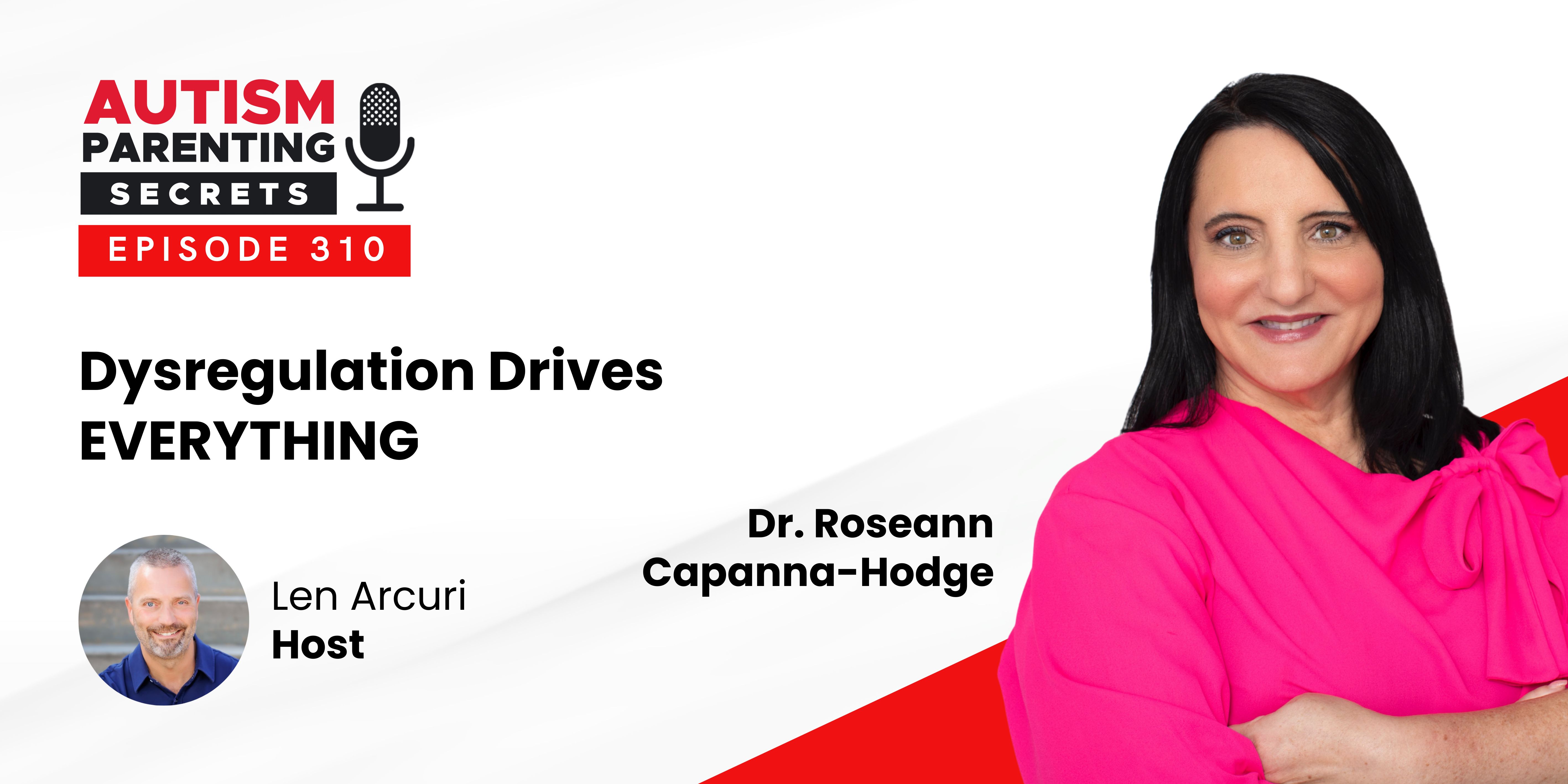
Episode 310 — Dysregulation Drives EVERYTHING
Guest: Dr. Roseann Capanna-Hodge • Date: June 4, 2026
Episode Overview
Dr. Roseann Capanna-Hodge joins the show to explain why so many emotional, behavioral, and learning struggles are actually rooted in nervous system dysregulation. She shares practical insights for helping both parents and children become calmer, more regulated, and less reactive.
About Dr. Roseann Capanna-Hodge
Dr. Roseann Capanna-Hodge is a licensed therapist, school psychologist, founder of Regulation First Parenting™, and host of the Dysregulated Kids podcast. She specializes in nervous system dysregulation and helping families better understand emotional reactivity, anxiety, ADHD, OCD, PANS/PANDAS, and chronic stress. She is also the author of the upcoming book The Dysregulated Kid.
You’ll Discover
What dysregulation really is and why it affects behavior, emotions, and learning (1:59)
Why many kids are not being defiant but are stuck in chronic stress (6:52)
Why masking can hide deeper nervous system dysregulation (14:49)
How screens and constant stimulation dysregulate kids and parents (23:03)
Why parents need to become the “wall of calm” before reacting (29:42)
Referenced In This Episode
Full Transcript
Dr. Roseann Capanna-Hodge 0:00
We are the anchors for our kids, and you don't have to be a perfect parent, but you have to be 80% awesome, and you have to, if you want your kid to regulate, you know, you can't yell at them to calm down, you can show them what calm looks like, but once your kid's in the red, I call it in a dysregulated state, those frontal lobes are offline, they're not capable of reasoning. Don't try to have a conversation with them. You're just going to make yourself angry, and you're going to make them more dysregulated.
Len Arcuri 0:29
If you're a parent of a child with autism, you are being called to rise with love, courage, and clarity. This journey isn't easy, and most parents aren't equipped, but you can be this podcast is your invitation to rise higher, because how you navigate matters. I'm Len, and this is Autism Parenting Secrets, where you become the parent your child needs now. Hello, and welcome. Many parents are working incredibly hard to help their child, yet things can still feel reactive, exhausting, and chaotic, and often what gets labeled as bad behavior or anxiety may actually be rooted in a dysregulated nervous system. Dr. Roseanne Capanahadge joins us today to discuss why dysregulation, what it really is, why it affects so much of a child's behavior and emotional health, and why traditional parenting approaches often fail with overwhelmed kids. Dr. Rozanne is a licensed therapist and school psychologist, founder of Regulation First Parenting, host of the Dysregulated Kids podcast, and author of the upcoming book, The Dysregulated Kid: The secret this week is dysregulation drives everything. Welcome, Dr. Birzan.
Dr. Roseann Capanna-Hodge 1 1:48
Well, I'm so excited for this conversation, because as we were talking in advance, it seems like everybody's talking about dysregulation in the nervous system, and I'm glad
Len Arcuri 1:58
it's taken a while, you know, for a lot of the the talk to really converge here, and it's amazing how many great minds, great thinkers, whether it's practitioners, scientists, this is a fundamental root cause of what might be going on that with focus here on this particular underlying driver, so much becomes possible for our, for our kids that we're trying as parents to make great decisions for. So I think this is a really important topic, and I love that you have a book that's coming up, and I know you've been at this for a while and have lots of resources for parents. So again, if someone's listening, and maybe just they understand the concept, but like again, if you could help them deepen their understanding of what dysregulation is and how it's manifesting, what would you say?
Dr. Roseann Capanna-Hodge 2:46
Yeah, I mean, you know, it is a concept that everybody's hearing, and they absolutely might not understand what it means. And so, to really make it very simple, when we talk about dysregulation, we're talking about the nervous system, we talk about emotional dysregulation, behavioral dysregulation, and all the different facets, and yes, our neurodivergent population is more susceptible to dysregulation, and we'll get it, get into that, but what dysregulation is, is that there are things in our everyday life that fill up our stress cup, whether they're perceived stressors or their sensory irritations, and they cause our nervous system to activate, and once we're in an activated state, we become more reactive to things, and so you might see emotional signs, or behavioral signs, or even physical signs, and so dysregulation is something that affects all of us, and we don't have an unlimited capacity in our nervous system for stress, we have to take some of those stressors out,
Len Arcuri 3:48
right, and as you alluded to, this applies to both the child and the parent, because again, it's impossible to bring your best self to anything with a dysregulated nervous system, and so then that leads to the question, okay, well, if, if that's what's happening, what are the drivers, what's what's behind, is it environmental, is it physical,
Dr. Roseann Capanna-Hodge 1 4:10
it's everything, right, so like we think of, you can visualize a cup, right, and then you know we walk through our day, today was a very exciting day for me, and that I did a bunch of things that are helping me on my book tour, and so I am booked something where literally is going to be 10s of 1000s of people at this event. What happened to me? I got off that call and I literally jumped into the air, so my nervous system activates. We think to ourselves, well, that's not bad stress, Roseanne, but your nervous system doesn't know the difference, so all day long, whether you know now you know you and I have lights on us, Len, right, your kids sitting in a classroom and maybe there's blinking lights, it starts adding to your stress cup, maybe they didn't eat well, maybe they didn't sleep well, whether. You or them, and it starts filling up over hours, days, weeks, and until we pull something out, right? Whether how do we reduce that stress within our nervous system? For maybe it's for our kids, we're doing sensory activities, maybe it's for you, you're getting up 10 minutes early, so you could journal, or you could pray, or you can do some yoga exercises. We have to lower that stress cup, but we all face stress, and that is a part of our life. I think the other side of this is we're accepting just constant levels of chronic stress, because we think, especially for those of us with uniquely wired kids, we think we can just get through it, and we're just going to push ourselves through it. And that's not to say there's never big hurdles where you got to push yourself through things when you're living every day and you're just pushing yourself through it. There's a price to pay. It's going to show up on the emotional side, maybe the spiritual side, maybe the physical side, you know, it there is, you can't just keep taking, you know, withdrawals out of your bank, you have to put some money back in,
Len Arcuri 6:10
right? No, it's a powerful message, and you know, we do tend, as parents, to normalize it, right, there's this normalized level of stress, and of course, it's very predictable where this leads if you don't do something about it, right? So, as a parent, if you don't find a way to alleviate or reduce that load, so it's basically total load theory, only like only specifically related to this level of of stress, or what I would like to call like the weight that we carry, and there's a lot that you can do to shed weight to get more grounded, and again, that may mean as a parent focusing on yourself, which is a hard thing for parents to take in as they're focused on their child, but shifting to the child for a second, if they do, are in a state of dysregulation, and parents may see that as manifesting as just let's say bad or problematic behaviors, whatever the case may be. There's some element where parents are thinking kind of how I was conditioned with the parent being playbook, my parents gave me that, oh, those behaviors, that's my child defying me or intentionally, you know, with malice doing something that they, they're not supposed to do, and while sure there may be some element of that, the vast majority of what's behind those behaviors we're not wanting has nothing to do with a child's intent, right? It's basically how they're reacting to these stressors.
Dr. Roseann Capanna-Hodge 1 7:39
Absolutely, you know, I always say, you know, it's, it's not defiance, it's dysregulation, and we often think that kids are doing things on purpose to, you know, irritate us, or, you know, try to avoid things, and that's not to say that never happens, but what I think most people don't realize is once you move into this chronic stress state, especially for kids, right, they're credibly activated. Maybe they have a mental health issue, maybe they have, you know, a physical problem, right. You know, I work a lot with kids with pans and pandas and OCD, and really complex layered issues, right. Or I should say, I used to work in a clinic with that, because by the time this comes out, I will no longer be doing one to one work, and so over these three decades I've worked with 1000s of people, and you know what happens is, and from a biological perspective, once your nervous system moves from a relaxed parasympathetic state that was ever in a parasympathetic state, I like to call it the hot tub state, Len, but once it moves into what's called sympathetic dominance, that is biologically that's the state where you have to either fight, flight, freeze, or fawn, and your frontal lobes go offline, so that you stop thinking and you can only to act, you're not even, and you're acting from a point of threat and fear, right. So, once that happens, we've lost our logical abilities, right. What are we going to do? So, your kid is super activated because they have a sensory processing issue, and I like to talk about sensory processing issues because I think it affects so many adults and kids, right. You don't have to be neurodivergent to feel very affected by I always talk about at night, I turn off all the lights in my house, Lynn, because it really sets me off, like I'm like, what, let's turn this down, it really affects how I sleep, so if I have a lot of lights at night, Roseanne ain't sleeping, and I don't like that, so I know, as everybody should know, sleep is important, so, and I'm not a great sleeper, so I have to take extra care to make sure that it happens, so as you're super activated and back to that kid, right, so that kid, his cup, her cup has been filling these hours, days and weeks, and so what happens when you're in fight, flight, or freeze, right. You are not capable of rational thought. You're not capable of thinking things through, and connection is going to be really hard. So, you're going to have a real hard time connecting. And don't worry, we can walk you out of this. This is not a permanent state, even though some kids get in there more, or you get in there more, right? But we do have to realize that a lot of kids are carrying this load, and we have to pull back before we can say, hey, you're being disrespectful on purpose. Why are they acting like that? Is it because they're just so activated, they're avoiding something, something's irritated, and we often think that, you know, kids have skills, and they're they are connected, but they are different sets of skills. So, you might have a kid with 127 IQ who still doesn't flush the toilet, and you're really annoyed by that, but that's a different set of skills. Matt taps into executive functioning, that taps into social awareness. So, we have all these different skills, and IQ can only get you so far, because many of our neurodivergent kids, you know, kids with ADHD, kids with dyslexia, have typically, on average, a higher, higher IQ than normal, so there creates this irritation from the parent side. Now, remember, all skills can be learned, don't think they can't be, but when you're activated, we have to pull back. We have to regulate first yourself and your child, right? There's a reason why, in an airplane, they tell you to put an oxygen mask on first, because you need to be calm, you need to be breathing before you put it on your kid when the plane's going down, and so you know it's a lot to think about, but it's really hard to avoid personalizing kids' behavior when you're carrying those old narratives and zone scripts, but more importantly, you're activated too.
Len Arcuri 11:52
Yeah, no, it all comes down to the parent and what we're believing in that moment, which is why the power of this concept, that dysregulation is what your child may be experiencing, then that gives you the space to not be annoyed, to not be aggravated, because again, what our children may be exhibiting, it might be befuddling, you're like, wtf, you're trying to make sense of it, and it may not make any sense based on where they are, so again, if you want, as a parent, to respond to your child to meet their needs, you can't do that if you're judging their behavior in a negative way, or if you're taking it personally, what they're doing, where it may have nothing to do with you as a parent, and just again, where they happen to uniquely be, which is where you're the energy you have can best be directed to meeting them where they are, and if there is something that's contributing to this dysregulated, dysregulated state, there's always something you can do about
Dr. Roseann Capanna-Hodge 1 12:56
it. Absolutely, and even just to think, if you look at it from the lens of the nervous system, right, and you say, oh, it's their nervous system reacting, oh, they're not giving me a hard time, they're having a hard time, and you really start going, what are the clues, and I think that lens really makes it where you're not so activated when you start seeing it in that way, and you become, I often talk about being a parent detective, you start going, what are the signs of under and over stimulation? Because either either sign from the nervous system could lead to an emotional eruption or no motivation or total remember it's fight, flight, freeze, or fawn, and those fawn kids are the kids that do everything 100% right, but inside hot mess, and they're these kids crash and burn. These are kids that are more likely like where people go. I, I didn't know that was happening, and the next thing you know, they're using drugs, or they refuse, they get school refusal. You start seeing the extreme, but they, they then look backwards, as Steve Jobs always says, you can only connect the dots looking backwards, and then they start making sense of the clues, and that's the conversation that that we're having. What are those clues? What do we do about it? And because we again can remove stress from our stress cup safely, easily, kids, parents, but parents really need to be regulated enough, not perfectly regulate. Regulated, wouldn't it be nice if we were perfectly regulated? Len,
Len Arcuri 14:31
right?
Dr. Roseann Capanna-Hodge 1 14:32
And you know, Len used to live in the Northeast. I live in the Northeast, like it's fast-paced around here, you know? Like, people are honking at you, and people are can be really nice too, but there's an intensity here that isn't in this, in certain areas of the country, but those things can really, for me, they feel very triggering sometimes, like I'm like, okay, I'm gonna breathe, I'm going into Costco, I need to do some deep breathing before I go there. You know,
Len Arcuri 15:01
right, yeah, and then even something like deep breathing, it's simple, but it again, there's lots of tricks or lots of tools at your disposal if you're prioritizing, you know, the idea of getting more regulated, so again applies to parents, applies to kids. I'd love to go back, though, because I'm always learning on recording these, these discussions, so I never, in terms of the fourth element that you mentioned, the fun piece of it, that's new for me. And when you're, when you were talking about it, I immediately said, okay, well, that must be the category of kids who like mask, right? Who kind of, they are the maskers,
Len Arcuri 15:37
they are the maskers, right?
Dr. Roseann Capanna-Hodge 15:38
They are the maskers, even though you can kind of fall into to all that fawn kids typically don't have, like, there's a new term, you know, a newer concept called after school restraint collapse. So there are those kids that act perfectly at school, and then after school they're just behaviorally a mess, maybe they're withdrawn, maybe they're smashing things like often those are the kids of the school are like what are you talking about, mrs. Smith, we don't see this with Bobby, you know, like they're not getting it, but but fawn kids are in a hyper vigilant state that they must be perfect, they tend to be in homes with a trauma background, so there might be a parent who, you know, let's face it, I work with people all over, I've had people with all kinds of degrees and different situations where they're letting their previous traumas play out in the current family home, and they're bringing not genetics, they're bringing behaviors to the table, right, so and I talk about my mom and dad, Tony and Philomena, all the time, and Philomena is with, with Jesus, and I always say she's probably up there bossing him around, organizing him, you know, making him some good pasta for Joel, and, but you know, they were not perfect parents, they were great parents, but you know, I repeat many of the things that Tony and Philomena taught me, and what I do try to do is share the good stuff, right, but everything we learn about parenting, 90% of it comes from what you learn from your parents, and so sometimes we can inadvertently bring things, including trauma behaviors, to the table, and so those hyper vigilant fawn kids, like my one of my best friends, Cynthia Thurlow - she's a really well-known - anybody, everybody should check out her podcast, Everyday Wellness. But she came on my show, and she did a very deeply personal interview about being a fun kid, and you know, these are kids that people just don't know until they know are in these completely activated states, and again, often they, they mask until they hit a wall, and then they fall. They, they really struggle psychologically at some point, and sometimes physically. You might have kids with unresolved. I have had kids with like chronic gut issues, and, and this doesn't mean this happens to everybody. These are those kids that it really has to be some pretty significant and heavy stuff happening at home,
Len Arcuri 18:12
right?
Len Arcuri 18:13
Yeah. No. Thank you for sharing all that. It was hard for me not to go to a particular client that I have now who is dealing with exactly that, where she does have a daughter who masks, and there's a lot of challenging situations, but the school doesn't see what the parent sees afterwards, which makes a challenging situation even more challenging. So, interesting that fourth category. Yeah, it's amazing
Dr. Roseann Capanna-Hodge 1 18:40
for all those after-school restraint collapse kids. I'm telling you, I think that is a huge portion of our neurodivergent population who does a really good job in the structure of the day, which is like perplexing for parents, because they're like, why are they holding it together all day? Well, they're going to school and their stress cup isn't full, and then they're very, they're hyper vigilant in the sense that in school they have the pressures of the peers, they have all the routines and structures, and so don't think your kid is doing it on purpose. Kids never want to act out, don't let anybody ever tell you that that behavior is just a clue.
Len Arcuri 19:21
Yeah, the kids, the kids are doing the best they can. They're trying to fit in, they're doing, but again, from a parent's perspective, because you're relying on the school to be able to support your child, you know, as they uniquely are, it's befuddling. Where if a school isn't seeing what the parent sees after school, it just makes a hard situation even harder, which is why my heart goes out to parents who are, you know, all parents who have their own unique challenges, but something like that just makes it even harder, because then you have people questioning, you know, you as the parent, because they don't see your child the way you see them, you. So, so, again, I'd say
Dr. Roseann Capanna-Hodge 20:01
it's so true, Len, so true. And then parents start thinking, like, I recently had this, you know, I have such great parents that I've worked with, like you, and I just adore them. And I worked with some of the most incredible cases. I would say that most of my kids that I worked with had already seen a dozen or more people by the time they got to me, it, my world record was, I was the 55th provider, and yeah, so I never took ice, was like, hey, we have nowhere to go but up, as long as I had parents who were willing to do the work right, which means also holding a mirror to yourself, because nobody's perfect, and sometimes you know, I didn't get the kind of kids I thought I was going to get. I thought I was going to get like the easiest kids known to man. My, my Max is the dysregulated kid, and he forced me to rethink everything I thought, because I thought behavior first, no, it's the nervous system first, and we have to do that, because nothing ever will stick, no treatment, no method, no medication. It's not going to work if you don't get that nervous system to regulate, and it's not as hard as we think, whether it's for yourself. Like I always say, I love going for my biweekly massages, you know. Yes, I have, you know, a PMF device literally in my pocket, but you, there's so many little things that we can do to just kind of pull, put a little deposit back in our bank, you know, and so we, we have to start thinking differently, because none of us can survive as, as humans, as people with this level of dysregulation that's out in the world, and call me optimistic. I mean, I just know that we can do things so much better, and again, in such a simple, accessible way. And that's what I walk through people in this book. This isn't just another book. This is how do I do this? How do I do this so easily? And, as I like to say, you're going to start doing these things like brushing your teeth. Why do you brush your teeth to not have cavities? Do you see right? And so when we think about our after restraint, you know, our kids with the after school restraint collapse, right? Parents often think of, like, you know, in the story of those great parents, they, they had a kid who was melting down the same exact time every day, so they kept going. What happened? What happened right there? And I was like, oh no, we're gonna journal and go back. And what they realized was that there were so many things filling up, and it wasn't one exact thing at school, but we were like, he's very sensitive, he's chemically sensitive. I was like, wait, the days they do this at school, this is what you're saying. And we actually had to really look out and figure out what we had to do. And nobody has the same tactical plan, but everyone does have the same tactical plan. Is there are always contributors, and it's not going to always be the immediate thing that just happened before, which I think is really surprising to people. Len,
Len Arcuri 23:04
yeah, it may be surprising to people, but it makes perfect sense to me, right? It's this cumulative load, and there maybe becomes a tipping point that may happen at a certain time of the day, but again, it depends on what uniquely was being experienced, and I guess that leads me to the question I wanted to ask you, in turn, and I know it may be a hard one, but if you think about, okay, what are those stressors that contribute to dysregulation? I guess I'd ask you to throw out the major categories and what you think is the biggest one, but I'll throw out that at least for my son, who is now 19, the biggest one is technology, right? It's screen time, and that's something that he's doing phenomenally with reducing on his own, yeah, but but that is quite the big dysregulator, but what, what, how else would you frame it, and I know it's in your book, but how would you frame it in terms of those bigger stressors?
Speaker 1 23:53
Yeah, I actually trademarked the term device dysregulation, there is an entire chapter on it, because I'd be foolish not to talk about it, I think there's so much wrapped around devices, it's, it's, it's overuse of it, it's what you're not doing, it's lack of boundaries around it. Like, I walk people through, like, the biggest problem people have with their kids, and it's such a reactivity point for families. Like, everyone wants to talk to me about three things, Lynn. They want to talk to me about how do I manage this behavior, like usually something that's happening they can't stop. They want to talk to me about restrictive eating, and they want to talk to me, how do I get my damn kids off the device. And, and the reality is, people think your kid should be self-regulated on that device, and they should be able to manage it on their own, that's bologna and cheese, like, how you know, even the difference between my 21 year old and my 15 year old, there has been a jump up in technology in that six year period, and you know, I have moms that I work with that have like a 20 year old and like a five year old and. They're like, I don't even know how to parent. Every single kid has faced a new thing, so, so the devices, in of themselves, I love devices. Like, I'm not going to say that I don't, but the reality is, you know, how are we managing it? How are we being clear, and to think that your kid is going to be able to self regulate on a device when it is designed to give you dopamine hits that are like crack, literally like drugs, you're kidding yourself. Even Dr. Rose kits, we had to have a Wi-Fi management system, and we had to budge, say this is all you get, you are not allowed to negotiate with us, and we love to tell the story of how Max, my now 21 year old, we have like, we're nerdy science people in, so like, and everyone's like an engineer and all that other stuff, so we would have like we had this thing in our basement with like literally all of our 1990s and 2000s computers and they would just tinker with them, so to this day we still don't know this, but Max used those computers to bypass the technology, and he was able to get on, and my husband said if I wasn't so darn proud of him, I'd be mad, but that's how addictive it is, and in, you know, so you know, again, How are you managing that? You have to have clear boundaries. Kids need reminders, they need visuals, and honestly, I am a huge fan of technology that budgets, budgets it, because it's the device to set dysregulating, and it's the arguing with parents and kids, the between them, they're just regulating both people, so, and you know, kids, like, we didn't, you know, I mentioned co-regulation, but we are the anchors for our kids, and you don't have to be a perfect parent, but you have to be 80% awesome, and you have to, if you want your kid to regulate, you know, you can't yell at them to calm down. You can, you can show them what calm looks like, but you know, once you're, once your kids in a red, in the red, I call it in a dysregulated state, those frontal lobes are offline, they're not capable of reasoning. Don't try to have a conversation with them, you're just going to make yourself angry, and you're going to make them more dysregulated.
Len Arcuri 27:22
Yep, very predictable. And I'm laughing as you're talking, because literally two days ago, because I slipped into that, where I was actually kind of raising my voice with my son, he was doing a final assignment for school, and he was stressing about it, and again I was instead of being calm and helping him through that. I was annoyed that he was dysregulated. So, again, I think we can know things as parents, but we're not going to be perfect. We're going to slip. The key is really being able to default back to what is going on with my child. How can I be useful? And a lot of times that is comes down to a parent being okay in those moments, not getting what they want, right? Just kind of dropping down acceptance, curiosity, and again, if you can in your mind default to, hey, it's not like this is bad behavior, this is just my child experiencing dysregulation, and why would I ever want to meet my child with being annoyed or angry or frustrated, so again, even I've been doing this for many years. Boy, I, and I do express a lot of it, but there's no question I go off the rails and need to go, need to bring myself back at times.
Dr. Roseann Capanna-Hodge 28:39
Yeah, I mean, I go off the rails too, but what I try to do is, if I identify a pattern, right? So my kids turn into teenagers. My youngest is like an easy kid, his name, his name is John Carlo, and, and he, when he came out, I understood why some people have six kids. I was like, oh, there are some kids that are born easy, right? You know, and he's just like he's calm, but he also benefited from my constant instruction that my other kid got. He just picked it up, right, because he was regulated enough to absorb. That's important, remember that. But you know, when we are really thinking about what's happening, right? So I found myself getting really annoyed asking my kids to come down for dinner, right? Like I was bubbling, just getting pretty mad, you know. You don't want to make a New York Italian mad, right? And, and so my husband was like, I got it, because we also think we're the funniest parents in the world, Lynn. So we pull out the karaoke machine, and he starts turning this into a funny thing, so he starts. We use a lot of humor for diffusion, and he every time they ignore him, he gets on, and he goes, "Dinner is being served in the promenade deck, or he'll say, "Everybody to the nurse's office, and he says stuff, and like. Nobody can get mad, you know. So, we were like, we're so mad, like, and you know, it's a totally normal teenage behavior to ignore your parents, like. So, it was like, how could we reframe this without causing conflict? And you know, I talk a lot about humor in everything that I do, but we do have to say, why is this happening, right? But it becomes a lot easier when we talk about, you know, understanding this is just a nervous system activating, and what I talk about, I talk about something called the love pause, and the love pause is as much for yourself as it is for your kids, and it's stopping for three seconds, right after five seconds the brain comes down, but five seconds is too long when you're mad at your kids, but all all it is is the three second pause. Don't say anything, just pull yourself back, whether it's a mantra you have in your breath, your head, a breath, closing your eyes, you know, whatever religious thing that you need, but just to pull yourself back for three seconds, and you know if you think right now that, or try it the next time, you're, you're annoyed, you're frustrated. I don't even care if it's your kid, right? Maybe it's maybe it's at the grocery store, at the bank, or whatever, that annoying coworker, and you just pull back, that three seconds is a long time to be able to reroute, not respond, just be regulated enough, because we often want to come in and be the solution for our, for our kid, and really the solution is regulating yourself, and that is not a joke, that is hard to do sometimes. It feels easier to go in and rescue our child, but we have to lead by example, and we, it becomes so much easier to do that when we give ourselves that love pause, that little bit of time. And I really want people to know, it sounds so simple, but it is that powerful that we're forgetting the basics, like I always have a magic wand at my desk, and you, for those of you listening, I literally pulled out a magic wand, and we think there's something - a homeopathy, a pill, a technique that is it, it is your power, because it will give you enough to recalibrate, and whether it's your nervous system or the words coming out of your mouth, and the actions, it's all those things, and when we do that, we teach our kids without telling them, we're showing them, because we have to show our kids what we expect, that is what we have to do, and that is the hardest part of parenting. We don't talk about,
Len Arcuri 32:48
yeah, no, everything you're talking about is the child feeding off the parent, the parent leads the way, the parent teaches by demonstrating what it looks like, and it's simple, the concept as it is, the concept of slowing down, pausing, having some silence right as you regroup, breathe, whatever the case may be. Sounds so simple, but no, that could be really hard to do unless you shift your own sense of why that's important, like if you firmly believe that it's okay, you give your permission to pause when something's going sideways, and you want to react. You can always just pause, say, "I need a minute. So, it doesn't take much, but it does take yourself believing that it's useful, believing that it's worth it. And yes, our kids would definitely witness that we can regulate ourselves, we can slow things down, and what a great thing to teach your child who's going to have lots of instances where it would be useful for them to be able to do that too,
Dr. Roseann Capanna-Hodge 33:48
but you have to actually do it right, and just to understand the nervous system and the subconscious mind. So, I don't think people know that your subconscious brain is in charge, so 95 to 99.5% of the time we are not in conscious awareness, that's how much it's in charge. So, when we do something right, like when you drive home for work, you don't have to think about it anymore, you don't put ways on, you have to do that with your nervous system, and that three seconds right will feel painful, you might even be mad at your kid in the inside, but you're not going to show it. You're going to be the wall of calm, but the more you do it, the more it becomes automatic. You will not have to think about it. You will do it, and the more your kid's nervous system will self-regulate on its own. And you know, if your kid is a highly dysregulated kid, they, they have impairments of any kind, or obstacles, or whatever you want to call it, and you know it's gonna take longer, and that's okay. We all think there's like a magic bullet, like your kid has 127 IQ, and you just tell them, and they're gonna do. It, because they can do that in history. These are different skills, and some skills need to be nurtured.
Len Arcuri 35:05
No doubt about it. And a lot of it, again, comes down to showing up strong as a parent, letting go of any specific thing that you want to see, and, and so it's about just adopting a more open, less demanding, like I guess the way I always like to describe it is, it's great for you to have as a parent strong wants for your child, but the minute they become expectations, that the whole energy shifts, and that can even though you may feel like no, it's okay to have expectations, if you do, and your child's feeling that again, I found it was inadvertently pushing my son away, so I could go big on what I wanted for him, but then have more patience and be more relaxed, that it doesn't have to happen immediately, and again, if I want faster progress for my child, me shifting how I am with him was the greatest thing I could do to kind of grease the wheels for success,
Dr. Roseann Capanna-Hodge 36:03
amazing. And it's so true, and you know, patience is hard. Like, I have a lot of great skills.
Len Arcuri 36:10
Did your, did your parents teach you patience? Mine didn't.
Dr. Roseann Capanna-Hodge 36:13
You know, Tony and Philomena were pretty incredible parents. Like, I didn't know that a woman couldn't be super powerful until I went to college, and people try to tell me, like, oh, you can't do that because you're a girl, and I was like, well, say what, like, you know, um, but they taught me some pretty incredible things. They were definitely not perfect parents, but I didn't know there weren't limits to things, um, would they, they were patient with a lot of things. I think about all the shenanigans I pulled in the 80s, like I would never let my kids get away with it, but, but they didn't have patience for, like, you know, on being unkind or doing like stupid things, like meaning, like black and common sense, right? That was bad
Len Arcuri 36:57
behaviors, right?
Dr. Roseann Capanna-Hodge 36:58
behaviors, you know what I mean? They were like, no, you know, and listen, I'm Italian, and I don't mean this to be triggering for anybody, but when Philomena pulled a wooden spoon out, which she never hit us with, she just needed to show us the wooden spoon. You better watch out, because she didn't do that too often, and it was this Italian sign, or the other Italian sign is, you put your hand in your mouth and you bite it. Oh, shoes about to blow, you know what I'm saying. But I think my mom's black patience, honestly, is in civil, typical sibling conflict. She just hated that, you know. But, but when none of us like patience is hard, it is like something, and that you really have to work on, and you can't do it if you don't pause. That's what the love pause is. It's literally a pause, so like you don't say something when you're irritated at your colleague, at your kid, you know, and you literally think it's not as strong as it is, but when you do it, boy, you're going to feel so much better about yourself. Remember, you need to be the wall of calm, and like your kid who's like, you know, they may, they might continue to really get spun and dysregulated, but if you're the wall of calm, it's not as likely to happen. Okay, eventually they'll just regulate, like, and I think when we always think about this with our little kids, like when they're hung, you know, hangry and stuff like that. But as kids get older, you said it, we have these unrealistic expectations. We think you're this old and you should be doing this, but guess what, there's a developmental range. You might have one kid, like my younger kid, was like a came out like a 57 year old Buddha, you know, but and then you know, and then this one can do this, you know, so, so we, we get a little hung up on things, and you have to meet kids where you're at, but you can't do that from, you can't pour from an anti-cup, you just, you just, you just can't, you know,
Len Arcuri 38:57
nope, nope, not at all, no,
Len Arcuri 38:59
no,
Len Arcuri 38:59
well, I love some of the concepts you threw out there. I love the love pause. I'm a big fan of the pause, but I think love pause sounds like a much better term. And the wall of calm again, there's a lot that you can do to, again, just to really help your child to get to a more regulated state. I know so much of Dr. Rozanne, what you've talked about builds also and expands on a lot of what Dr. Neil Nathan talked about when he was on the show about, but about nine months ago, but I'll put that in the show notes, and I think one thing that Dr. Nathan and you would agree on, right, which is the unless the nervous system is more regulated, forget about all that other perhaps expensive stuff that you're wanting to do that might help, because this is kind of part of that foundation that really has to be at least moving in the right direction for that other stuff to work,
Dr. Roseann Capanna-Hodge 39:49
and that's called psycho immunology. Like, there's a whole study of the impact of the stress on the immune system, and that's how I really unfolded this work, and that's a whole other conversation, but the body. Cannot do what it's supposed to do in a stress state, that's just biology. So we have to regulate first, and it's much easier than you think. It's not a massage every day, even though I take a bath every day, like you know, there's lots of things that I know I need to do, because I'm in the middle of, like, I have a book coming out this year, so there's just a lot of like extraordinary demands on my body, and I can't pretend that it's not there. I, as a mother of a dysregulated kid, I didn't know that I was in a marathon. I thought I was in a sprint, and what did I do? I burnt myself out, and so it's.. I want to share that with people, because it's not as hard as we think. We don't think brushing our teeth is very hard. I want you to start thinking about the nervous system in the same way, and I, you know, can't wait for people to get their hands on my book, The Dysregulated Kid. But if you buy it in advance, you're going to get immediate, accessible things that you can start using today to start bringing nervous system regulation, making it not this abstract concept, but things that actually you'll feel good about immediately from the first day.
Len Arcuri 41:10
Fantastic. No, excited for that. Coming up, we'll include links in the show notes, but again, I really appreciate you taking the time to go deeper on this just super important concept, and once your book comes out, we'll have you back on. We can, because things I know are constantly shifting, but I really appreciate you sharing these, these really important concepts with our listeners. So, thanks so much, Dr. Roseanne.
Dr. Roseann Capanna-Hodge 41:33
Thank you, and you know all you need to do is just take a few minutes to regulate yourself, and every single parent has that ability
Len Arcuri 41:40
totally within your control, if you choose to do it, and it would be well worth your time to do so. So, thanks again. Your child needs you running on all cylinders now, and the fastest way to rise is with personalized one on one support. Get started today. Go to elevatehowyounavigate.com.