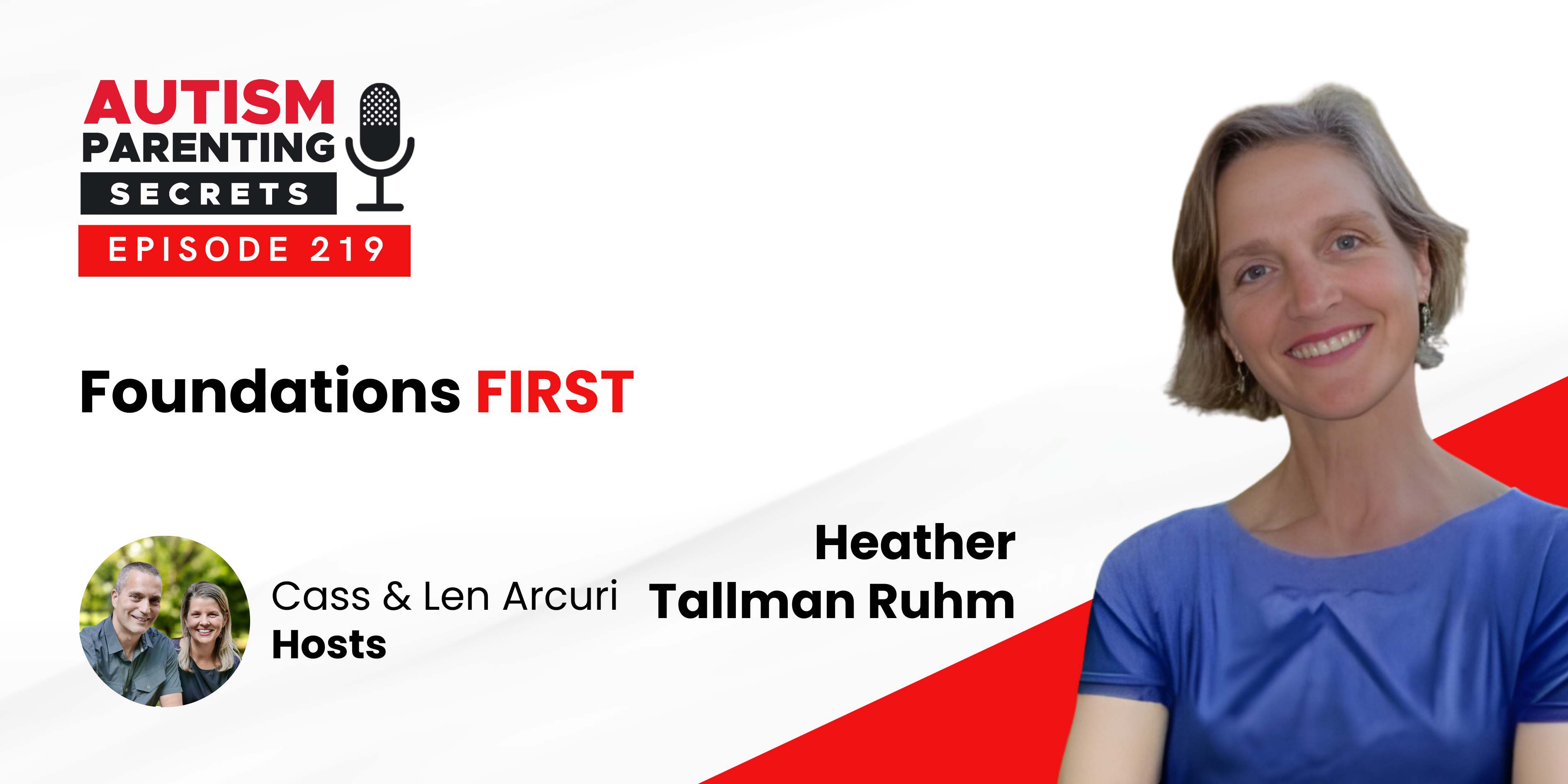
Episode 219 — Foundations FIRST
Guest: Heather Tallman Ruhm • Date: August 29, 2024
Episode Overview
Dr. Heather Tallman Ruhm, Medical Director at Documenting Hope, reveals the critical connections between gut health, mindset, and healing. She emphasizes reducing environmental stressors restoring balance, and how Documenting Hope empowers parents with research, success stories, and an upcoming conference you won’t want to miss.
About Heather Tallman Ruhm
Heather Tallman Ruhm is the Medical Director for Documenting Hope – an educational and research-oriented not-for-profit organization established to help care providers, parents, and practitioners understand, prevent, and reverse chronic illness in children. As a Medical Doctor and Certified Family Physician, Dr. Heather has always embraced an integrative and functional approach to root cause medicine. Her clinical experience in this field began at the Whitaker Wellness Institute in Newport Beach, California, shortly after the completion of her residency. Since then, she has spent the last twenty years in private practice, working in multi-disciplinary clinical settings throughout New England, including her current part-time practice at the New Hampshire Health and Wellness Center.
Dr. Heather is a native of Montana and a “global” student and teacher at heart. As an adjunct college professor for over a decade, she taught pathology and Foundations in Complimentary Health and Wellness with an emphasis on whole systems biology; she also hosted a radio series on Health Matters and, in 2018, helped establish one of the first bio-regulatory clinics in the US fashioned after the Paracelsus Institute in Switzerland. Before studying medicine, Dr. Heather received her BA in Human Sciences at Montana State University and her master’s degree in public policy (MPP) from Harvard’s Kennedy School of Government. She has both studied and worked in a volunteer capacity overseas, and she, her husband, and their grown daughter have hosted numerous exchange students over the years.
You’ll Discover
The Forces Working Against Your Child (6:17)
What Often Keeps Parents Stuck (13:36)
We’re Living In A World of Micro-Traumas (17:41)
The Mission OfDocumenting Hope(23:38)
The Case For You To AttendThe Documenting Hope Conference(29:09)
How You As A Parent Can Make History (35:09)
The Case For Your Practitioners To AttendThe Documenting Hope Conference(37:47)
Referenced in This Episode
The Documenting Hope Conference, November 15-17, 2024, Orlando Fl
Reversal of Autism Symptoms among Dizygotic Twins through a Personalized Lifestyle and Environmental Modification Approach: A Case Report and Review of the Literature, The Journal of Personalized Medicine, Volume 14, Issue 6
Underestimated: An Autism Miracle by J.B. Handley and Jameson Handley
Full Transcript
Heather Tallman Ruhm | 00:00
Foundationally, what are the things we think we need to understand from a physiologic standpoint, from a fundamental standpoint, and what can we be hopeful that we can make a difference and maybe even return our children to their optimal potential? Of living in a body that they feel comfortable in and that does all the functions that make brings joy to their life.
Cass Arcuri | 00:26
Want to truly be the best parent you can be and help your child thrive after their autism diagnosis? This podcast is for all in parents like you who know more is possible for your child.
Len Arcuri | 00:37
With each episode, we reveal a secret that empowers you to be the parent your child needs now, saving you time, energy, and money, and helping you focus on what truly matters most, your child.
Cass Arcuri | 00:48
I'm Cass. And I'm Len. Welcome to Autism Parenting Secrets.
Len Arcuri | 01:04
Hello and welcome to Autism Parenting Secrets. My guest today is Dr. Heather Tallman-Rome. She's a medical doctor and licensed family physician dedicated to helping people reach optimal wellness and improve their quality of life. In addition to being a clinician, She's a writer, speaker, and professor who loves to teach in a way that makes sense. Dr. Heather is the medical director at Documenting Hope, and you can meet her in person at this year's Adventures in Healing Conference, November 15th to 17th in Orlando, Florida. And the secret this week is... Foundations first. Welcome, Dr. Heather.
Heather Tallman Ruhm | 01:45
Thank you so much for having me. It's such a joy to be here. Amidst all your amazing people you've interviewed in the past, I really hats off to you for all you do for the community and in particular for the for families who have a child with autism. I know that's where you got started and I know you've branched and what you offer is much broader than that. Just a parenting in general. I think you're like leaders in parenting parents is really what you are. And we all need it. We all didn't come with a handbook on how to do it well for our children or for ourselves for that matter.
So thank you.
Len Arcuri | 02:22
Well, I appreciate that. But yeah, we have a high bar in terms of who's on the podcast. And again, that's why you're here today. And I know based on your experience as a clinician, but coupled with your involvement at Documenting Hope and all the work that's been done, I know we've had Beth Lambert on a couple of times. And so, you know, longtime listeners will be familiar. But can you take a step back and talk a little bit about to whatever extent you want to flesh out your background, but then with Documenting Hope, what it's about and what's leading to this conference experience?
You know, that I know happens about annually, but it's an opportunity, an incredible opportunity for parents. So we'll make the case today about why you might want to get on a plane and get to Florida.
So I'll hand it to you to give a little bit more of the backstory.
Heather Tallman Ruhm | 03:11
That's wonderful. You might want to leave just to get out of the snowy north or wherever you live and just get in the warmth for a little bit. And that's hard to imagine right now where we're all in a heat wave. But thank you.
So, yes, I started out long ago thinking about the health of people. People throughout the world and was very interested in as a youngster. Really nutrition and how that could help people who were either in the extreme situation of malnutrition around the world, which there seemed to be a problem with, you know, back, I learned about that from the BBC and my, you know, in the 1970s and That coming from an athletic background, I really had a lot of confidence in the human body and what it could do if you gave it the right resources to achieve.
So I kind of imagined blending those things together and it moved me through an environment. Kind of what wouldn't necessarily be a normal or typical route. I didn't go directly to doctor. I thought about nutrition and I thought about being a nutritionist. And at the time they didn't, that was not something that was really availed to the healing process as much as just kind of how to take care of someone maybe with the medication. The right jello in the hospital setting, low salt diet.
So I went into public policy, got a master's in public policy and thought, well, I can help on a policy level. And then Realized that the people making policy really need to be in the trenches because that's where the growth should happen is who is driving policy should probably know what they're driving, right? And why?
So I looped back, ended up in medicine. And 20 years later, here I am. Really teaching nutrition again and how to take care of the human body and having a greater confidence in the human body than I ever have. That being said, that's partly been driven by seeing how much suffering there is in the world. And in particular, I think I was brought into this world of autism and children's health beyond just general family medicine by, interestingly, a few things that I see on the wall behind you. And one is autism.
So somewhere along my career path, I started to encounter more children with that disease. Or tendency.
And then... Discovered fairly early on that there was a large community of physicians and practitioners that were already starting to understand the biochemistry, the underlying root causes, the challenges faced by these children and their families. And it just pulled me fully in, not because I became a doctor that dealt exclusively with autism. In fact, most of my practice is adult. But what it did was it opened my mind up to the possibility that these children that are experiencing these forms of suffering or phenotypes, manifestations of illness from every part of their being, you know, whether it's focusing on what we, you know, conventionally sometimes put in silos as the lungs or the kidney or the liver or the GI tract, you know, what autism showed was this giant Venn diagram of with the child in the middle of all these areas that were being impacted through modern living, really, and through even some of the medical practices that we institute, you know, things that have become institutional in terms of how we care for them.
So it really made me appreciate, one, the work that had come before, and two, the potential for recovery and healing and working once again with things as basic and foundational as nutrition, movement, sleep, mindset, education. Really understanding, and this has gone further through the course of my years being a physician, is What are we culturally kind of doing that is contributing to this kind of downward spiral, as it were. In our children's health. And autism became not because I felt equipped at all and still don't to manage or handle all of the things that it is dealing with concurrently.
You know, I think we have a... This takes a village, right? And, What I did realize, though, if I were to re... Create our medical schools. Because for me, medical school was phenomenal.
I mean, I loved learning how the body worked. I love learning about biochemistry and physiology. In fact, to this day, I can't you know, ignore a podcast if I'm out for a run or a bike ride, or I learned my biochemistry running in the foothills of New Mexico in the Sandia mountains. I've, you know, I've learned all those things on the fly driving from here to there because it's still, I'm so enamored of the human body and its potential for healing, for optimization and to understand the biochemistry, the physiology, they have a great reverence for the different organ systems and how they how it is a big, an orchestra. That plays together in this incredible symphony or harmony, and then looking at what dysregulates that. And it feels like that kind of awareness. You probably know that I started writing a book about 15 years ago and haven't completed it. But the first chapter is literally on awareness and how that comes first. And I think that's a lot of what you represent in your work. Autism parenting is awareness. Really taking a look at ourselves and where we come from and where we have gone astray in terms of doing and believing and thinking about the body in this magnificent way. And supporting it and supporting ourselves through this journey and this, you know, incredible opportunity to be alive and what we're doing that is at odds with that.
And then how we don't necessarily beat ourselves up based on that, because that creates even more resistance to what is harmful already. So Backing up, I think what I was about to say and got a little off track was that at somewhere along the way, I realized if I were to redesign medical schools. I would use something like autism. Maybe autism as the beginning and because Alzheimer's is a different version and an older end, right, of the compilation of lifestyle and mindset and fear based even medicine. That gets us where we are today. And that just studying those two models would teach us, you know, would give us the platform to understand whole systems. And what we call system biology, which is that you can't really anymore look at one part of the body in isolation. That isn't to say that it hasn't been helpful along the way for somebody to deep dive into the, you know, the pulmonologist to understand the lungs really well, or the nephrologist to understand the kidneys really well, or the whatever specialist, you know, in that timeframe. But now we're ready to move beyond and realize that these systems are all connected. That you can no longer disregard nutrition. As an important player in brain health. In your microbiome.
I mean, I used to refer to the gut and microbiome along with the other early, you know, autism doctors as that was key, that source, that's the center, the roots of, you know, as Natasha Kamloch-Bride once said, that's the roots, you know, the inside of your gut, those little villi, that's the root system from which, you know, the nutrition comes forward. That's where you house this giant microbiome. But 10 years ago, you just got lots of eye rolls around the gut being relevant. And so... It is painstaking to be in an environment where everybody that you're kind of surround yourself with medically understands that, but there's this big between where we were trained and how we were trained kind of in a silo style, which maybe suits for training, but then there's this need to bring back to wholism. Bring back to how all those systems work together and how one system is when you manipulate or work with one area, good, bad, or otherwise, it has an impact on the rest.
So, I think our topic today was foundations first. And We talk about awareness and just mindset and belief systems. And I think, for instance, what you're doing is really something so fundamental and so at the beginning of people's journey to full healing is shifting into a place of taking a breath Right. And moving into where you do have control, where you can make a difference, what things are modifiable.
So we can look around and make little incremental changes in our lives, in our homes, in our way of thinking. That put us into more of a mindset and. Set us on a journey for healing. And oftentimes it begins with the hope or understanding that there is healing possible and that some of the things we're looking at as our enemy. Or as broken, which is often what we hear when we get a diagnosis that we are broken or our child is broken or when we hear of somebody, another family's diagnosis, we think, well, thank goodness that our family isn't broken like that, right? Or, that's all just, you know, quietly walk my own path because that must be their genetics, not ours.
So what this kind of whole look at the human body and all the systems and the connection between systems really creates a different level of reverence and for even the sufferings. And what it is teaching us. And Stepping back and hearing What is... What is the body saying? What is the feeling that I'm going through? What is the emotion that's coming forth? Around any topic. What holds me in a stuck place? And I think oftentimes, working with children It is... The parents who are first very stuck. And that isn't to say that they're the cause of their child's misfortune. At all. But they can be an obstacle to the repair. When there is great resistance to the challenges that they're facing, And what I mean by that is we are in a. Culture. Of medicine. And health. And I think you probably made this mistake early on, too, using the word warrior in your description of what your practice was to teach people to be warriors that it isn't fighting against, but working with. The amazing human body. And honoring what it's telling us.
You know, I look at that, the book behind your head, Underestimated, and it's That. Is such a powerful story And it's so metaphorical and representative of what we have to kind of, the hurdle we need to overcome in medicine, which is, listening when it's not coming through as a voice with words. The human body whether it has words or not, as constant communication. With us. And honoring what it's telling us I never look at a symptom anymore as a bad body. I look at a symptom and I think this goes along with German new medicine or some of the other practices that are more global at this point and cutting edge too. And honors the great traditions of Ayurvedic and traditional Chinese medicine, looking at things as a whole. That when something manifests, whether it's a cough, a sneeze, a behavior, what we call a behavior, It is rooted in some form of protection.
So one of the things we talked about earlier is about getting parents to a place of not only where they are empowered, but where their child is safe. Safe enough to move forward.
So fundamentally This gets back to foundations. Which one thinks of as getting enough sleep, getting clean water, having pure air, having movement, being with people you love. All of those things are foundational. And Before that...
Before that, is the concept that We need safety. Everything is built on that, whether you're looking at cell danger response or Dr. Navia or whether you're looking at internal family systems as a form of mental health empowerment or you're looking at things along those lines. Or I think that the term for me came through Peter Levine's work in somatic experiencing is the concept of trauma.
You know, we're living in a world of micro traumas, some macro traumas and a lot of micro trauma and trauma. Fundamentally, and there's probably a better definition, but the best one I've come up with by taking all this into account is perceived lack of control.
So whether a cell has perceived lack of control or a parent that just got the diagnosis has perceived lack of control. It is going, whether it's the sell, Or the organ? For the tissue, or the human being or the parent, there will be a propensity to protect. And sometimes that protection is to resist what seems scary. And or what is presented as frightening. And one of the things we've done in medicine oftentimes through the last century or so, is presented everything in a fear model. And in, like I said, that warrior model. Where we are coming after it. We have most of our medications, I think, from the last century, maybe not that long, but an antidiuretic, an antidepressant. Histamine and anti histamine. And that we're battling cancer and we're blaming our allergies. And so it's this war against the human body, which is to me at the core, like the giving tree, the Shel Silverstein book that just gives of itself. It gives its branches. It gives its leaves. It gives its trunk.
At the end of the day, the old man comes back and the tree says, what more can I give to you? And he says, I'm just tired. I need a place to sit.
Well, here are my stump. You know, the human body, including your children, And they're this body that's amazing and trying to express itself in ways that don't have the language necessarily to do so. Are giving us clues to how we can help them and how we can help the world.
So what is creating the trauma? What is creating the micro trauma? Allows us to pull back and say, Maybe that gets me back to policy in my early career, you know, which wasn't a career, was What do we do in our world? That lowers that what we call the total load, what many people call the total body burden, what we call the filling of the barrel. Everything reaches a certain capacity where it spills over. Right. Whether it's a cell or a parent. Or anything in between.
So anything we can do to mitigate and bring that into alignment, it's, kind of the Goldilocks look, you know, too much, too little, not enough, just right. And with all of this communication that I'm talking about that the body is doing to us or the world is telling us this is harming and this is helping, you know, there's a lot of feedback we've gotten. AI can probably write you a list of the things right without us even thinking about it. Go back and look at it in that kind of Goldilocks way that medicine and even our approach to probably helping parents is, where, you know, we're stuck, right? Obviously, there's some stuckness in traditional Chinese medicine. It's lack of flow, right? That is the source of all illness.
So we have to say, what is it that there's too much of that's overwhelming? That is not contributing to overall health, And what is there not enough of?
So it's really foundational. What do we have too much of that's streaming in through electromagnetics, through the air, through our water, through our soil, through our building materials, where there is potentially damage? Are those in forms that are harmful to us as human living creatures?
So where can we take the edge off of that? And where do we need to build back up? Where have sometimes through trauma... We've lost our resources because all of our resources got utilized or we our body robbed Peter to pay Paul, so to speak, and redirected its resources under a stressful situation where it did not feel there was control. It had to gain control some other way.
So how do we add what is missing? How do we lower what is harming?
And then how do we get back? Something that has been dysregulated. Or thrown off kilter. The body is an amazing thing. Amazing things. It has so much to offer us. And so much we can appreciate and work with. It requires we listen differently than maybe we've been culturized. To listen.
Len Arcuri | 22:32
Yep. And that listening, you know, again, so much of what you just talked about, the whole theme is awareness, right? It's having the awareness to listen to the body. It's having awareness to take a step back to be able to understand what's really happening now, which is why finding the right practitioner is really important because that practitioner's perspective and their degree of awareness is incredibly important and it will vary wildly from practitioner to practitioner. And the other concept of awareness, which I think is a great lead-in into documenting hope.
So would you mind explaining a little bit more? I know you touched on total load, but can you give the high level on Documenting Hope, what the mission is, and ultimately why Documenting Hope's deciding to have a second conference this year?
And then we can talk a little bit more about What's going to be happening there and how that could be a phenomenal way for a parent to really increase their own awareness as to what might be happening in addition to networking with phenomenal parents and.
Heather Tallman Ruhm | 23:39
Practitioners. Right. And that really is that it is a community gathering as many of the... I think conferences are becoming, you know, really that place of finding others and recognizing that you're not alone on a path, whether you're a practitioner exploring what's helping our kids recovery, or whether you're a parent trying to grasp some form of hope or direction or guidance or find the tool that you haven't found yet that could be the game changer for your child to really flourish in a way.
So yes, part of me has a foot in the door as a clinician and a family physician. And the other part of me has a big foot in the door of an organization called documenting hope that some may not have heard of. And it stemmed out of probably a dozen years ago out of the book written by, Beth Lambert called a compromised generation. And at that time I got to know Beth because of the book. And I said my gosh, she's written the book that expresses what I'm encountering in those early days of being introduced to autism.
And then this world of people helping to turn that around. And that developed into a great resource, starting a dozen years ago that built a whole webinar and library of resources for parents capturing testimonials of parents who have recovered their children successfully from a whole host of conditions, not just autism. And trying to get that word out so that their parents are aware that there's possibility, that there's empowerment, there are tools, that there are people that are on the cutting edge that isn't necessarily in mainstream medicine, it isn't necessarily going to come through insurance, but it is availed to them.
So out of that then came, well, we really need to branch into something that is respected in the scientific community, you know, into the peer reviewed realm of things to say that we're as Beth is so good at saying, you know, why aren't we studying these N of ones? Why aren't we studying these ones, the successes and how do we get that word out? And so we started doing, they started, I wasn't part of it yet. I was an advisor on the side waiting for this big project to happen. I was one of those people just very interested in the work and then joined in and that evolved to research.
So documenting hope became the research piece that was original name for just the research component. But now it's merging into documenting hope overall to research. Demonstrate, to document that children can get better And to document and explore what is it that's contributing to what we call a total load.
So that idea of a total load or total body burden or whatever, way you choose to call it. We really needed a deep exploration into that and started a survey that's extensive, takes parents four to six hours to fill out, or maybe not quite that long. And we're in the process of rebuilding that now, and hopefully we'll have it available to your people. In the near future because it teaches parents a lot about where their kids are and where they need to go and what might have insulted them along the way of the many factors in the.
Len Arcuri | 27:02
World. It sounds like a big investment of time and it is, but again, it's worth it to go through that exhaustive list. And I know a lot of parents who are reluctant to taking it because none of us want to relive things that maybe happened on our watch that we're not really proud of, but it's so useful to... Increase that awareness to understand those potential stressors and events that have happened in the past. Again, not to beat yourself up because that information could be really critical with that key decision of, hey, what's my best move now to help my child, which is why...
Heather Tallman Ruhm | 27:55
And I think what you're saying is, you know, it may reveal to you lots of things you aren't thinking about in the context of what might be contributing to your child's health or mishealth or dishealth or whatever, but just points of doing, of a possibility, you know, unless we're aware of what might be contributing, then we can't do much about it, right? If we don't know there's an elephant in the room, we don't, you know, we can't move around it, right? It's, so it's to not look at, and it's not really looking for one elephant in the room, it's looking for all the little pieces that you can, you know, make little changes in.
So that led to So the research has led to a recent paper, and I know you were involved in that as well because you were one of the practitioners or the providers that helped a family out in recovering their children from autism in a very kind of short span of time. Hats off for really engaging those parents in a powerful way that really got them on some beautiful track for healing their children.
Yeah. So out of that kind of came like, how do we continue to bring this community together, whether it's the community of parents or the community of providers or the community of parents and providers. And there really hasn't been that platform for some time where parents and providers are kind of in the same room together. And that's what our conference has been. We had one, our inaugural conference last year on adventures and healing. And this is our second and we're learning as we go. There are other beautiful conferences that we promote that help practitioners become Better at doing functional medicine, let's say, and we call it functional medicine. It's kind of a catch-all, but I mean, more of the medicine that is leading toward recovery, repair, restore, restoration, and not necessarily symptom mitigation. There's enough of that. But hopefully in the process, a lot of symptoms are mitigated. Right. We don't want symptoms, but we want to listen to them. Right. And learn from them.
So this conference is for an opportunity for parents to come together and really listen to what's happening kind of on that. Forefront right now. And it's not just all new bells and whistles. It is coming back to foundations. And in fact, some of our most popular speakers last year had to do with very foundational supports for families and very foundational places to begin. And I know that you're you know, have really have met the needs of a lot of those people who probably did come to our conference too And it's a challenge to do both.
Yeah, definitely. To have a parent conference.
I mean, it's a challenge for parents to go to a conference. Let's just face it. Right.
I mean, busy practitioners as well. But parents to spend the time and money and make, you know, put all their resources toward that travel and maybe time away from children that are, you know, have special needs. It's a lot to ask.
So it's a nice balance that we have between practitioners who are doing foundational and cutting edge. And really bringing into the realm of understanding something that we've even missed probably somewhat in some of the functional avenues that medicine's taken is that, you know, like dentistry has been a separate entity, but the teeth shouldn't be, you know, excused from the rest of the body. We know there's a huge connection between dental health, oral health, and the rest of the body. But I'm not learning that in my medical school or my medical training or probably even in a functional medicine workshop. Right.
So it's really lovely to be able to bridge some of these kind of whole thinkers that are cutting edge, whether it's the neuro optometrist that's showing you that the eyeballs are. Heart of brain matter. Outside you know, the, bony matter.
So that's an incredible peer, right? Peer as an EER peering in to the mind and the nervous system. And that is not something that's taught typically in medical schools or functional chiropractics, where you're recognizing that the structure of the spine is relevant to function. Your ability to focus at school or your allergy, you know, or those kinds of things.
So that, so it feels like we have this incredible opportunity to bridge something in these conferences. That isn't typically dealt with in a conference. Right. Bringing the different systems together and the kind of like work you're doing, the mindset, the parenting, that that's a fundamental component.
I mean, I can work myself till I'm blue in the face, but if a patient doesn't see the potential to heal or that the human body is capable of that, or that they as parents are capable of helping their child, or that they as parents are judging and resistant and angry or feel there's a brokenness to that. Expression of their child versus, wow, what is this teaching us together?
You know? It's just that that's so that's foundational.
Len Arcuri | 33:24
And those kind of foundational changes, by the way, it's easy to talk about, but it's really something that becomes much easier if you're surrounded by the right people. And so community can take many different forms, but I know this cost benefit of getting on a plane and going to a conference, right? You would do that or consider that because in community, in one place, with fellow parents, with practitioners who are actually accessible, because I've been to conferences in the past going way back where there were parents and practitioners at one conference, but the only way parents could actually get access to those practitioners was through Q&A. You write a question down on a card, you hand it in, and maybe that person would answer it in a group forum. But at the Documenting Hope Conference, the Adventures in Healing Conference, Everyone's commingling. The key reason why you might want to be there in person, Because it might be a presentation you watch that sets a light bulb off. That's like a missing piece where it might just be a casual conversation you're having, you know, after the conference with practitioners who are all commingling. And again, you can get so many nuances and so many like minor insights, maybe some big ahas as well, but it's just, There's an incredible benefit that's hard to even articulate of being in community with the right people with helpful perspectives.
Heather Tallman Ruhm | 34:51
Yeah. And one thing we're leaving out that's a little bit of an elephant in the room too, is that really what drives us as practitioners, or certainly I can say what's taught me the most of my own patients, because they bring to me the new understandings, you know, and parents may not realize how important and critical they are in not only moving their own child's health forward, but moving the health of many children forward or moving the future of health forward.
So for instance, when you said it's worth doing the survey for the feedback, It's worth doing the survey to be part of that scientific movement going forward to learn what is it that is most impactful in our children. You know, if we look at the whole array of things from down to dietary practices and what products you use in your home and where you live and what kind of support systems you have, looking at all of that and then saying, okay, you know, using sophisticated statistics and things to analyze that you are part of making history. You are bringing the richness that teaches all of us. I think, you know, I remember I used to bike for the Harvard cycling team as when I was in graduate school. I guess I technically didn't, but I biked with them because I was already a graduate student. We didn't have, you know, I guess, but anyway, on the, none of the jerseys, you know, someone had placed what doesn't kill you makes you stronger. Right. And, you know, I think that there's some truth to that, but the reality is that you're doing what you do that is empowering the rest of the world right now, land. Because of what you experienced. First-hand. Had you not taken that quote unquote manure and turned it into the Lotus that you're making right now. We wouldn't be... Riding on your coattails, which is what I'm doing of all my patients. And I want parents to know that they are part of a movement for better, not just for their own child. But for all children. Right. And that, you know, I'm sure we could get Confucian or Buddhism or others to say, you know, like. What keeps us stuck in our suffering?
And then how does the suffering allow us to, you know, emerge or as the old saying, my barn having burned to the ground, I could now see the moon. Sometimes we're feeling like our barn, which is our source of life, is being burned to the ground. And yet something beautiful is evolving. And if we can capture that and be part of that and nurture that. And build new barns together, you know, that this is a barn raising to be metaphorical. And I do, I would encourage people to go to the conference. I would encourage, the practitioners to go because one, they can get Continue medical education. And that's always a drive for people to go to a conference. And that really helps support a lot of the... Partners that are representing different sources of healing there at the conference too.
So we have practitioners and then we have people providing services or products that can be helpful for recovering kids. And that practitioner community really drives that forward too.
So It's just, as you said, we're all in this together. And it's not often that you can be all in one place together with that mutual respect that we're all driving this together. Forward together. None of us are alone and we wouldn't learn. We wouldn't be where we are without people coming through their suffering or having learned the hard way. That the suffering had to continue.
I mean, I just... Honor. Honor those who are suffering, have suffered, have recovered from suffering, have the potential to recover, to be optimal, to live in joy. To do the things that any of us would aspire to do. In communion, in community, in our lives, you know. There is such an opportunity. There is so much hope. And I love documenting hope because it's not just about hope. It's about documenting it. And being part of that documentation.
So by showing up, You are... Part of documenting what's possible. As one person... In the family, I was discouraged from talking to a family member that was quite ill in my husband's family at one point because I might give him false hope. And so I spoke with those where I thought hard about that. And I said, you know, I just I don't want to give you false hope. But I want to tell you some things I know about the human body and what might be at stake here and what might be helpful here. And at the end of that conversation, this gentleman said to me, Heather, there is no such thing as false hope. And He just took to heart... The really listening to what his body was expressing at that time, which was illness. And what might empower and work with his body To heal. And sometimes we're late to the party. And we don't want to be.
So we are not promoting a conference to run after shiny objects or just displaying the shiny objects. But we are because that's sometimes the frenzy that you get in, right? Whether you're doing conventional medicine and your group thinking that that's your new shiny object or you're, you know, there's a lot of shiny objects, you know, right? We're all looking for the one pill, the one placebo, the one whatever it is that's going to save us all. That happens everywhere, whether you're in conventional medicine or natural medicine. And so we really are not about that is just foundationally. What are the things we think we need to understand from a physiologic standpoint, from a fundamental standpoint? And what can we be hopeful? That we can make a difference. And maybe even return our children to their optimal potential. Of living in a body that they feel comfortable in And that does all the functions that make brings joy to their life.
Len Arcuri | 41:28
Well, I think that's a beautiful thought to bring this conversation to a close. So thank you for sharing your perspectives. Again, I think for anyone listening. Yes. Helping your child and doing everything you can, doing it in isolation. Just doesn't work.
So look out. Allow support in whatever way feels right for you. And again, the conference in November. I'll put everything in the show notes. But again, I really appreciate you sharing your thoughts with me today, Dr. Heather, and I look forward to seeing you in Orlando.
Heather Tallman Ruhm | 42:05
Thank you, Len. I think you are doing amazing work. I love that you are really one-on-one with parents. And I think that is first and fundamental. And if you explore documenting hope, we have lots of resources to augment your resources, which you give a ton of free resources away that really help. Open people's minds to possibility. Appreciate all you do. Thank you.
Len Arcuri | 42:26
Thank you so much.
Cass Arcuri | 42:29
Want to learn more? Go to elevatehowyounavigate.com