
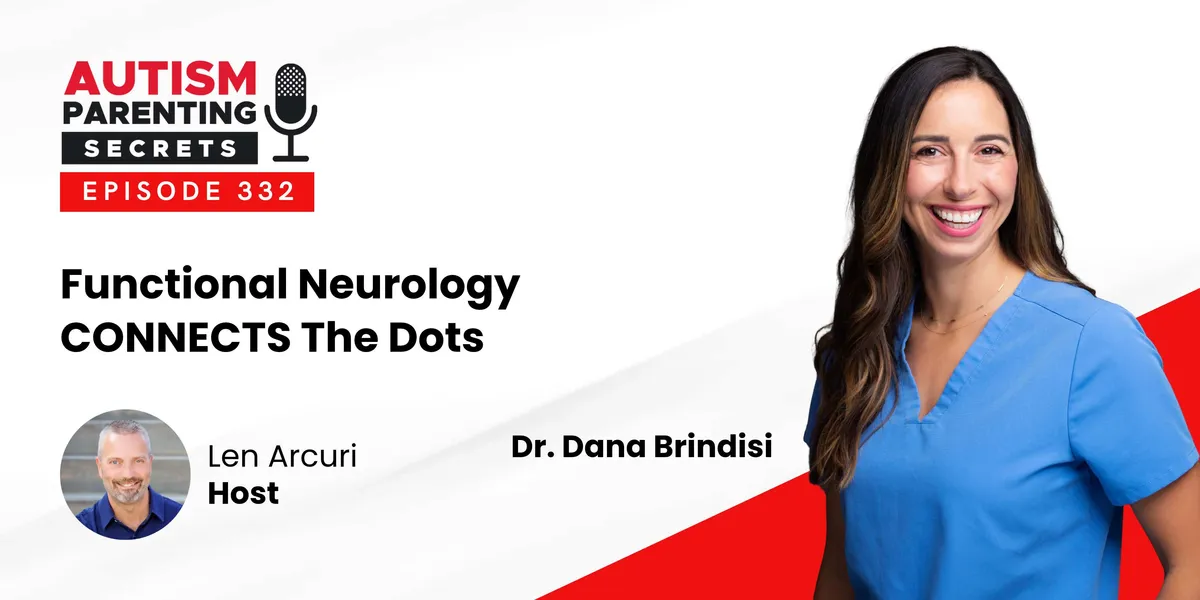
Episode 332 — Functional Neurology CONNECTS The Dots
Guest: Dr. Dana Brindisi • Date: November 5, 2026
Episode Overview
Dr. Dana Brindisi, founder of Carolina Functional Neurology Center, joins us to explore how brain development and nervous system function can influence the challenges children experience. She explains why understanding a child’s neurological foundation can help parents and practitioners make more informed decisions about what to address first.
About Dr. Dana Brindisi
Dr. Dana Brindisi, DC, DACNB, CFMP, is the founder of Carolina Functional Neurology Center and clinic director of its Raleigh, North Carolina location. She is a Board Certified Chiropractic Neurologist and Certified Functional Medicine Practitioner with 14 years of experience working with complex neurological cases. Her practice focuses on neurological evaluation and rehabilitation, including neurodevelopment, vestibular function, sensory processing, primitive reflexes, and other aspects of nervous system function. Through Carolina Functional Neurology Center, Dr. Dana and her team work with children and adults experiencing neurological and developmental challenges.
You’ll Discover
Why Neurological Foundations Matter (1:28)
How Primitive Reflexes Can Affect Regulation (7:40)
What Functional Neurology Actually Does (12:22)
Why There May Be Multiple Root Causes (32:15)
What Parents Need To Understand About Survival Mode (38:23)
Full Transcript
Dr. Dana Brindisi 0:00
Movement is the best thing that we can do for our brains, hands down. Doesn't matter what age you are, if you are sedentary and not moving, and sitting in front of a computer all the time, or posted up in front of the TV or your iPad or whatever, right? It's not good. When we evaluate you, we want to know what's happening in the vestibular system, what's happening in the cranial nerves? What's happening in the brainstem? What's happening with their autonomics? What's happening with their higher cortical function? And as we put all of those pieces together through their evaluation, then we can say, "Here's how we are going to attack this from a rehab perspective."
Len Arcuri 0:39
If you're a parent of a child with autism, you are being called to rise with love, courage, and clarity. This journey isn't easy, and most parents aren't equipped, but you can be. This podcast is your invitation to rise higher, because how you navigate matters. I'm Len, and this is Autism Parenting Secrets, where you become the parent your child needs now. Hello and welcome to Autism Parenting Secrets. My guest today is Dr. Dana Brindisi. She's the founder of Carolina Functional Neurology Center and clinical director of its Raleigh location. Dr. Dana is a board-certified chiropractic neurologist and certified functional medicine practitioner who spent the last 14 years working with complex neurological cases. When our children are struggling, it's natural to focus on the symptoms that we see. But what if some of those seemingly unrelated challenges are actually connected? And what if understanding how the brain and the nervous system are functioning could help us identify opportunities we might otherwise miss. That's what we're exploring today, and the secret this week is functional neurology connects the dots. Welcome, Dr. Dana.
Dr. Dana Brindisi 1:53
Thank you, Len, for having me. Happy to be here.
Len Arcuri 1:56
Well, I'm looking forward to this conversation, and yeah, fortunately, your practice is kind of in my backyard here in North Carolina, but I know the concept of functional neurology is a powerful one. And I guess let's start with you know the patients you see, particularly children with complex challenges. If when they come to you with whether it's autism, developmental delay, or some other neurological challenge. What are you looking for that might not be obvious from their symptoms or even their diagnosis?
Dr. Dana Brindisi 2:29
So when the kids come in, we are really running them through the hierarchy of neurodevelopment. When we do their initial evaluation, there is a sequence and an order to the way that the brain and the nervous system develop, and so we're we're looking at all of those stages along the way. So you know, parents will you know know them as milestones, right, for their kids, and we connect those milestones to the development in the nervous system and what is going on at each of those stages, and when should those things be? I'd say completes the right word because you know neuroscience continues to push the envelope on you know when is our brain fully developed. So I think they're even pushing past 30 at this point, so you know maybe there's still hope for us for some more neurological development. But trying to connect the dots between what the parents are seeing as either development, developmental delay, or symptomatology to what stage is this child's brain at in development, and where can we meet them when we go in to do rehabilitation? Because you have to go through that sequence to kind of come out the other side and make sure that we're setting a good foundation, and we have to understand what that foundation is, and that foundation is much more than you know, speech and language and sensory processing and emotional regulation. Right? It's truly in the different parts, pathways, and networks in the brain.
Len Arcuri 4:15
Got it. And I guess that naturally leads to when somebody comes in and you start working with a adult or a child for the first time. What are you looking for in terms of the key assessments to help you determine where they are and what stage they're at?
Dr. Dana Brindisi 4:30
There's a lot of things with the kids that we will do maybe quite different and separately from the adults. So a lot of your parents are probably familiar with primitive reflexes. It's something that you know the world talks a lot about in autism and neurodevelopment and delays and learning disabilities and all that type of stuff, right? It's it should be at the forefront of any practitioner's mind if they are seeing. This patient population, because you cannot build a house on a faulty foundation, and so that's kind of where it starts, right? Every human is born with primitive reflexes. They are survival mechanisms in the brain, and they are there so that we can eat, sleep, eliminate, breathe, you know, digest, do all of that stuff, right? And then we start to develop on top of that foundation. So we develop postural reflexes, right? You start to see your kids, or even vestibular reflexes before that. So you start to see your kids moving their heads around, right? And they're rolling around, right? That's all vestibularly mediated. That's also playing a role in postural reflexes. But then we get into postural reflexes as we start to see kids sit up against gravity, and so we're looking very heavily at those things because all of those things have to be in place for then emotional regulation to take hold, for ocular motor control to take hold, right? Because a lot of people will come to us with their children once they get into school age because they're having difficulty learning, they're not able to do math, or they're not able to read appropriately, or maybe they're starting to see some forms of dyslexia where their writing is inappropriate and things like that, all of those primitive reflexes and and reflexive mechanisms from the vestibular system to your spine and your posture and our like tiny little muscles that fire against gravity all the time. All of that has to be set in order for a human to be able to appropriately track and maintain stability of their ocular motor system on any type of object, we start to see it first usually when kids start getting into school.
Len Arcuri 6:54
Yeah, no, I appreciate that expansive response because what you're accentuating over and over is the importance of having a strong foundation, setting that strong foundation, and I think that's where there's a lot of interventions that a parent may be aware of that may sound appealing, but unless that foundation's in place, it's really just from a priority standpoint maybe too early before going down a certain road and primitive reflexes. Yes, on this show we've featured it many times with Dr. Robert Malillo and the Malillo method and the Muscatoba method. And so many practitioners really highlight primitive reflexes because of what you were describing. That if those primitive retained reflexes aren't lost by like 12 months or so, or early on, as they're they're kind of designed to. We're supposed to move past them, but if your child hasn't moved past them, you may not be able to identify them specifically because they may be subtle. But it doesn't mean that they're not impacting your child's ability to thrive, whether that's their nervous system, or or just you know how they're operating, and then you mentioned with ocular, and I know vision therapy is another road that parents hear about in terms of you know doing something there that maybe help the eyes better track, and that also is again a key foundational piece. So, so I love that you're highlighting that because I think that is something I know I missed as a parent. You know, having that priority of focusing on the foundation first doesn't sound as exciting as some of the other interventions you might be hearing about.
Dr. Dana Brindisi 8:33
Yes, 100%. And I think you know what we hear most often from parents once they get to our office usually is the emotional regulation piece, but what I think, you know, maybe we as chiropractic neurologists need to disseminate more information about is how did we get there in the first place, right? Because these are not kids that are are doing this, you know, to be defiant or, you know, kids are going to be kids, but it's it's truly like if we don't integrate those primitive reflexes, if we don't take hold of appropriate you know postural and vestibular reflexes, and allow that person's brain to understand where they are in space, it's extremely dysregulating. And we're also if those primitive reflexes are present, their brain is still running on a fight or flight system. They are running in survival mode, right? And parents will oftentimes describe it that way, right? Like it just we're we're surviving. It feels like we're surviving and not thriving, right? And it's truly like that little body and brain. That's what they're doing. That's how their nervous system is running, you know. And we all know it as you know, adults, right? Our world is very stimulating and very demanding in terms of like time and energy, and you know you. We all experience it at some point in our lives, like sitting in traffic when we, you know, are already late for the meeting or or whatever, right? And we're getting amped up. It's like that is your kid's brain if they have primitive reflexes and they don't have these appropriate postural mechanisms and vestibular mechanisms. That's their brain all the time.
Len Arcuri 10:17
All the time. So
Dr. Dana Brindisi 10:18
then it starts to help parents understand, you know, when and and this is not just a child who is neurodevelopmentally delayed. I have a four-year-old, right, and it's like sometimes, you know, you don't peel the banana the right way, right? Or they wanted to peel the banana, and you did it anyway, and there's a whole meltdown. And it's like their brains are the same, right? Their brains are still trying to figure that out. They are certainly not 30 and fully developed, right? So you see it in children all the time, and so you know, just helping patient help paint that picture for parents, I think, is really important because you know, just as a parent in general, it's overwhelming, especially if you have multiple kids and kind of trying to navigate. Like, is this my kid doing something wrong, or is this actually just neurodevelopmental, and this is you know appropriate, or should it have been appropriate at four, and now we're at seven, and we're still seeing these types of things? So, so where do we go, and how do we investigate that?
Len Arcuri 11:23
Right. Yeah. And as a parent, I think we're constantly seeing things that we'd like to change. I mean, you're never you're never satisfied, but having that curiosity as to what might be happening within your child, right? That's where if you could shift your gaze to really figure out what's what are the underlying root causes of why my child might be dysregulated or anxious or not sleeping, you know. Again, that that leads to I think the work that you do in terms of all the the tools you have in your toolbox. So I think I'd like to talk a little bit about or ask you to more clearly define your role, like what what you do because I think the term chiropractic neurologist might be new for some for some people and I think just for me personally it took me a little bit but I eventually got to appreciate how important chiropractic care was for my son and it absolutely was and we've had some dynamite providers and in that space, I learned that pretty early on that your typical chiropractor is not likely to be the right fit, particularly for a complex child. So I would always kind of have the concept that I want a chiropractor who's neurologically informed, who knows that chiropractic is just not about the physical adjustments; it's really about brain function. You know, so you'd want to find. I was always looking for somebody who talked about that, you know, when you met them, or or you know, and not all chiropractors do. But you're kind of like I think in a more specialized place where you have credentials, kind of in in very powerful areas that I think give you a a very unique perspective to be able to determine what's happening with a child and what they might need. So, can you talk about how your role is distinguished from other practices or other professions that people may be aware of?
Dr. Dana Brindisi 13:14
Absolutely. So, you know, I do think that there's a a huge gap to bridge when you know we tell people we're chiropractic neurologists, and and I'll even take a minute to say that we don't even take patients for that adjustment piece of it, right? So we have a lot of colleagues around all of our offices that if parents are looking for like I I want to get my kid adjusted, I want somebody who also understands the nervous system while they're adjusting them and all of that kind of stuff. We will refer you to one of our colleagues that does that, and that's what they do all day long. We can adjust people. We have the credentials. We have the education. We have the background to do it. But our practices probably look more like physical therapy than it does like a traditional chiropractic. So everything that we do is from a rehabilitation perspective. I always tell people we are in the business of changing brains. We are trying to create neuroplasticity, create efficiency in the brain, and reduce symptomatology, and make life easier for that person because their brain is working better. And so, yes, our background is in chiropractic. All of our providers' postgraduate work is in the field of clinical neuroscience and rehabilitation. So, what a lot of people don't know about chiropractic is that you can specialize. So, similar to the medical field, right? You can go in and you can just be a general practitioner, right? You can be a family practice provider, you can be a pediatrician, right? You just general practitioner, and then you can go and say, well, no, I want to specialize. I want to be a cardiologist. I want to be an endocrinologist. I want to be a dermatologist. What people don't know is that chiropractors have the opportunity to do something very similar. So we do essentially like a fellowship in a couple different areas. Neurological rehab is one of them, and so that's kind of where a lot of chiropractic we're trained in. How does manipulation to the spine impact the nervous system. It impacts it greatly, and I think what people don't understand is a lot of people understand that the brain is basically like a computer. Sensory information in, and then there's some type of motor output, right? Sensory information can be as simple as like I'm getting sensory input from this joint, and my brain has to understand, or my brain is controlling it, right? But my brain is also processing that sensory input that's coming in, and then we're having some sort of response to that, right? I'm I'm aware of where this finger is in space compared to this finger, for example, or this finger compared to this finger, so our brain movement is the best thing that we can do for our brains, hands down. Doesn't matter what age you are, if you are sedentary and not moving and sitting in front of a computer all the time, or posted up in front of the TV or your iPad or whatever, right? It's not good. So all chiropractors have a general basis of understanding that if we manipulate a joint, there is going to be some sort of consequence in the brain because you have strips that tell you this is the sensory input that's coming in. We have moved this joint or this limb. We're going to take that, you know, down a huge rabbit hole to say, okay, when we evaluate you, we want to know what's happening in the vestibular system, what's happening in the cranial nerves, what's happening in the brainstem, what's happening with their autonomics, what's happening with their higher cortical function, and as we put all of those pieces together through their evaluation, then we can say, here's how we are going to attack this from a rehab perspective, and everything that we do is based on neuroscience research. And most of the reason why we, as like people in the neurology field, even understand that if I move this joint, there's some consequence over here in my motor and sensory strip that I have moved this joint. All of that is done through research and functional MRI, right? So we're not making this stuff up as we go, right?
Dr. Dana Brindisi 17:29
We know what happens when we do that, and we're utilizing those concepts in rehabilitation and saying, okay, well, if we see a vestibular deficit in this person's brain, for example, on this right side, and it's a global vestibular deficit. We could probably utilize some rotational therapy that we know is going to activate that system on that side and be feeding more appropriate signal into the brain globally, and that's kind of how we are approaching and attacking it from a rehab perspective, and people always ask, like, okay, well, what type of tools or what type of therapy? And it spans the spectrum, right? So we do, you know, for the kiddos, right, very commonly, you know, primitive reflex integration exercises, and then capitalizing on that because I think where a lot of times, things fall short with the primitive reflexes. Is there are kind of general known rehabilitation strategies for those? But you have to think about now if we're remediating primitive reflexes in a five-year-old when they should have been integrated at one and a half, right now we've been sending faulty signal, creating maladaptive plasticity for the last three and a half years, and we need to make up for that. So after you get through kind of the general rehabilitation strategies when it comes to primitive reflexes, then you need to capitalize on that. And there's a lot of other rehabilitation that can be done to make sure that it solidifies. Because we've seen a lot of parents bring their kids back in, saying, "We've been doing primitive reflex exercises for the last three years." Like, you shouldn't have been doing that for the last three years. You should have been doing that for a few months. Make sure that it gets integrated, and then maybe now we need to combine vestibular rehabilitation with some, you know, more primitive exercises that are a step up from kind of the traditional primitive reflex remediation things that you know, kind of most practitioners that are in this field know what those are, right? And parents will probably know, right? Like we're doing a starfish, or we're doing a rock and roll, or we're doing the lizard, all those kind of things, right? And then you take that stuff further. So, you know, we do a lot of that kind of stuff. We do a lot of vestibular rehab. We do a lot of motion and sensory integration therapy. We do vibration therapy when the kids are ready. We could do ocular motor retraining and things like that. That takes time because, as we talked about in the beginning, you have to build that foundation before you can ever even get there. And I think that's a huge gap to bridge as well in helping the parents understand that even though now the issue seems to be in their ocular motor control, there's there's very few scenarios where you can just go in and try and do ocular motor rehabilitation and it take hold and be effective because you have to fix everything downstream of that first.
Len Arcuri 20:35
Right, which is why knowing exactly what's going on, what stage where where a child is in this case is is such an art, right? In terms of how of how to do this, because the sequencing and the prioritization is everything.
Dr. Dana Brindisi 20:49
100%.
Len Arcuri 20:51
And I then I appreciate you sharing more about how, particularly with you you and your practice, it's really mainly movement, right? It's centered on a lot of movement type exercises, and I know you have more more than that. But again, to compare and contrast, you know, parents they think about their team. Okay, they might have a chiropractor, you know, to to help with the physical piece of it. And that you know, if you have somebody local who can do that, great. But again, what you're doing is not that piece. You kind of like have providers who do that. You're focused more on the motor, and then from a neurology perspective, a parent might have a neurologist on the team, right, who has a certain specialty. But what they have in their toolbox is very limited, you know, in terms of what a neurologist, how how they assess what's happening, and you know what their options are, which is mainly medication, you know, for the most part. But that's where having a neurologist who who has that expertise but has a more expansive view on how to look at what's happening and therefore what a parent might do is really important. So I guess what I just said is a long-winded way of saying make sure you have the right people on the team who have the right experience to to to provide guidance that's going to help your child.
Dr. Dana Brindisi 22:07
Yeah, I mean there is a place for everybody. I think with any patient that has complex neurological symptoms or conditions, you know, I always tell my team, stay in your lane. You are not the doctor of everything, and we're not trying to be. But oftentimes, people get to us as kind of a last resort of hope, of like, please just help us, you know. And I'm, I'm like, okay, we can. And here's what we can help you with. Here's what we are not. We're not a medical neurologist. We are not prescribing medication. We're not running neuropsych evaluations to to provide an autism diagnosis, for example, or to provide the metrics of all of the you know different like standardized things that we're looking at in order to provide those things. Right, that's that's not our wheelhouse. Our wheelhouse is rehabilitation, creating neuroplasticity, changing brains, and it it goes a lot beyond you know the motor piece of it because we see kids with you know all kinds of sensory issues, emotional regulation issues, postural issues, like all different kinds of things that come along with this delay in neurodevelopment. So I hope I didn't paint a picture of like you know if it's if it's a motor issue then you know that's that's what we do because it's it kind of spans the spectrum of all of the different symptoms and signs and and things that these that parents are seeing in their kids that they're like okay is there room for improvement right and I think you and I spoke about a little bit on our previous meeting that you know we're not changing who your kid is, right? We're helping facilitate to allow their brain to be more efficient, so that things are not as difficult for them and for the parents, right? Because this affects the family; it affects family dynamics, right? It's like family dynamics changes. You bring in any kid, you know, and so it's a whole comprehensive approach. We also try to help the parents understand, like, what are some even behavioral modifications sometimes that we can help them with, right? And I always tell parents, I'm, I'm not teaching you how to be a parent, right? I'm still figuring out how to be a parent myself. But what I can tell you is, like, if this, um, uh, like if this is happening, right? Here is how their brain is perceiving this, and if this is our response, here's what their brain is perceiving, right? Because it is just very computational sometimes, right? And we as parents are so emotionally invested; it's hard to separate those things. But trying to help also parents understand, like, okay, here's maybe a strategy that you can use for this behavior that you don't like that might be. More helpful just based on what we can see in terms of their neurophysiology. Not that you're doing something wrong as a parent, and here's how you should do it better. But I could tell you how their brain is perceiving it, and maybe that might change how that dynamic goes in the household.
Len Arcuri 25:17
Yeah, you're you're being very very polite with how you're phrasing it, but bottom line, parents, we can respond in a way that we think is appropriate. That might be making things worse. That might be making it harder for your child. And of course, we don't want to do that. So the more you can share with a parent what might be happening within their child, right? Then again, that might result in a very different way that we can respond in those moments, which which you know again, I think our kids are always every any moment doing the best they can, based on you know where they are right now. So having curiosity as a parent, being open to guidance and information about what's happening with your child, you know I think that's something which I knew I I knew I wish I was more receptive than I was early on because I kind of thought I had an idea of how to parent, but again, I think my my son showed that he was very different from the get go, and that my you know kind of default way of parenting wasn't necessarily going to be helpful, and so an openness to shift and to to again meet your child where they are is a is a key piece of this.
Dr. Dana Brindisi 26:27
Definitely, and I think that also you know bridging the gap, and we talk about this in many different conditions, but bridging a gap and understanding what is due to you know the Neurological place that they're in, and what might just be personality, because those two things can get very mixed. And we talk it a talk about it a lot in like multiple sclerosis, for example. So we'll just like set autism spectrum aside or neurodevelopmental delay aside, right? What happens to people often is that they get this diagnosis, right, and then everything that they deal with must then be a consequence of that diagnosis, and that's not entirely true, right? So if you think about somebody with MS, they have a lot, you know, sensory issues. They have a lot of like muscle spasm and difficulty moving as the disease progresses and things like that, but they get pigeonholed into right. So now somebody you know actually injures their shoulder, for example, or maybe has some structural problem, but now everybody sees the stamp of MS. They're like, oh well, that's just probably MS. You're probably having like a relapse of, you know, symptoms, or maybe you have a new lesion on your brain, and now this is probably related to that. And if somebody's not taking an objective look at the person as a whole and saying, "Okay, well, yes, you have MS, but you are not MS. You're a human. There's other systems involved here, and could you actually have torn your labrum and have it be nothing to do with MS, 100%. But they get like pigeonholed into this box, and we see it a lot with different neurological conditions because either I think either people don't understand, or it's kind of like an easy default, right? And it happens a lot with the kids. It's like, oh well, you know they're just developmentally delayed so, you know that's what it is. It's like maybe it's not. And if I can, I'd love to give you guys like a diag um an example, with one of the kids that that I treated, um, where, you know we were working on a lot of stuff. We were working working on a lot of gut things. He had a regression in his speech and some of his motor abilities, and they got referred to us from their chiropractor. And so we started working with him. He was making all these improvements except for this one thing that was very disruptive to the family. He would bang his head on the floor or on the wall, and they kept just telling the parents that this was related to his delay. So you know, all these other things were improving. So then we took a moment on one of their visits. I was like, let's talk more about this. Explain to me what's happening. Like, how do we get to that point? Like, what precedes these events. What happens after these events? How do you guys respond to these events? Right, and like, just what's the dynamic? So we kind of walked through all of that. I said, okay, let's try this. Like, let's not do. There was there was a lot of attention around because, of course, it's you know heartbreaking when you're seeing your kid do something that is potentially hurting them and harmful to them, right? And all you want to do is stop it, right? Well, I know it will. Really want to intervene, and so I was like, okay, let's let's just try this for the next couple times that this happens. We're going to restructure how everybody in the family is responding to this. Because there was a lot of attention, and it was like there was an older sibling involved, and a lot of it had to do with the sibling dynamic. And so, so we revamped how they responded to it. So then, a few weeks later, we hop on another call, and you know, how did it go? And mom goes, "Well, we may have took it, taken it to an extreme, but he hates putting his bike helmet on. So now, when he was banging his head, we were like, "Okay, if you're going to do that, you're going to have to wear your helmet." Within 24 hours, he stopped doing it.
Dr. Dana Brindisi 30:39
It was not a neurodevelopmental issue; it was a behavioral thing, and just by providing some input that he didn't like versus providing a lot of attention to him to stop the the behavior, it resolved. No neurological rehab needed, you know. So it's just those types of things that I think a lot of people with any neurological condition kind of get themselves into, and I think that we always try to take it a step further to really understand when it comes down to it: what is what? What is the brain, and what is behavior? So I don't know if that maybe helps parents a little bit separate those things because they all exist.
Len Arcuri 31:20
They do, and it's hard to notice or to make that to really distinguish, particularly in the moment. So, no, I appreciate that that example and that that kind of case study, if you will. And as you were sharing it, what go where I keep going is that everything comes down to root cause. You know, whether it's you know for your child in the moment, what's the root cause behind that behavior that they're exhibiting, or be behind how they're presenting? And so, in this case, okay, there was something specific that was more behavioral that was at the root, as opposed to something that was neurological. But I think this concept of root cause, which I admit I'm obsessed with, as you know, as an advisor, because I feel like this journey it's all about a parent determining what are the key root causes to focus on now for my child, and I also think a parent can identify the root causes that are in their way of navigating this well and determining what makes sense. So, with what you see and kind of where you specialize. Can you just talk, even if it's high level? What are those top root causes that you see time and time again, particularly for our kids? And and I know primitive reflexes have to be one of them, but can you talk a little bit about what possible root causes are there? Because I know you have a whole suite of tools and interventions and and things that you can do with a child to address what's happening, but I'm sure there's a few high level root causes that you see time and time again.
Dr. Dana Brindisi 32:52
For sure, and I think you did a really good job at differentiating. Like, you know, root cause is a is a term that a lot of people throw out there, but then you also start saying root causes, which I think is the more realistic actual term, plural causes, because it's usually not just one single thing. And I think that a lot of people get told like this is the root cause, when in reality it is Is multifactorial, so of course, right? When you are coming into our office, right? We're we're assessing the brain. So of course, the primitive reflexes and all of the things that we've been talking about for the last 30 minutes, right? Like that that's there, and that is essentially how we're creating the symptomatology. But what are the things that impact that? Right, like our brain is controlling everything, but everything is impacting the way that our brain functions, and we can't be naive to think otherwise because we know that to be true. And you know, with these kids, and I'm sure a lot of your parents that you work with, and people that listen to this podcast have already understood that we also want to take a look at in these kids' gut function. I mean, it is absolutely hands down. And if you go into any integrative medical provider's office, probably at nauseum, they're going to talk to you about their gut. And as a functional medicine practitioner, you know we've I run we run stool testing, and I don't think I've ever seen a kid in my office that didn't have significant things come up on their stool testing. So that's absolutely one of those root causes that needs to be addressed, and and you need to have somebody on your team that can at least look at that and assess it, and actually run the correct testing to make sure that you're you're seeing everything that you need to see. I think vitamin and mineral deficiencies are huge, and again, is that a root cause or is that a consequence of gut and brain dysfunction? I don't know, but usually by the time people get to us, it's not a matter of okay, well, let's fix the gut and let's fix the brain, and then all these other things will fall in line. A lot of these things have to be addressed simultaneously, right? We've we've disrupted the gut lining, we've disrupted the brain gut axis, right? And now we're trying to intake food, which probably, as most of your parents know, a lot of these kids are extremely picky, right? So we get four foods, all of them are white, and they don't have a lot of nutritional value in there. So, like, of the things that we're intaking, now we're not even absorbing all of the nutrients that we're hoping to get out of those things, right? And like, how do we bridge that gap? So, and then I think just environment. I think that a lot of our environment is just generally overstimulating in that we have access to a lot of screens. We have, you know, all the the Wi-Fi and you know the the LED and all the lights, and you know we don't spend enough time outside and all that stuff, and it's like it's so comprehensive when you're looking at a little brain just trying to survive and how many everything is impacting that. So I think those are kind of the general ones, right? Like clean up your environment. I'm sure you've had people on this podcast that talk about like microplastics and removing that, and you know, air filters and having those things in, right? Because a lot of these kids also have, you know, they're so immunologically sensitive as well. So there's so much stuff that is impacting and inflaming their little bodies and their brains that you know I think it's overwhelming for parents because they're like, my God, how many things can we clean up, right? And it's like, hopefully all of it, because you know we're all so impacted by it, right?
Speaker 1 36:50
And some some brains and bodies are better at managing it than others, but it's just it's it's on a steady rise, and it's like all of us could probably afford to definitely like eliminate as many plastics and you know the pans that we're cooking in and having air filters that are appropriate. You know now there's all this like talk about the water and all that kind of stuff. So it's like clean up the environment, clean up the the gut, know where they sit neurologically in terms of like truly where are they at in development and where can we assist their brains in creating some efficiency and setting a better foundation for them. I think those are the big ones.
Len Arcuri 37:37
I love it. No, but and you you covered a lot of great ground. A lot of what you just recently shared really kind of goes under the banner of total load, right? That there's a lot of things that might be, you know, kind of overwhelming our kids. Toxins of all kinds, stressors. You know, even the physical environment they're in and the people that are surrounding them. All that plays plays a piece in this, so no, I I think those are some powerful ones that you mentioned. You had to kind of boil this all down to like a key takeaway. So if a parent is listening, and if there's just one thing that you'd really like them to catch, right, about what might be happening in their child's brain and nerve and their nervous system, is there any key insight that you think, if they really understood, would really change the way they navigate this journey for the better?
Dr. Dana Brindisi 38:26
I think in the little moments, just knowing that their brains are truly in survival mode, and so you know when when we have the meltdown over spilled milk, that's very frustrating. Just understanding better that it truly is out of their control, and that you know, getting a good team to help you guys navigate how to make that a little bit easier for them is only going to lighten that environment. Yeah, I think just understanding that because we all know what it feels like to feel anxious, overwhelmed, overstimulated, you know, all that kind of stuff, and their brain is running like that 24/7, and they don't have the cognitive ability to rationalize that I shouldn't be doing that, right? And they get a little bit older, and they can be remorseful about it, right? And that's a that's a good piece of information for parents to understand because that remorse is is good, right? But it doesn't prevent the meltdown. So I think I think that would be my big takeaway, just to, I don't know, hopefully ease their their stress in like, why does this keep happening? How is it happening? They're sitting in rush hour traffic in Charlotte at 5o'clock while they're already late for their their meeting or dinner or whatever, right? All the time.
Len Arcuri 39:59
Well, that that is a concept that will definitely stay with me for sure. And again, it's a powerful reminder, right? For sometimes, what our kids most need from us is more patience, more compassion, for us to be less annoyed, less triggered in in those situations. So, I think having that understanding of where your child is, I think, can definitely shift how you respond and just the energy and what you're feeling as a parent, because that's a big part of this journey as well. So I think that's a dynamite reminder. So, Dr. Dana, thank you so much for for sharing your insights, including the show notes where people can find you and your team. And again, appreciate everything that you're doing.
Dr. Dana Brindisi 40:41
Thank you, Len. Thanks for having me.
Len Arcuri 40:43
Your child needs you running on all cylinders now, and the fastest way to rise is with personalized one-on-one support. Get started today.
Go to elevatehowyounavigate.com.

