
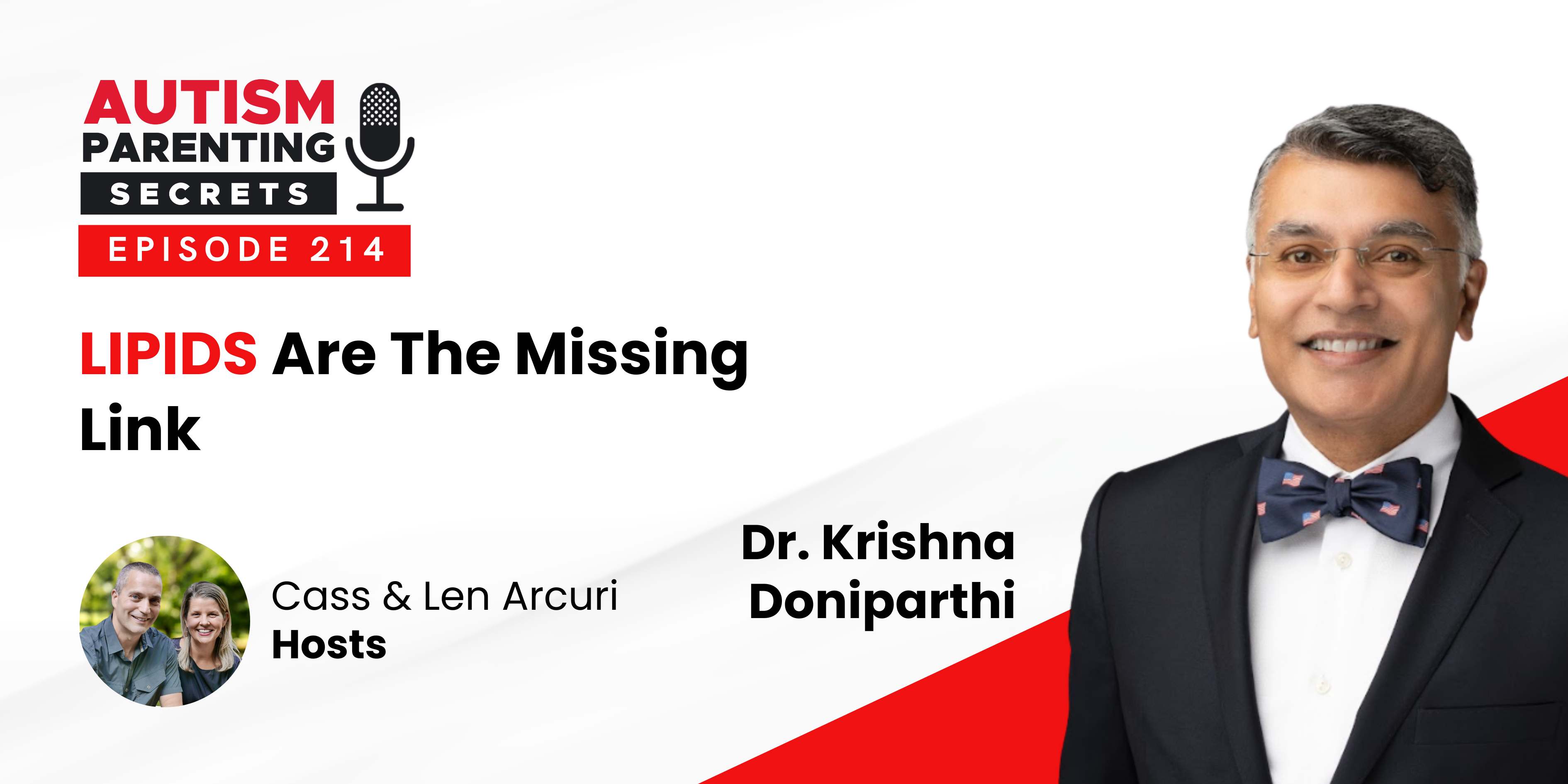
Episode 214 — LIPIDS Are The Missing Link
Guest: Dr. Krishna Doniparthi • Date: July 25, 2024
Episode Overview
This week, Dr. Krishna Doniparthi discusses lipid replacement therapy's impact on autism. He emphasizes phospholipids and plasmalogens in cell membranes for neurotransmitter storage, essential for cognitive and neurological health. Personalized treatments and nutritional supplements are transforming children with autism.
About Dr. Krishna Doniparthi
Dr. Doniparthi, a healthcare professional based in Alpharetta, GA, prioritizes a patient-centric approach to identifying the underlying causes of ailments rather than merely treating symptoms. Operating from his clinic Functional Medicine Georgia (FMG), Dr. Doniparthi specializes in lipid replacement therapy, focusing on cellular repair and rejuvenation, particularly highlighting the significance of plasmalogens in bolstering cellular health. Additionally, Dr. Doniparthi is the founder and medical director of Doniparthi Neurogen Academy (DNA), a non-profit 501(c)(3) organization dedicated to advancing education and research in neurodegenerative diseases, developmental disorders, and autism.
You’ll Discover
Why Lipids and Plasmalogens Matter (3:23)
The Wrecking Ball That Causes Inflammation (8:19)
The NATURAL Way To Rid The Body of Toxins (13:28)
Two Testing Categories To Consider (16:42)
The Cornerstone For Better Health (20:00)
Why It’s A Motor Neuron Issue (28:00)
A Call To Action You Don’t Want To Ignore (33:44)
The Difference Between Gray Matter and White Matter of the Brain (35:26)
Why Chewing Your Food Matters More Than You Think (41:41)
Referenced in This Episode
Full Transcript
Dr. Krishna Doniparthi | 00:00
We have billions of nerve cells, and each one of them will connect with another thousand nerve cells at a time. But the signal's got to start. And that part of the nerve cell where it starts is where the neurochemicals are, what we call neurotransmitters and so on. They travel through the axon, the middle part, and finally reach the very end. When it gets to the other end, it has to get released. And the starting and the ending of that signal is mostly phospholipids and plasmalogens on both ends. And in the middle is mostly plasmalogens. And that's why phospholipids and plasmalogens are so important. For not just motor neuron capability, but even sensory.
Cass Arcuri | 00:45
Want to truly be the best parent you can be and help your child thrive after their autism diagnosis? This podcast is for all in parents like you who know more is possible for your child.
Len Arcuri | 00:56
With each episode, we reveal a secret that empowers you to be the parent your child needs now, saving you time, energy, and money, and helping you focus on what truly matters most, your.
Cass Arcuri | 01:06
Child. I'm Cass. And I'm Len. Welcome to Autism Parenting Secrets.
Len Arcuri | 01:23
Hello and welcome to Autism Parenting Secrets. It's Len, and today we have Dr. Krishna Doniparthi, a healthcare professional from Alpharetta, Georgia, specializing in lipid replacement therapy for cellular repair and rejuvenation. Dr. Doniparthi is the founder and medical director of DoniparthiNeuroGen Academy. A nonprofit advancing education and research in neurodegenerative diseases, developmental disorders, and autism. Today, we'll explore cellular health and its impact on individuals with autism. Dr. Doniparthi will discuss the role of phospholipids and plasmalogens in cell membranes and their importance in storing and releasing neurotransmitters. These compounds are vital for cognitive function, nerve conduction, and overall neurological health, and through personalized treatment and targeted nutritional supplementation, Real-life transformations are happening in children with autism. The secret this week is... Lipids are the missing link. Welcome, Dr. Doniparthi.
Dr. Krishna Doniparthi | 02:28
Thanks, Len. Glad to be here.
Len Arcuri | 02:30
Wonderful. I've seen you speak a few times at MAPS conferences, and I'm excited for our audience to hear your perspective because I think it's absolutely so exciting, the research you're doing and what's emerging. And I'm just really excited for people to hear about this topic, which for me was something that really wasn't on my radar. Sure.
Dr. Krishna Doniparthi | 02:50
Yeah, that's right. And I started this process many years ago, understanding lipids, fossil lipids, and how they relate to overall better health, whether it's Not just neurological conditions, really, it's whole body.
Len Arcuri | 03:05
Yep. And I think for people who are listening, I think a little bit of 101 on lipids and cell membranes, I know enough to be dangerous, but can you just give a little bit more of a context of why lipids matter more than people think?
Dr. Krishna Doniparthi | 03:21
Yeah, very, for sure. This is probably one of the least understood topics in either in medicine, but in functional medicine or what a lot of naturopaths or other doctors, practitioners do. And lipids are simply what most people call fats and oils. We have a fancy word in science, it's called fatty acids. Just like proteins are, some people may have heard that they're Smaller components are called amino acids, while in fats and lipids, those are fatty acids. And the nice thing about these fatty acids is that they help create cell structure. And we'll talk a little bit later about cell function, but Those fatty acids, when we either make them or we get them from supplementation, they get modified within our cells to the next thing. And the next thing is phospholipids. Those phospholipids can go just a little bit more modification and become the next thing, and that's called plasmodilogens.
So between phospholipids and plasmalogens, the things that come from fatty acids. That's what makes up cell structure.
Len Arcuri | 04:37
Right. And so it's, and cell structure is something that I don't think most people would think is a big issue. Right. But what you're saying is that, you know, Autism is pretty complicated and there's a lot of different ways you can look at it, but the actual structure of the cell is super important.
Dr. Krishna Doniparthi | 04:55
That's right. And to kind of use an analogy, is that if you wanted to build a house, you know, you have to frame a house first, all the walls and the roof, has to be made with wood. The wood has to be just right and you nail it together. And once you frame it, that's the structure of the house. That's the main structure. You wouldn't call the sheetrock, the structure or so on, or the furniture or the appliances, those are not the structure. The framing of the house is the structure. And if he did that, Then you can start cutting out places for a window, places for a door or places for electrical outlets to be placed. Installed and now you are creating a house.
Well, The cell is really not any different than that. These things called phospholipids and plasmalogens make the structure of the outer coating of the cell and every little internal part of it too. And by doing that, then it creates function, just like my analogy of a house. If you have the structure of the house framed, Now by adding doors, windows, and outlets and so on, Well, now you have functions. And now you can live in that house.
Well, the same is true. On a cellular level, those phospholipids, plasmolygens, and actually a third component, cholesterol, all come together create that cell structure. And by doing so, if it's the right kind of phospholipids, plasmalogens, now you have good function that comes out of it.
Len Arcuri | 06:37
Got it. So if that's the case, that the cell structure really matters, which is, I think, one aha, I guess, to take a step back. Why doesn't everyone have solid cell structure? What occurs that may result in kind of a weakened structure, particularly for perhaps kids on the spectrum?
Dr. Krishna Doniparthi | 06:57
Yeah, absolutely. And so the interesting thing about phospholipids and plasmalogens, particularly plasmalogens, the content of cells increases right before we're born. And right after we're born, and continues until about mid-40s. And 50s of our age. What can cause poor phospholipid structure or plasmalogen structure or overall sell is that it comes down to either nutrition. Are we eating the right foods and participating in eating non-GMO organic foods that are as best as we can, keep them clean? Because chemicals and foods air or water can disrupt us. And of course, those toxins that we get from food, air, and water go into our cells. And they cause damage to our fossil lipids and plasmodogens and to the metabolism, the internal working of the cells. But the, One of the bigger things, and of course, this is Autism Parenting Secrets, And it's no secret that, what some of the vaccines, based on the adjuvants that they use, what they can do. And particularly one is aluminum. It's very neuroinflammatory. It goes in and is basically a wrecking ball. And it causes a lot of inflammation and that inflammation in turn starts to break down cells, particularly the brain, but it can happen in other places. But that's what That's the biggest cause right now is between nutrition and some kind of environmental influence.
Len Arcuri | 08:44
Got it. And so it sounds like it's yet another example of an epigenetic type of condition where perhaps people are set up, you know, with maybe a more of a susceptibility, but it's all about the environmental insults of which there are many. And you mentioned a few that basically contribute to this state where the cell membrane may be whatever, weak, not intact, something of that nature.
Dr. Krishna Doniparthi | 09:08
That's right. And we can look at it from a science level or a toxicology level. As Of course, there can be sometimes what seems like a cause and effect. I got this vaccine and then something happened. That is one way of looking at it, and that is a very important way of looking at it. But we can build up a variety of toxins and toxicants in our body.
So our overall toxic burden And it's, Every generation, unfortunately, is building up a little bit more and a little bit more toxins. And now... It doesn't take a whole lot to disrupt our cellular function. Now along comes aluminum or mercury or whatever other kind of substances And they will just really push our bodies over the edge.
Len Arcuri | 10:02
Yeah, no, any regular listeners to this podcast will have heard time and time again, we talk about total load theory, where it's a whole series of factors that ultimately can contribute to These conditions that give rise to the symptoms that are labeled autism. And there's a number of factors. I guess as you're talking, though, and you mentioned, again, a few of those potential environmental stressors, in your estimation with the kids that you're seeing and treating and working with, do you think that it's likely that the cell membrane issue is something that happened before? That they were exposed to after they came into this world? Or do you think even, you know, when they're born, their cup's already pretty filled and perhaps their cell membranes are already compromised.
Dr. Krishna Doniparthi | 10:52
It is both. It is both. But if you look at some of the studies that were done on cord blood from before, and you'll notice that children who are born, and this was a study that was done a couple of decades ago, it already showed that brand new babies, cord blood, polluted with a variety of different things. And so and what the body can put up with is actually pretty amazing. It will tolerate quite a bit.
So there are things that are happening at the time of conception to the time of birth. And in no way is to blame any mother or parent. It's not their fault, but mother will... Detox onto a baby. And that baby will build up some level of toxicity. And that is unfortunately, like you just mentioned, it's an epigenetic issue where the environmental influence has an effect on our genes and other parts of our cell. And this is a newer kind of concept that I've been talking about for the past several years, what we call preconception medicine, where you what could be a good way of living and eating prior to conceiving so that you have the best outcomes. But even if you didn't do that, now the problem is what happens after birth? What are we exposed to? Again, food, air, and water, but in this case, we're talking about medications, as, whether vaccine or otherwise.
Len Arcuri | 12:33
No, I appreciate that response. And, you know, the reason I asked that question is just because awareness of what might be behind what's happening with your child is really important in order to determine what steps can you take now that might help. Right. And that's where if you have a root cause problem. Curiosity and I know I do, and we talk about it a lot on this show, a root cause that there may be issues with the cell membrane that might be a root of what's going on is very novel and it leads to many other Roads that you might be able to go down.
Like I think every parent knows that nutrition and quality foods and not eating poison is beneficial. But I think what you're sharing now gives me a deeper perspective on why that may matter so much.
Dr. Krishna Doniparthi | 13:27
Yeah. Well, And naturally... Divine design, in my opinion. But we have, yes, in toxicology, we want to avoid as many toxins and toxicants, but there are certain chemicals that can persist for whether months, years, or decades. And so how do you get those out?
Well, our natural ability to get those out the phospholipids our cells make. They will surround... Any toxin or toxicant that's found within ourselves and basically make it exit out by enveloping it and moving it to the outside of the cell. And when it gets there, it can then go to the liver for final disposal. But one of our other natural defense mechanisms is the production of glutathione.
So between phospholipids, and glutathione, those are some of the things that can help. People who said, well, I'm eating well, and I have been for the last four or five years or 10 years or whatever it might be, But that's not to mention, well, what did you do prior to all of that? And is there anything there that's still in your body and cells? And there are some chemicals that can, like I said, persist for a long period of time.
Len Arcuri | 14:45
Absolutely, which is why detoxification can be a really powerful way of helping the body get rid of what it needs to get rid of. And again, that's something which you'd want to do under the guidance. However, medical practitioner because sometimes you can look to detoxify and sometimes cause more harm than good unless you're doing it in the right way with binders, that type of thing.
Dr. Krishna Doniparthi | 15:09
Yes, that's.
Len Arcuri | 15:10
Correct. And it almost sounded like when you're describing the lipid function, which is new to me, that they almost act as a binder in terms of escorting out of the body what needs to be escorted.
Dr. Krishna Doniparthi | 15:20
Out. That's correct. They are our natural surrounders or binders.
Yeah. But when they do get to the liver via... By themselves or glutathione. Then we need to have a healthy gut. And a healthy liver. And there are certain supplements that can help get that healthy liver going. And I think a lot in your crowd, I'm sure the parents who are listening in, they probably heard of a healthy gut and what to do for that, whether it's testing or... For better God. Gut microbiome and function. That's just as important because just because these phospholipids get the toxins to the liver, the last thing is really is exiting it out. And that's through our digestive tract.
Len Arcuri | 16:12
Right. And I think many parents who are listening are likely to have already gone down more of a functional medicine or have some guidance under like a MAPS doctor or a practitioner where they may be running the stool, urine, blood tests to see what's going on. And I think that's where I'd love for you to share with me if someone's looking at the health of the cell membrane, what types of tests would show and give an indication of whether their child may have more of an issue in that space.
Dr. Krishna Doniparthi | 16:42
Really, there's two tests that you can kind of focus on or two categories of tests. Number one is what's going on a cellular level And there is a test that looks at the phospholipids and plasmodium content, especially as it relates to nerve cells, because our brain is 100 percent nerves. And so that's where all the activity and when we're talking about is you and I are chatting a little bit before. When we talk about autism, where is it?
Well, it's not the heart. It's not the liver. It's not the digestive tract, it's the brain. And so there's that component, like what, Can we measure phospholipids, plasmalogens, and the fatty acids? The answer is yes. The next component really is what I look at is the digestive tract. Do we have a healthy gut? Is there any imbalanced bacteria or dysbiotic bacteria or some people known as SIBO, small intestinal bacterial overgrowth or yeast overgrowth or parasites? And are you making enough of the natural stuff called butyrate because whether you're, you know, it should be eating some dietary fiber with your good bacteria, you make this wonderful thing, butyrate that keeps the gut healthy and as some of it will get into our blood and keep ourselves healthy.
So those are the two major components. What are the phospholipids and plasmalogens? Can we measure those? And the answer is yes. And what's going on in the gut and liver? And that's a stool analysis.
Len Arcuri | 18:19
Okay. So would that then translate into, if it's a stool analysis, some form of like CDSA type of test, right, where you're taking a stool sample and I know there's a few different labs that run it, but something of that nature?
Dr. Krishna Doniparthi | 18:33
That's correct. And there's a variety of different labs that run specialized stool analysis. This is not the kind that's done at your conventional doctor's office because they're not looking for the things that we're looking for as a functional medicine practitioner. But yes.
Len Arcuri | 18:50
And then so the other test that you're referring to where I'm going to in my head is something like an organic acids test. Is that the other test that you'd suggest something like that?
Dr. Krishna Doniparthi | 19:00
Organic acid test is sometimes very useful. It's a little lower on my tier list of what I look for. Really, it's the first two things. Fossil lipids, plasmodium content, fatty acids, followed by stool.
Len Arcuri | 19:15
Okay. Super. And again, this is all just to kind of highlight what this looks like in terms of a process. And I know you walk patients through. I'll just remind everyone listening, right? We're not giving medical advice, just about shedding light on this approach, what's involved and the type of testing that would then give you, a practitioner like yourself, the information to be able to piece together what might help that child the most.
Dr. Krishna Doniparthi | 19:38
Yeah. That's right.
Len Arcuri | 19:40
And I'm going to guess that the first thing you would say is, Yes, healthy diet, you know, with food you can do so much, which may be step one being stop feeding poison.
Dr. Krishna Doniparthi | 19:51
Yeah, absolutely. The cornerstone for better health is always is nutrition. Eating as much organic non-GMO foods, although even that is kind of tricky. I just saw another report of this one couple of few companies that were have organic snacks for kids. They're laced with lead and higher than the whatever recommended limits, no amount of lead is good in the body, but it's yeah. Nutrition is, We have to do the best that we can. And it's really, it's not, chasing after organic snacks. It's really more natural foods. And I always mention it like this. We're not trying to substitute I don't know. Potato chips with coconut fried potato chips. That's all right. But really, what we're talking about is God-given foods, things like natural meats, natural eggs, vegetables, minimal fruit, certain nuts and seeds.
Len Arcuri | 20:55
Right. Yeah. Real food, but real food is real inconvenient, which is where at least I know in my mind with my wife, Cass, I mean, she was amazing in the kitchen still is in terms of putting the time in to serve real food. But I know most parents were like me where it just sounds hard and it is going to be more inconvenient. And the only way you can actually take action is if you really believe that food matters.
So I love that you're teeing that up. And again, I think a lot of parents may kind of know that, but you almost don't want to know because of the inconvenience involved.
Dr. Krishna Doniparthi | 21:32
Now it. It's not to say... And my heart always goes out to parents who are having to take care of the children who are afflicted with autism, there are a lot of issues from a nutritional standpoint, sensory issues that only certain foods, are what's liked by the child. And so it is a challenge. And when that kind of challenge is happening, yes, there is like somewhat of an exception. But even then, we want to do the best that we can with the foods that we have.
Len Arcuri | 22:06
Yeah, no, that's absolutely correct. And yes, there's lots of challenges that many parents can face, but not anything that's insurmountable in terms of at least taking baby steps to serve something that is healthier and you can do more and more over time. But again, it's hard for people to really even have that determination if they don't believe that food really matters. And that's where, again, I feel like there's a lot of And people are being programmed to kind of not take it as seriously because, you know, for a parent who's already exhausted, who already has so much going on to have to spend even 15 more minutes in the kitchen seems like a lot for them.
So you have to really believe it matters.
Dr. Krishna Doniparthi | 22:51
Correct.
Len Arcuri | 22:52
And so with you and what you're seeing as being incredibly helpful, you know, feeding nourishing foods that's not toxic is kind of step one. But then I'm guessing invariably even a parent who is doing so much, there may be only so much they can do with foods. And that's why usually some kind of supplementation usually is part of the picture.
Dr. Krishna Doniparthi | 23:17
That's right. So in that list of things, what would I, if you came to me, what would I do? We are definitely going to talk about nutrition. Then if there's some issue with dental health that really needs to be addressed, I'm not a dentist, but I do know that there's some things that we just don't want. We don't want some dental disease infection that can really hinder gut function. Dental amalgams are an issue. And seeing an integrated dentist, it's not my arena, but if I identify them, I'm going to mention it to the parent.
Like, hey, this is something you need to look at. And then it's really next is the testing component. And based on the testing, then we can kind of figure out. What supplements or for lack of a better word, what supplements do you need in order to restore better cellular health? And so supplementation will help and it does help. But I kind of divide things into two kinds of arenas. Damage control and damage repair.
So we want, we don't want any further damage. And what is damaged, we'll go back and fix.
Len Arcuri | 24:30
Right. And what is damaged, would you agree that the body kind of has an innate healing capability as long as it's got the building blocks to repair.
Dr. Krishna Doniparthi | 24:40
Absolutely. If we didn't, we wouldn't survive as humans for very long. And so again, we have a very huge capacity for environmental toxins and toxicants, but it does eventually add up and there can be a limit and there is a limit, I should say. And that's, we don't want to get to that limit. And so, yes, we have a natural ability and our natural ability are the things that are made in our liver, digestive tract and on a cellular level. Phospholipids, plasmodogens, butyrate, glutathione, these things called TUTCA and bile in the gallbladder. All of them are... Wonderfully designed body to get rid of things as they come in.
Len Arcuri | 25:29
Got it. And with the children particularly that you've seen and you've run tests for, what are you seeing? Is it that every child has a huge issue here? Are they all train wrecks? Or do some have much more major issues, therefore a much more intensive approach would be needed for them?
Dr. Krishna Doniparthi | 25:49
So I kind of break it up in three levels. What's going on a neuronal or nerve cell level. What's going on a liver level, there are certain things that can damage or not damage, I would say, sets up the liver to become dysfunctional.
And then what's going on a digestive tract level. So a healthy gut. A healthy liver and healthy nerve cells is the way I think about it.
Len Arcuri | 26:14
You have something called the autism plasmodium hypothesis. Can you explain what your working hypothesis is on the connection between the symptoms we call autism and plasmodiums?
Dr. Krishna Doniparthi | 26:28
Yeah. So phospholipids and plasmalogens, when they make the structure of the cell, If there's any level of inflammation in the brain, Our supportive cells called oligogendrocytes, they start to deteriorate and actually act like kamikaze fighters. And they go in and just blow away nerve cells and the coating around the nerve cells called the myelin sheath. And that myelin sheath is a coding for the cells so that when nerve cells need to make their signals, They need that. Insulating coating In order to get the signal from one end to the other end. And in the case of autism, we noticed that myelin sheath is damaged And it happens... Particularly in the motor neuron part of our brain. And what I mean by motor neuron is those are the nerve cells that control movement. And so that movement If it's not, functioning correctly, you will notice it in a lot of different ways. Movement disorders. Can't speak correctly because Use of tongue, lips, mouth, And the voice box is highly motor related.
And then that sets up other issues later on. So the child... Will feel like they need to keep for lack of a better word, they look excitable, like they need to move, but they're really just trying to smooth out their natural movements, but they can't. And so it looks very erratic. And of course, you get the problem of, well, they're not communicating.
Well, no, they're listening just fine. Listening is a sensory issue. But talking, getting that to go through the brain and say it out loud is a motor issue.
So the motor neurons of the brain are heavily affected And again, that's the focus that I approach in autism.
Len Arcuri | 28:39
You're focusing on autism being, at least in many cases that you've seen, a motor neuron issue. It's interesting because we've had some dynamite discussions with other people in the past, including JB Hanley, who talked about, from his perspective, that's episode 38, about with his son, Jameson, who is a non-speaker, that the aha that JB had is that it was a motor neuron issue. Once that became clear.
That's why spelling to communicate and assisted communication devices became so big because that was the core thing for his son.
Dr. Krishna Doniparthi | 29:19
Right. And again, I think your audience knows this very well, but you're right. When the studies were done looking at children, they don't have a learning disability. It's no different than the regular general population, about 1%. We'll always have a learning disability or Maybe not learning as fast as everyone else, like the other 99%. It's not a learning issue. Because if, These kids were able to speak. They're intelligent. They'll put it out. They'll say it correctly right now, as you mentioned, the spell to communicate, the S2C. They're spelling just fine. They, their vocabulary is fantastic. It's grade level, if not higher. And so, They just can't put it into vocal vocalization, but even just to be able to type on a device like an iPad, is a motor neuron issue too.
So they're going to be slow. They might have to Practice slowly, one letter at a time. Until they get it right. But that is a good venue to use.
Len Arcuri | 30:32
Yeah. So it just opens up a totally different way of looking at what might be happening for your child. And if it's a motor neuron issue, that will lead to very different actions that you could potentially take to meet your child where they are. And you're 100% right. These kids usually, many more times than not, are absolutely brilliant, but they just don't have the way of communicating properly. To show it because so many of the families that we coach as well, they want more than anything for speech for their child and they're trying all kinds of different things. But if they're not aware that it could be a motor neuron issue, they may be missing a whole faster way of getting to the root of what's going on with their child. And again, what actions can they take?
Dr. Krishna Doniparthi | 31:21
I mean, could you imagine me? I know we were talking earlier about framing a house so you can create the structure of a house.
I mean, how silly would it be And this is where I somewhat, I kind of see some of the speech therapy if I could use that analogy at the house, what good would it do if a bunch of people showed up to your house, workers, but you have no wood and no nails. They'll say, where's the raw material? I need some raw material to build a house. And everyone's looking around, scratching their head, like, what do you mean? We've got the workers here. And so that's exactly what's happening. And it's a little unfortunate. And I think things are going to change very soon. Across the nation, if not internationally, where we are looking at say, well, it's not just doing, you know, physical therapy or speech therapy or occupational therapy, but let's give them the raw materials. What does the brain need? In order to carry out those functions.
Len Arcuri | 32:22
Yeah, no, it's a perfect example. And that's why services that are out there that have been out there for a long time aren't reflecting this at all, right? It's just, okay, speech therapy, if there's a lack of speech therapy is the answer. But as you said, in this case, it could be wildly pointless. Maybe it will have a purpose down the road. But in the meantime, there's a much more direct way to get to the root of what might be going on with your child.
So I think that's a really powerful concept to have. Is it a motor neuron issue? And my guess is you're seeing that oftentimes it truly.
Dr. Krishna Doniparthi | 32:59
Is. Yeah. And Len, you just mentioned something And it's kind of important. Again, our bodies are, our cells are resilient. And it's possible.
Like if we thought that aluminum, because it's so neurotoxic, Would the body have the capability of removing it? The answer is yes. But if the damage is done... You have to go back and repair the damage. And so it's just like that.
So again, part of it has to do with avoidance or remove the thing that's inciting all of this. But then... For parents. And I will have to say one other thing. To anyone out there. If you think that your child has been affected by a vaccine, get them to a practitioner as soon as possible, a functional medicine practitioner. Because the sooner you intervene the better it is. And I'm not saying that later on during the course of cellular injury, can you still recover. Absolutely. It's just better the sooner. It's kind of like a house that's burning down. You don't want to wait for the whole house to burn down. Of course, you can completely rebuild a new home, but you want to contain the fire as soon as possible.
So that you have less to fix.
Len Arcuri | 34:23
Yeah, no, I think it's a powerful message. And I think the reason why parents may not, you know, kind of respond is because there's a perception, okay, whatever's done is done. There's really nothing that can be done now. But the reality is if there was some issue with some exposure or immunization, whatever the case may be, and particularly if it's something that's in the body, there's a lot that you can do to help the body again to push out and to move beyond. And it's never too late, as you said, but the sooner you address it, the better.
Dr. Krishna Doniparthi | 34:56
Absolutely.
Len Arcuri | 34:57
Okay, now that's very helpful. I think thinking through There's so many questions I have about to better understand this. And I know in some of your presentations, you really focus on talking about the brain and the difference between like gray matter and white matter and why it matters, for lack of a better word. Can you just give a little bit of an understanding, like more of a one-on-one, the different parts of the brain and function of each?
Dr. Krishna Doniparthi | 35:23
Sure. Yeah, absolutely. Our nerve cells are somewhat similar, if I can use a different analogy, like an electrical cord. We start at one end and it has a receptacle at the other end. And if you plug a cord into the wall, well, The plug goes into the wall and the electricity starts to flow through, but it passes through the cord. And gets to the other end, which you plug into whatever you want, computer, blender, whatever, TV. And the thing works on the other end.
Well, our nerve cells are similar. We have those starting where the signal starts. That's where the gray matter is and where it ends. That's where the gray matter is. And in between is the connection. And that's where the white matter is. And it's white or looks whiter on cut section of a brain because the gray matter is just a little darker.
So the white matter is made out of what's called myelin sheath. And that's the protective coating, just like my analogy of an electrical cord. In the middle part, the cord itself is wrapped with an insulator. Our natural insulator is the myelin. And that myelin allows for that conduction of the nerve cell from one end to the other end. And without it, the signal is either lost or slow. Or it may not actually, it might even get to the other end, but it may not create enough of a signal for it to carry on. But that gray matter is on the outside part of our brain. And the white matter is like the connection to the next cell. And so for those who may not know a little bit about anatomy, Most of our brain cells... Our two connections. It goes from the brain to our spinal cord.
And then from there makes the connection to the next nerve cell that goes to our arm, legs, or organ. So most of the time, it's just two, maybe three connections, three nerve cells at a time. We have billions of nerve cells, and each one of them will connect with another thousand nerve cells at a time. But the signal's got to start. And that part of the nerve cell where it starts is where the neurochemicals are, what we call neurotransmitters and so on. They travel through the middle part and finally reached the very end. When it gets to the other end, it has to get released. And the starting and the ending of that signal is mostly fossil lipids and plasmalogens on both ends. And in the middle is mostly plasmalogens. And that's why fossil lipids and plasmalogens are so important for not just motor neuron development, capability, even sensory. I know some kids have sensory issues on their tongue. They want to eat only certain kinds of foods or they got to keep touching certain things. It can a little bit be sensory, but we're talking about is being able to talk and move correctly.
So gray matter and white matter are very important. And it And without those two components, nerve cells just won't work.
So we, again, we can help both parts of the nerve cell, gray matter and the white matter.
Len Arcuri | 38:44
And that's a great way of describing why lipids truly may be the missing link, right, in terms of something that a parent might be overlooking now, because they could be doing all these other interventions. But if the lipids are, or if the cell membrane is not strong or intact, or if these lipids are insufficient, then again, it could be derailing the progress a child could make and maybe all those other things you're doing may not be working because these foundations of the house aren't in place because.
Dr. Krishna Doniparthi | 39:20
And just a little point on what people think about lipids. Lipids, I know there's a lot of different People might define it differently or think about it differently. This is not a lipid panel like you go to your doctor and get your cholesterol, HDL, LDL, and triglycerides checked. That's a... Different kind of lipids. When we're talking about lipids here, we're talking about really is fatty acids, the things that come from, again, we either make or get from our foods. And this should not be confused by thinking that, well, I'm cooking with you know, olive oil and coconut oil, and aren't those healthier types of fats? They are for the purpose maybe of cooking, maybe not olive oil, but coconut oil and butter and beef fat and so on. But we got to still make Other kinds.
So this idea of fatty acids is what we call lipids in science in this arena. And so in our body, we have over close to 40 different kinds of fatty acids, but some are more than others. And we need certain kinds. Because again, they go on to be modified by ourselves. To become the next thing, which is phospholipids, and the next thing, which becomes plasmolygens.
So by eating certain kinds of fats and oils you can get abnormal phospholipids and therefore abnormal plasmalogens. And so this is where I guess the testing and the kind of the understanding behind nutrition comes in. It's not, what I'm promoting is not so much hey, we need to eat good fats and oils. That is part of it. But really, it's about How does that translate into good phospholipids and plasmalogens? And are some safer than others or better than others? And the answer is yes.
Len Arcuri | 41:25
I guess the only other thing I wanted to throw out that I thought was interesting in, again, hearing you talk was you seem to be very focused on the importance of... People, kids chewing their food and how important that is for digestion. Can you talk a little bit about that?
Dr. Krishna Doniparthi | 41:42
Yeah, our digestion starts in the mouth. And we do have a very complex system between mouth, brain, and then back to the gut. And by... Eating our food and not drinking our food, what eating does is it moves our masseter muscle. This is the muscle that's attached to the jaw. By the mouth going up and down, it sends a signal to the brain that we are eating. And that sets up what's called pre-digestion. And the brain says, it tells the stomach and the rest of the digestive tract, hey, get ready to eat. Here it comes. And by doing so, then we release... Digest ven cy appropriately and so, And that allows for good digestion and absorption of our foods. What does not happen much is with drinking when we drink. Liquids we do not use this muscle as much. In fact, we can... Barely move our mouth and just swallow food. That does not allow for the pre-digestion and the question is so what? The answer is, well, you're not going to start digestion correctly and those liquids can get past the stomach and the digestive tract is not ready for it. In fact, when we think about in nature, ones that we processed So we can make apple juice and orange juice and so many other kinds of things that we can drink. But really, the only two things that are naturally available to drink are number one, water and number two, coconut water. Even breastfeeding, is not a passive event A baby's suckling, not drinking. And the suckling, as any mother knows who's breastfed, The mouth is moving faster. And the tongue is moving very rapidly or, I should say, moving period. And that does set up the digestive tract for the baby to digest the Press melt. Even it happens with bottle formula. The jawbone has to move along with the muscle there.
Len Arcuri | 44:03
Got it. So drinking... Calories as well as perhaps eating or scarfing your food and bypassing that, my guess is two reasons why that's a problem. One, as you're saying, it just hampers digestion and I'm guessing could lead to Pranic inflammation, dysbiosis, leaky gut, all those things. Yes. Coupled with the fact that nutrient absorption, you know, getting the benefits of that food, I'm guessing would be hampered as well.
Dr. Krishna Doniparthi | 44:31
It would because, again, we may not be properly releasing digestive enzymes from our pancreas correctly. Yeah. And so I'm not. Completely opposed to if someone says, there's my child or I need to drink this or that. Sure. Follow it up or start with something crunchy. And so eat that first.
So, for instance, if a child is able to munch on a celery stick. That would be wonderful. That would get the mouth going or some cucumbers or something like that. Or even a crunchy piece of fruit like a pear. And that can set up the pre-digestion process so that when it's followed by a liquid, it has a better chance of being digested and absorbed correctly.
Len Arcuri | 45:24
Got it. No, that's helpful. And again, the more people can understand why, you know, something that's been an adage for so long, right? Chew your food, chew 20 times, whatever. It really does matter. And again, if you're looking at your child and saying what could help, a healthy digestive system is really important. And that's one thing that you could do to improve digestion and overall health.
So yeah, so thank you for that. But I'm delighted that we've covered this ground. I think it's important and I really appreciate other parents, listeners to understand the work you're doing. And it's a pretty exciting area of research in terms of what this might lead to in terms of more and better ways that people can help their children.
Dr. Krishna Doniparthi | 46:08
Right. And I'm trying to do as much as I can. And if I can make a quick plug, I do try to If, Parents are looking for help. They definitely should go to the MAPS website and see if they can find a practitioner in their area. But I'm trying to teach practitioners whether at MAPS and other places. How to utilize phospholipids, plasmodogens, or these things will be simply called lipids in order for better cellular function. And that, is a nonprofit organization that you were mentioning about earlier called DNA. For drdnadr.org. And I want more practitioners to learn about this. And as I'm training, we're getting more and more interest in this. And we're trying to help as many children as possible. We do take donations for those parents who are looking for this kind of supplementation. They can get it. We're doing a research project around it and offering the supplements that are under this research so that they don't have to come out of pocket. But we can't help everyone.
So if someone can help, donate to us, that would be great. And then, of course, I help in my own practice.
Len Arcuri | 47:29
Fantastic. Thank you for sharing that. And it will all be in the short show notes if people want to find out more.
Well, I really appreciate you taking the time, Dr. Doniparthi. It's been an absolute great conversation. I know I learned a lot and I know our listeners will definitely appreciate it as well. Thank you very.
Dr. Krishna Doniparthi | 47:44
Much. Thanks, Len. Thank you. Thank you.
Cass Arcuri | 47:47
Want to learn more? Go to elevatehowyounavigate.com