
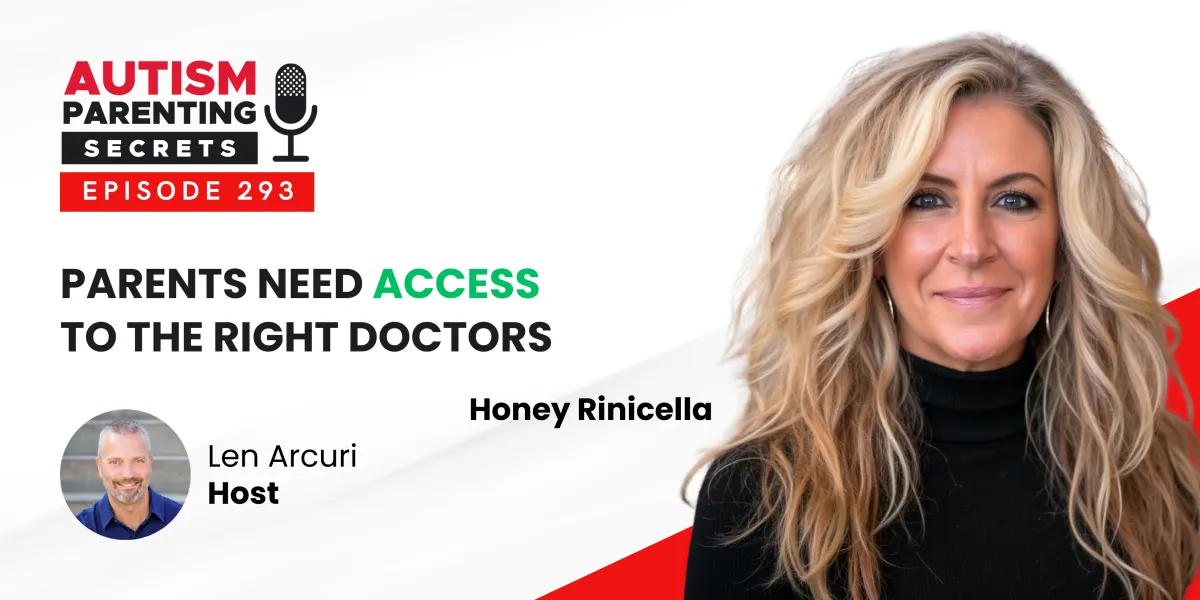
Episode 293 — Parents Need ACCESS to the Right Doctors
Guest: Honey Rinicella • Date: February 5, 2026
Episode Overview
Parents often assume that finding the right diagnosis or protocol is the hardest part of their child’s journey. This week, Honey Rinicella, Executive Director of MAPS, explains why access to the right doctors - those trained to handle real complexity - is what actually changes outcomes for families.
About Honey Rinicella
Honey Rinicella is the Executive Director of the Medical Academy of Pediatrics and Special Needs (MAPS), the nation’s leading organization training physicians to care for children with complex medical needs using integrative and functional approaches. Under her leadership, MAPS has expanded its educational programming and strengthened collaboration among practitioners, researchers, and advocacy leaders nationwide. Honey’s work is deeply personal. As the mother of twins with complex medical needs, her advocacy began at home and grew into a lifelong commitment to ensuring families have access to compassionate care, reliable information, and a supportive community.
You’ll Discover
Why Most Doctors Aren’t Trained For Complex Kids (2:10)
How MAPS Doctors Think Differently About Complex Kids (6:45)
Why MAPS Is Rapidly Attracting More Physicians (12:30)
How In-Person Community Changes Parents And Outcomes (21:40)
Why Parents Play A Bigger Role Than They Realize (29:10)
Referenced In This Episode
Full Transcript
Len Arcuri (00:01.688)
Hello and welcome to Autism Parenting Secrets. If you're a parent trying to support your child and you've ever felt unsure about who to trust, where to turn, and whether the doctor you're working with really understands your child's complexity, today's conversation is for you. I'm welcoming back Honey Rinicella, Executive Director of MAPS. Honey has been on the show before and that episode went straight to the heart of one of the most important decisions a parent ever makes.
Honey (00:03.722)
Thank
Honey (00:19.37)
Thank you.
Thank
Len Arcuri (00:32.034)
choosing the right practitioner. But this time we're going to go deeper because something important is happening. MAPS is opening the door wider for parents here directly from the doctors and practitioners and thought leaders who are already doing this work together in community. Parents just don't need more opinions or summaries. They need a direct line to the right doctors who think, elaborate, and approach complex children. The secret this week is...
Parents need access to the right doctors. Welcome, honey.
Honey (01:03.082)
Thanks so much for having me back. love being on your show.
Len Arcuri (01:09.762)
Well, we love having you and yeah, I can't talk about maps enough and it's not just that I happen to like your organization. The work you're doing is incredibly important. The mission of maps, the mission of what I'm trying to do with this podcast. It's all so aligned. So, I'm sure people who are listening are familiar with maps, but if they aren't, would you like to give the one on what maps is, what its mission is and leading to this.
I know you have a few events this year that are going to be super powerful.
Honey (01:38.378)
Yeah, so MAPS is the Medical Academy of Pediatrics and Special Needs. So we do infancy through adulthood education for physicians. We're actually the only organization in the country dedicated to serving a fellowship program to train physicians how to treat whatever complexity walks in the door, right? So used to be really heavy with autism. Now we've kind of gotten more into, you
a ton of pans and pandas and epilepsy and seizures and allergies and ADHD and eczema, anything that is complex. It's really our wheelhouse.
So we do have two conferences twice a year to educate our clinicians, East Coast and West Coast typically, or spring and fall. And what we ideally do is recruit new physicians, this is the dream, right? To recruit new physicians to understand this complexity because as you know, the rates are continuing to rise.
with our complex issues. So like one in six kids has an issue. So we want to be able to make sure any kid that walks through any pediatricians or any GP's door or any neurologist, you know, they're going to understand what they're looking at. And so, you know, we have our, our set group of doctors, but we're continually growing. So we opened up our door to bring in as many new people as we can. And I'm thrilled to say that I
originally when I took over this in the fall of 2022, we would get about five or six newbies as we call them, first timers. And at our last conference, we had close to 180. And that was the second time that we had close to 180. I think we had 178 the spring, and I believe it was like 182 in the fall. So I feel like the little club that we had is starting to grow.
Honey (03:36.81)
which makes me so excited because I'm a parent myself of 25 year old twins with autism and complex medical issues. And it's just incredible to see that, you know, the rates are growing for the need and these kids are having all these insane issues, but we're starting to fill the gap there with more and more physicians that are coming alongside. It's incredible. I love it.
Len Arcuri (03:58.786)
Fantastic. Yeah, no, and so on all bottom line in my own language, right? You have right now pediatricians or medical doctors who largely in the conventional world just aren't equipped, don't have the tools, can't even come close to kind of really serving the needs of these kids. And so when you talk about people, newbies coming over, we're talking about practitioners of all kinds who want to become educated.
Honey (04:15.594)
Mm-hmm.
Len Arcuri (04:27.042)
knowledgeable, skilled to be able to have approaches that actually meet these kids and young adults where they are.
Honey (04:36.17)
Absolutely. can tell you, we actually went to the American Academy of Pediatrics as an exhibitor. They had us come. And since we do have this specialty area of the complex medical cases, I have to tell you, it was so disturbing. I mean, so disturbing because we went there thinking that we were going to be able to recruit physicians to come over. And instead, what happened? The vast majority of the physicians actually came to us and said,
Can we send you our patients? We don't know what to do with them. We only have 15 minutes with them. We have 10 minutes start to finish to help these kids. We don't know what to do with this. We don't know what these kids, we think they might have PANS. So they were starting to believe this, you know, PANS exists, but they didn't understand that there are tips that they could take away and help those kids to get started on the right, you know, path to healing. And instead they wanted to just send them all to us. They were basically like, great, you're the database.
And we were like, my gosh, no, no, no, you can come. And they were like, we can't come. We don't have enough time to help these kids. So it's like this, ugh. But if you had a few of our clinical pearls from our conference, you actually could. So it was a little sad for me to see almost every pediatrician say the same thing. Occasionally we'd get a few that were like, I love what you're doing. I'd love to learn. But the vast majority were like, we just don't have time for these kids. And that just can't happen. That can't happen.
Len Arcuri (06:02.21)
Well, can we, can we hover on this a little bit and talk about, and talk about perhaps the why. And I'm not here to indict anyone. I'm not trying to assume anything, but the fact that you had that type of reaction, which basically is saying not, Hey, how can I help these kids? But Hey, somebody else, you take it. Right. And so it comes down to what's the motivation. And that's where, again, I don't want to say anything negative about.
Honey (06:04.581)
yeah.
Honey (06:23.516)
Right.
Honey (06:30.954)
and hi.
Len Arcuri (06:31.082)
anyone, but I could say something very positive about you, your organization, the maps practitioners and leadership. Every single person cares about one thing, helping these kids and we'll do whatever it takes to do to accomplish that mission. And that means, you know, sharpening your skills, your capability and the likes. think that is the unifying, you know, the quality, the consistent element that
Honey (06:41.578)
Mm-hmm.
Len Arcuri (07:00.206)
practitioners have is that they own and feel a sense of responsibility to get better equipped as opposed to, let me find who can handle this. find someone else to do this.
Honey (07:08.938)
Mm-hmm.
Yeah, I think that it's incredible because some of our physicians that are pediatricians, and I do have to say, we do have lot of obviously two on our board, Dr. O'Hara and Dr. Mumford, American Academy of Pediatrics pediatricians. So we have a ton of the AAP pediatricians, but we don't have enough. Usually it's like general practitioners that really come in with a more open mind. I don't know how or why to explain that completely, but
It is really disturbing because some of them will come in and I love the fact that they find their way to us. And sometimes I'll ask them, you know, I'm actually pretty wise with how I identify people that walk into our conference. I give everybody a specific colored lanyard. And so anybody with a white lanyard, it means that they're a first time attendee. And my goal is to go up and say, hey, how did you hear about us? I'm so happy you're here. Let me introduce myself to you. And upon doing that, I always say, how did you hear about us? And there's actually a lot of them that are in these physician groups.
that have shared with me that they will have a large discussion within one of the forums of this child has something I think might be pans, what does this look like? And they're all looking for answers of how to treat this. And so a lot of them were like, well, you should probably head over to the maps group. And it's so funny because they'll be like, what is maps? And then they'll find out about it. And they're like, they kind of specialize in anything outside of the norm. So it's really...
kind of beautiful, right? That we're being known as that. But then some of the doctors that do come, it actually is a little heartbreaking because it's all so new. They're like, we didn't learn any of this in medical school, none of it. Like some of them are dear in headlights. Some say it's just really overwhelming and too much because they don't know how they would ever incorporate it into the practice. And so that's where, you know, we do have a whole fellowship and a mentorship program.
Honey (09:09.31)
We record everything for the doctors to be able to go back to and look at if they're a member. And we're trying to make it as a nonprofit as easy as possible for them to have the tools to not feel so overwhelmed, right? But it just has shown me, and I have to tell you just a two second story in my background, you know this, but some of your listeners may not, but prior to me jumping into this world of maps, I was in parent support, much like yourself, for 20 years. And I did.
the National Autism Conference and I threw the East Coast conferences for parents for Taka. And the thing that's really incredible and I wasn't expecting was that when I took over at MAPS, I jumped in full force and what was crazy is that when I jumped in, was like for every five hits to our website, four were parents looking for a MAPS doctor. And I was like, my gosh, like we're getting more, more.
parents on our website than we are physicians. Like this is a problem. The parents are knowing more than the doctors. So I felt like after 20 years, I'd done my due diligence, passed the ball over to a ton of people like you, which I'm so grateful for. And you've been around, you know, much longer than that. But the point is, is that these parents have needed this growth for a long time. This is not some, this is just, we're just seeing it really loud and really clear. And our kids are getting older. My twins are 25.
And with that age, I don't know what's going on with our community. But right now, know, puberty and, you know, know, adulthood is really throwing some wrenches into our children with some complex issues. And a lot of these pediatricians and these GPs are like, you know, these kids started having seizures. you know, these kids are having catatonia. Like things are happening outside of their norm, even though they don't know enough. They're there. It's even outside of our norm.
So it just proves that the need is great and we need to get even bigger and recruit more physicians because the more that get in there, they typically then will be like, hey, what are you doing about this? Because this is what I'm seeing in my practice. And then somebody brings it up and we put it on the docket. And then when we do a call to abstract, we almost always get somebody mentioning, treating whatever that was. So we tend to put the most pressing issues that the doctors are facing with or the physicians, healthcare workers, you know.
Honey (11:30.824)
We take nurses, naturopaths, we're all encompassing nurse practitioners. We welcome any healthcare practitioner, but the goal is to ensure that at every conference, it's something that's really prevalent right now in our community that we want you to know about, like that we want all of the healthcare workers to know, what do you need to know about this?
So, which brings us to our Up and Coming conference is gonna be all things toxins, which is great right now with what's going on in the current administration. So the whole Make America Healthy is not anything that we're new to. It's kind of been our expertise. Their maps is expertise for like 20 years. So I am thrilled because I feel like this is literally, it's like a megaphone for what we do.
Len Arcuri (12:19.34)
Yeah. Thank you for talking about all that, but especially with this upcoming conference in the spring in my backyard in Charlotte, again, for practitioners and the theme, you always have a theme. So the theme on this one is toxins. And I know you go back and forth and some people may be listening, just saying, okay, yeah, toxins, get it. They're not a great thing, but like really how this comes into play is that even though your road as a parent with your boys was autism, that's the case with my son.
Honey (12:24.714)
Yes.
Honey (12:31.722)
you
Len Arcuri (12:49.128)
it really doesn't matter what the diagnosis is. cause again, there's a lot of challenges out there, a lot of diagnosis is out there, but the key is really ascertaining. What is the root cause that's going on that's contributing to however your child's presenting, whatever's holding them back. And that's why toxic exposure other, whether it's in the past or currently is a huge root cause.
Honey (12:56.49)
Thank you.
Len Arcuri (13:13.122)
which is why that theme that, you know, why you're packaging it is that it's not like a side issue. It's actually the core issue. And, and I know depending on the year, there's different toxins that seem to be more, more discussed, this year. there any particular, whether it's mold, EMFs, or is it really just, kind of everything in terms of what the focus of the conference is? Like some of your speakers as an example.
Honey (13:23.306)
Mm-hmm.
Honey (13:38.468)
Yeah, no, I mean, we're hitting everything. I mean, one of our board members, Dr. Gaitanis, he was chief of neurology at Brown, previously chief of neurology at Tufts, hugely well known and respected in our autism community and beyond. Like he's talking about like the health costs of agricultural chemicals, know, like glyphosate, right? We're going to talk about pesticides. We're going to talk about, you know, acetaminophen. Dr. Parker is one of our, William Parker is from Duke, 28 years from Duke.
He has been involved in our organization for a really long time and he's gonna be discussing, everybody's talking about the Tylenol buzz, right? Well, he's one of the most published researchers on it. So he's considered the expert. We're talking about all the overload from metals and toxicants from environmental insults, but we're even talking about things like sugar as a toxin, right? So how critical, I've always learned this like...
know, sugars, cancers, candy. Well, what does it look like in a child? So we're bringing in everything, ammonia, indoor environmental hidden, you know, pollutants that you might not know that you even are being exposed to, right? Like, you know, radon. I know that I bought my house in Pennsylvania and they were like, you need a radon and mitigator. And I was like, what's radon? Like there are things that we don't even know about, right? That could be potentially hurting us. So we're going to talk about
You know, everything that can impact you, we're going to talk about plastics. We're going to talk about where this all ties into like causing like anxiety. It's going to talk about how this can alter your immune system. You know, everything that we can think of, we have brought to the table like fluoride, you know, all these little things. They're not just, you know, for
autism, right? So every child has the ability to only withhold so much before their bucket gets overloaded and they start having significant issues. So this is going to be applicable to all children and development. And it goes all the way up, right? Because like I just said, we have 25 year olds now dropping from seizures or catatonia. So what is tipping them over, right? So we got to have, we got to have all hands on deck toxins. What are we looking at? What are we missing?
Len Arcuri (15:51.643)
Great. No, thank you for explaining all that. yeah, I mean, again, it's wildly unique for every single individual what toxic exposure or what toxins are problematic, right? It's also so personalized. So that's great. So the conference coming up three days, practitioners, all about toxins, dynamite speakers, some of which are going to be hanging around for a parent day, the first parent day on Sunday. So talk a little bit about what thought you put into that.
Honey (16:13.8)
Yeah! Yeah!
Len Arcuri (16:20.876)
what you're hoping to accomplish and why if someone's listening who's a parent, why in the post COVID era would they consider getting up and traveling to Charlotte for an in-person conference? And I know you have a virtual option, but otherwise make the case for the parent listener.
Honey (16:35.314)
if we wanted to.
Yeah, so well, first of all, I come from that world, right? So I came from the world of throwing the conferences. So in 2022, I threw the National Autism Conference and when I walked away, nobody picked up the ball. So even right now, one of the largest conferences on the East Coast was also Taka and they're not doing an East Coast one right now either. So I really felt the need, I'm a mom, this is my community and I see the good that MAPS has done for my children and I want it everywhere. So.
You know, we did make a virtual option, but I have to tell you, I am not a virtual person. And I believe that us as a community, we need to be with our people. I think what kept me my head in the game, you know, my son was critical in the move of the Spellers movement, and he would have never been where he was today if I wasn't surrounded, you know, side by side with like minded moms that were just like me saying, let's go. What's next? So I feel like being with the energy and the vibe of the parents.
is critical. So yes, we're kind of, we say we're kind of tiptoeing into this, this realm because again, our area of expertise are practitioners. So, you know, I beg every parent out there, if you know an open-minded practitioner, we do have something on our website. It's invite your doctor to maps. It's under our parent tab.
Len Arcuri (20:34.818)
Fantastic. Yeah, no, think just to clarify. So the parent day is on Sunday, March 15th. And this is 2026 in Charlotte. And the night before the Saturday evening on the 14th is this two hour roundtable. So if you're considering this conference, which I would highly recommend, if you come in person, you can participate in that roundtable and get that
know, one-on-one direct access depending on the topic most interesting to you. And so really the experience for parent did come to Charlotte would be that round table and then the full day direct access hearing from Dynamite practitioners and speakers. And if they were to do it virtually though, that would just be for the Sunday for the Parent Day agenda.
Len Arcuri (25:44.93)
Well, I love everything that you just said. I love your heart and you touched on so many key concepts, but I just want to touch on two of them. One is that the landscape is constantly changing. the only thing that's, neither of these situations are a good thing. If you have a doctor who's not curious and basically just doesn't have many tools in a toolbox, that's not a great thing. But even if you have a doctor who may
claim to be kind of functional or biomedical or whatever the case may be, if their protocol hasn't changed in 20 years, that's also not a great thing. So the doctors who are curious, who want to remain current, who want to keep learning, you know, that's, an intrinsic quality that sometimes parents miss when they, when they think who do I want to be my, my guide? And that curiosity, that desire to constantly learn is so key, which is why, yeah, keeping up with the changes is, is absolutely essential.
But then the other comment I want to yeah, it is critical. But the other comment I wanted to make was on this concept of community. Because I don't know what you were like very early on. I didn't want to be at conferences and in community. You know, it seemed like a waste of time. It didn't seem like it would be that helpful. And that's why for parents who haven't been, right, you can't really describe the power of being in community in proximity. And sometimes the most powerful insights you might get out of a conference
are what happens in between the presentations when you're connecting with doctors or other parents. So it is powerful in a way that I can't really adequately describe.
Len Arcuri (29:18.752)
Wonderful. think that's a fitting way to end the discussion. Just people are interested. You want to tell them where to go. Of course, there'll be links in the show notes where you can go to register for the conference to learn more about apps. But is there any final thoughts that you would have for parents or any suggested next actions that you would recommend?
Len Arcuri (32:17.706)
Absolutely. And yes, I mean, in terms of expanding, achieving the mission of having more practitioners and doctors who are equipped to help these kids, parent, you are the key in terms of sharing this information, getting it out there, attending the conference so you get better educated as well. And yeah, don't underestimate the power of community of being with this group of people. And it's the same thing for any practitioner that you send that you recommend they go to MAPS.
they'll have the same shift when they're in community and things really do shift. And that's the case to travel, to get in proximity with people. And if you can't do that, virtual is great too. And love that this conference coming up for the parent day on the 15th of March, you provide both options. So thank you for putting this together. I'm so looking forward to it. And again, thank you for all you do and the entire MAP organization.
Len Arcuri (33:22.904)
Thank you.