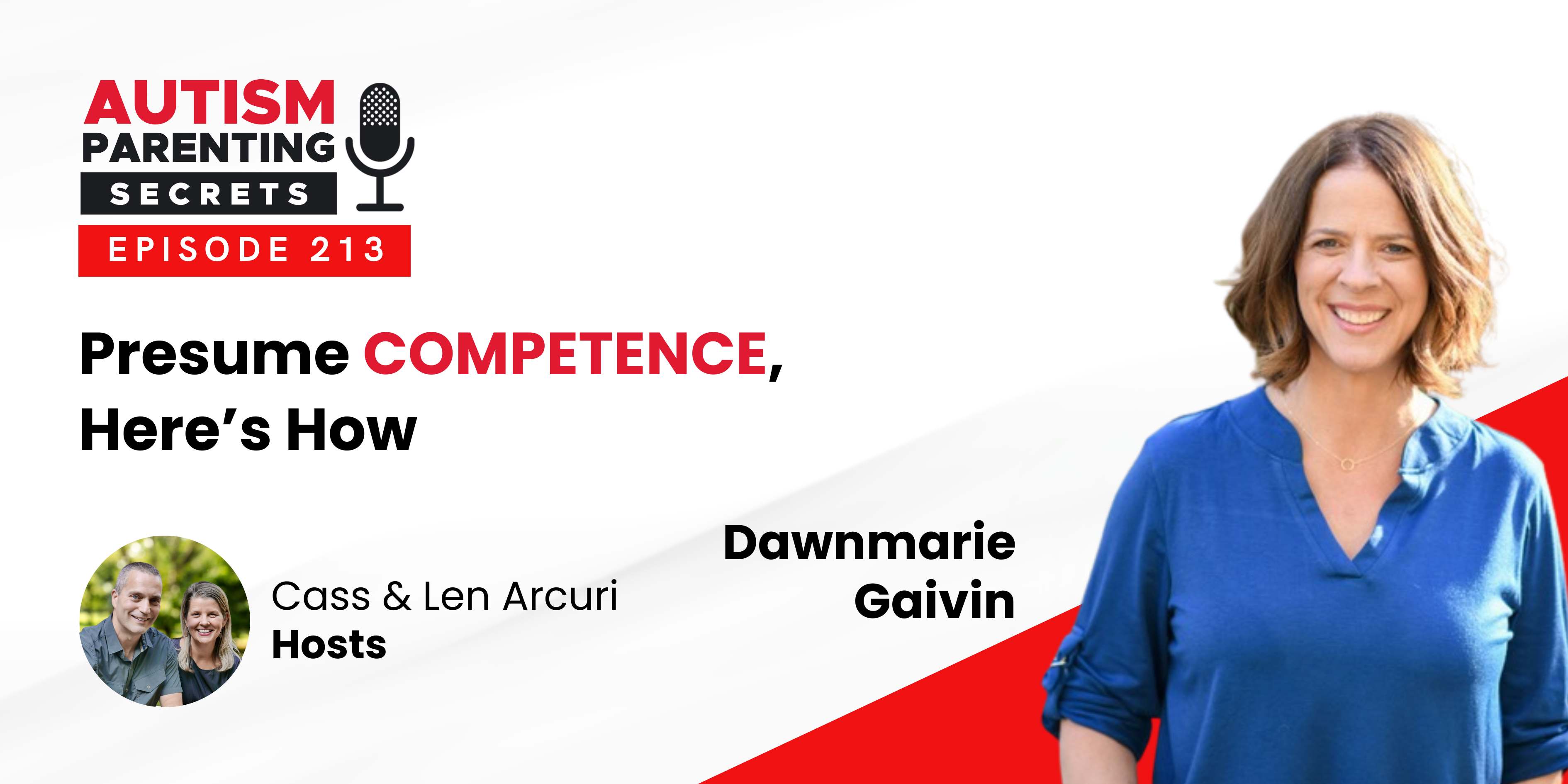
Episode 213 — Presume COMPETENCE, Here’s How
Guest: Dawnmarie Gaivin • Date: July 18, 2024
Episode Overview
Dawnmarie Gaivin, the inspiring founder of Spellers Center San Diego, joins us. Dawnmarie's children inspired her specific passion to support all nonspeakers in the development of purposeful motor skills and a reliable form of communication. Dawnmarie’s work was featured in the 2023 documentary SPELLERS, which revealed how spelling and typing can truly liberate nonspeakers.
About Dawnmarie Gaivin
Dawnmarie Gaivin is the Founder & Executive Director at Spellers Center San Diego, located in Oceanside, CA. Before her career moved into the world of nonspeaking autism, Dawnmarie worked for over 11 years as a trauma & transplant RN.
In 2005, her first son regressed and was diagnosed with autism. A year later, her second son followed the same path. Today, her eldest, Evan (20), is a nonspeaker and fluent letterboard communicator. Her younger son, Trey (19), is a minimal speaker who uses multiple modalities for effective communication.
Dawnmarie is a former DIR/Floortime® provider, cofounder of the Spellers MethodTM, and is currently an Assistive Technology Specialist (AT-ACP) as well.
In March 2021, Jamison Handley, a speller, and his dad JB wrote a book entitled "Underestimated" about their journey learning how to spell to communicate with her. In 2023, the documentary SPELLERS was released - now available on YouTube - showcasing how spelling and typing as a method of communication have liberated many nonspeakers from a life of silence.
Dawnmarie's" children inspired her specific passion to support all nonspeakers in the development of purposeful motor skills and a reliable form of communication.
You’ll Discover
A Powerful Approach That Defies Skeptics (3:37)
The Pivotal Role of Motor Skills (11:51)
Language DOESN'T Require Speech (14:52)
The Magic of Top-Down Regulation (16:50)
The Brain-Body Disconnect (20:03)
Who's A Fit For The Spellers Method (23:01)
We See What We Believe (28:10)
Why You Want To Be A Motor Coach (29:41)
What the Spellers Method Looks Like And The Best Way To Start (39:52)
The Three Phases of the Spellers Method (45:28)
Why You Want To Rethink Expectations (51:41)
An Important Thing To Keep in Mind (55:36)
Referenced in This Episode
The documentary Spellers on YouTube
Autism Parenting Secrets Episode 38 - Your Child Understands EVERYTHING with JB Handley
Autism Parenting Secrets Episode 140 - 26 Letters = INFINITE Possibilities with Elizabeth Vosseller
Full Transcript
Dawnmarie Gaivin | 00:00
You don't have to have speech in order to have language. And so the presumption of competence that we have with all of our non-speakers and students is that You may not know the information that I'm about to teach you in a spelling lesson, right? I don't presume you have all the knowledge in the world of even the same age seven-year-old, but I 100% presume you can learn it and that you want to learn it. Despite whatever it is your body is doing, right? The body might look like, I want to go home. I'm trying to crawl under the desk. I don't want to sit in the chair. All the things that we've interpreted through a lens that we've been taught, that this is behavior. This is them communicating. They're not interested. This is, you know, whatever. When once I've spelled with hundreds at this point, hundreds and hundreds of spellers who've become totally open-ended on the letterboard, they're like my gosh, that is literally just my nervous system, like going haywire because it's so exciting.
Cass Arcuri | 00:59
Want to truly be the best parent you can be and help your child thrive after their autism diagnosis? This podcast is for all in parents like you who know more is possible for your child.
Len Arcuri | 01:10
With each episode, we reveal a secret that empowers you to be the parent your child needs now, saving you time, energy, and money, and helping you focus on what truly matters most, your child.
Cass Arcuri | 01:20
Welcome to Autism Parenting Secrets.
Len Arcuri | 01:22
Hello and welcome to Autism Parenting Secrets. It's Len. And today I'm joined by Dawn Marie Gavin, founder and executive director of Speller San Diego in Oceanside, California. Dawn Marie was a trauma and transplant registered nurse for over 11 years. And in 2005, her first son was diagnosed with autism. Followed by her second son a year later, her eldest son, Evan, who's 20, is a fluent letterboard communicator and her younger son, Trey, uses multiple communication methods. Don Marie, a former DIR floor time provider and co-founder of the Speller's Method, is now an assisted technology specialist. In 2021, Jameson Hanley and his dad, JB, wrote Underestimated about their journeys learning to spell with her. And JB shared that story, by the way, in episode 38. Definitely listen to that one in addition to this one. And in 2023, the documentary Spellers that's now on YouTube showcased how spelling and typing have liberated many non-speakers. Dawn Marie's passion to support non-speakers in developing motor skills and reliable communication is what she's all about. And you can learn more at www.spellers.com. And she's with us today. And the secret this week is presume competence. Here's how. Welcome Don Marie.
Dawnmarie Gaivin | 03:03
Thank you so much for having me.
Len Arcuri | 03:06
Well, delightful having you. We've covered this exciting news through a couple of different podcasts with your crowd, your people. And I just don't think we can talk about it enough. Because at least from my standpoint, This is a gigantic news story. That even with the documentary and all of your efforts, it's just not getting the attention it really warrants in my.
Dawnmarie Gaivin | 03:30
Opinion. - Right? It's funny when I think about, and I know we're gonna really deep dive into the topic, but if I'm a parent out there and I think I know my son or my daughter or my child And I hear about this for the first time, I instantly, for me, I'm going to go to, well, that's good for them. Of course, the, you know, that child could learn to do this, but I know my child can't do this. And this is why I believe that's true.
So, presuming competence or just even thinking spelling could be an option for someone else's non-speaker. Some people have a burning bush moment. They're like, they see the film and they're like, yes, I see it. Now I understand everything clearly. And other people, it's more like the educational variety. They need to audit a little bit. They need to watch other people learn to spell. They need to listen to podcasts like this and start doing their I call it cognitive dissonance, right? I love it when parents come to me and one parent's all on board, burning bush moment. And the other parent's like, I don't think so. I'm like, it's great. Let's talk about it, right? Let's talk about it and come to believe in your own time and terms. And so anyway, I'm happy to play whatever role I play in people seeing the future of possibilities.
Len Arcuri | 04:44
Right. Fantastic. Walt. Two concepts, right? There's doubt in two ways from a parent perspective. One is doubt that this whole method, this spelling to communicate now, it's gone by a few different names. It's been around for a little bit, but that whole method. Approach just doesn't work or it's fake, it's not real.
So there's a doubt in terms of the modality. And then even if you get beyond that, we think, okay, this could be effective. Then what you're saying is you run into parents all the time who have doubt that their child will be able to do it as if the ones who are able to do it are somehow, you know, have some skills that their child doesn't have. Is that fair to say there's doubt on both sides?
Dawnmarie Gaivin | 05:33
Of course. And I think it was JB who said something, whether it's in the book or in a podcast he did, where hope is a dangerous drug, right?
Like, and as parents who've done so much to support our children's health and well-being and communication development, all the things, regulation, you just get to a certain stage or point where you think, I just can't. Dig deep again to chase another elusive white rabbit.
Like, is this an elusive white rabbit? So that I totally understand.
And then the methodology, the skeptics out there, there's a small but very vociferous crew of people who've actually made it almost their career to discredit methods of spelled and typed communication. Because the original method that started 25, 30 years ago involved physical support of a speller as they move their hand towards the letterboard. Which could be easily influenced if the person was not properly trained, right? If they're properly trained, it actually is a valid method. You're supposed to, I'm not trained in it. Let me disclaimer that, but I understand. And I have colleagues who do it. You provide resistance to the person.
So they're actually, you're giving feedback to their sensory motor system. And so they're able to better control that motion. But understandably, if it's not done properly, someone could totally just move a person's hand around.
So that goes, A group of people who've been actively trying to fight against that particular approach have now generalized it to say that every single method of spelled and typed communication has been debunked. And that's not true. And in most of these other methods, there's no physical support. The speller has to move their hand volitionally towards the letterboard. And we do all the motor coaching to get them successful at that, you know, so yeah.
Len Arcuri | 07:19
Got it. Well, and just the, Dive a little bit deeper into this just because I'm curious.
You know, so you said there's a vocal but very small minority, very few people who are passionately kind of against. What do you think's behind it? Is it that they are just skeptical? Is it that it didn't help their child, therefore they didn't? Don't want to, you know, They want to prevent parents from going down a road they think won't help. What do you think's behind the opposition?
Dawnmarie Gaivin | 07:47
I mean, I'm sure it's multifactorial, right? There's got to be a little bit of all of those things. But I think, so there's been some cases of influence. By the way, I can influence you right now by giving you a dirty look. And you're going to think, like I'm going to influence your thinking, right? And you might say something different based on me giving you a dirty look, like something's wrong, what's going on. I can influence a person, you know, neurotypical person with my communication.
So Influence itself is ubiquitous in our environment. So I'm sure there's cases, and I know there are cases of, yes, there was influence in a person's spelled communication. And so they're using that to blanketly say, you know, then all of it is ridiculous. But let's look at like medications and how many like, things that go wrong. X number of people can die from this medication, but the medication can still be on the market. I'm like, so, you know, You don't throw the baby out with the bathwater. If like there's something that's wrong, we have to put in safeguards to make sure we're protecting the most marginalized portion of the population who we're trying to serve. However, it's not to say that the whole method doesn't work. In fact, I think that does more harm than good. Right. But I think it takes a lot of humility to admit that maybe you've based your whole career on a premise, for instance, the whole ABA industry is based on the idea that we're not presuming competence. We presume the children don't understand and that they're not capable and therefore we have to teach it all to them. And so if we're saying, no, they do understand. They just can't prove to you they understand because no one's taught them the motor skills necessary to follow your directions or to point to the correct flashcard.
You know, it's like it flips everything upside down. So you have to have some humility to go, wow, I've published papers on this. I've made all these assumptions. I've, you know, I got to pivot and that's hard for some people, but I don't, you know, I don't know any of these particular critics personally.
So it's not fair for me to like pretend to get inside their head. But I think those are the two major things. And to be whatever. There's money involved in big industries that are very motivated to keep things the way they are to support systems that are in place.
Right? So, and we're talking about a revolution where we're like, hold up, we got to do everything differently now because these kids are in there. They can learn to communicate through letter boards and keyboards, and then they get to have a say in what they want to do with the rest of their life. Which is pretty rad when you're a parent, you're like, yeah, I don't want to pick the shirts out for the, like, I want them to, I want to know what they want to do with their adult years. It's amazing.
Yeah.
Len Arcuri | 10:25
No. And yeah, what you're touching on again is gigantic news, something we didn't know truly. And it's easy to, in this world that I know, you know, but two children and all the work you did to try to find answers. There's so many interventions, there's so many roads a parent code can go down. And I know I was very skeptical about everything. I thought everyone was trying to reach into my pocket on stuff that wasn't really going to help.
So it's good to have a healthy skepticism, but I think what's now happened is that It's not a couple isolated incidents where this modality has unlocked who these kids and adults really are. And that's why the game has totally shifted, our landscape's totally shifted. And again, people I think just don't understand the magnitude of it.
So you, when you were talking before, brought up the concept of motor. And I know that's so key in understanding this.
So can you give a little bit of 101 on motor? 'Cause I think if parents are listening, you may have heard this in terms of some of the services that your child may be getting, like occupational therapy as an example. But the concept of motor, gross motor, fine motor, Can you just assume somebody doesn't know anything and really just explain that concept? Because it's super important to understand why spelling to communicate in this modality is so incredibly powerful.
Dawnmarie Gaivin | 11:49
Yeah, thank you. So Dana Johnson, who is a PhD occupational therapist, my business partner within Spellers, she has a clinic in Tampa. She's an OT. And so together with my parent background, my nursing background and my assistive technology, and we both were trained originally in spelling to communicate, we started joining forces because we realized we can reach more non-speakers with even more complex motor profiles, meaning we Children with extra disabilities like Down syndrome and cerebral palsy and all sorts of variations of things that impact their ability to on demand, meaning when they want to do something, volitionally move their body in the direction they need to go, right?
So we realized that there's this whole wealth of research and information and that we could adapt it and implement it within our spelling protocol, which is where Speller's method was born from, is to start addressing the individual motor profiles and the developmental optometry, like the eye movements, because To your point about fine motor versus gross motor, you know, your big muscles like your arms and your legs, those are considered gross motor muscles. They're easier for your brain to move, right? They move much more. It doesn't take as much of the motor strip in your brain to move them purposefully. To move your digits, your fingers, or to move your eyes or your articulators, which is like your lips, your tongue, your jaw, all the things that make speech, much more difficult those are considered fine motor muscles and so our kids who are non-speaking or even minimally speaking my son trey is a minimal speaker or unreliable that could be somebody who has a ton of speech by the way but they're scripting or they're talking about things unrelated to what's happening right now repeating phrases from old movies whatever it is right All of those people have some level of apraxia or dyspraxia where there is a breakdown somewhere from the motor strip to making those muscles move purposefully. Right.
So people will think like my child's vision is fine. They can navigate, they can play their game on their YouTube. I'm like, well, that's one situation with one thing. And they're able to do that because they've practiced really hard at it. But can they, when you say, hey. Go get your backpack. Can they turn orient their body and get their eyes on the backpack? Because by the way, your body always follows where your eyes go first.
So that's one take home tip today is if you want to motor coach your child in any way to do something, to follow a direction, start with, Hey, get your eyes on the doorknob or Hey, get your eyes on the seatbelt buckle, right? Like whatever it is you need them to reach for or do something with coach their eyes, like tell them what to do with their eyes. And you'll see, It makes it that much easier, not perfectly at first, but that much easier for them to start executing the sequence of steps. And so... Speech and language, people have erroneously thought, and this is a big part of presuming competence, right? People have thought all the time, for years and years that if you didn't have speech That meant you didn't have language. When really, like the sound of my voice right now, you're listening to it and it goes in your ear and it goes into a part of your brain called Wernicke's area. And that's where your brain goes, I hear that. Those are speech sounds. Those are words. And it's your expressive language center and it's processing. It's processing the auditory input.
And then the signal travels down your brain to Broca's area. And now you're having thoughts and ideas about what I'm saying, but you're not talking yet. You're listening to the podcast. But that's your, I'm sorry, that was your receptive language. This is your expressive language now in Broca's area where you're having those thoughts and ideas. I don't know you're having those just like our non-speakers. I don't know for sure you're having those thoughts and ideas unless you have a way with motor planning, with muscle movement to communicate. That could be a dirty look, like I said before. That could be through typing, through texting, through speech, through any number of things, but you have to move your body purposefully and intentionally in order to communicate those thoughts and ideas. And so that all is language. This talking stuff is speech.
So you don't have to have speech in order to have language. And so the presumption of competence that we have with all of our non-speakers and students is that You may not know the information that I'm about to teach you in a spelling lesson, right? I don't presume you have all the knowledge in the world of even the same age seven-year-old, but I 100% presume you can learn it and that you want to learn it. Despite whatever it is your body is doing, right? The body might look like, I want to go home. I'm trying to crawl under the desk. I don't want to sit in the chair. All the things that we've interpreted through a lens that we've been taught, that this is behavior. This is them communicating. They're not interested. This is, you know, whatever. When once I've spelled with hundreds at this point, hundreds and hundreds of spellers who've become totally open-ended on the letterboard, they're like my gosh, that is literally just my nervous system.
Like going haywire because it's so exciting or because I'm nervous or because I just met you. And it was just a lot to take in. And you're talking to me like a typical seven-year-old and asking me to do all these things. And I have, past experiences that didn't go well with new teachers and whatever it is that things come out sideways. But within one or two sessions, these same kids who've never sat through a single like ABA session without constant reinforcement are sitting most of the time sitting and doing these lessons. And ABA therapists will come and observe and be like my gosh, like how did you get him to do that for 45 minutes? I'm like, yeah, Top down regulation. I'm feeding his brain. I'm like, I'm not asking him to point to the same colors over and over.
Right? Like I'm presuming he knows his colors because ABA has been drilling it. I'm not trying to knock ABA by the way. I literally just had a call last night with a BCBA to help me with some things.
Like I love ABA. Quality ABAs. This is not a knock on them. Just in the sense of if you don't understand motor planning, ABA has been kind of traumatizing to a lot of non-speakers. And that's why in the neurodivergent community, there's a lot of pushback about ABA because they're like, they don't presume competence and they make us do these things over and over again, but nobody's teaching me How to do the motor planning so I can prove to you I understood it.
Right? That's a little bit about the motor versus the cognitive.
Len Arcuri | 18:21
No, that's fantastic. And yeah, I think what you're touching on is this concept of a root cause. There's a root cause that's in the way of speaking.
You know, so why non-speakers may be non-speakers. There's some root causes that are at play, and I'd love to focus more on some of that. And that's where something like ABA, which I agree with you, I mean, I think there's so many fiefdoms and back and forths, this versus that, very black and white polarization. But, you know, again, there's a place. For ABA in terms, and it really comes down to that particular therapist, right? That personality is so important compared to whatever method. But ABA really by definition is looking at the symptoms and the behaviors and it's looking to modify behaviors. Whereas there's really nothing root cause about ABA. And so I think that's where, okay, parents, In addition, it's going to be really useful for you to have some curiosity about what's underneath, what's the root cause of whatever it is that your child is exhibiting that you're wanting to help them with. And when it comes to speech and non-speakers, the key, a key root cause is this motor issue.
So you touched on that to explain to people. Anything more you want to go into in terms of, you just had to bottom line it as a what's a root cause of why my child is a non-speaker? What would you say?
Yeah.
Dawnmarie Gaivin | 19:48
I mean, the root cause, again, I don't know right yet. Like we haven't done enough functional MRIs or whatever to say where in the brain is there some sort of disconnect, but that is the layman's term. And you'll hear spellers use it too. There's a brain body disconnect in the sense that they're making a plan.
Like when you want to move your body, You literally have to make a plan like, hey, I'm thirsty. I'm going to go get a glass of water after this, right? Yeah, there's fresh water in the fridge or I could use you're making a plan. You're thinking about it. You're organizing it in your mind. Eventually, you have to get up out of your chair. You have to initiate motor movement with your body to go towards the kitchen, walk, take all the steps, open the fridge, reach in. Let's say somebody distracts you and you miss. You have to turn and adapt and grab the correct bottle open. And pour, stop pouring, inhibit when you feel, you know, all the things that if you don't have apraxia or dyspraxia, which is difficulty in motor planning, then you take that stuff for granted. You do things all day long, just simply having an idea, like I'm going to do this and you do it and you execute it. And we underestimate that. How hard it is for our kids to do even the thing they executed perfectly yesterday to do it again today. Right. And so we say in apraxia, it's consistently inconsistent. And that's what leads people to be very confused because they're like, okay, on Monday and Tuesday, when I said, go get your shoes and put them on, he did it right away. On Wednesday, he ends up crossing the room and doing this whole other thing. He's just being naughty, right?
Like he just doesn't want to do it today. And we've learned no, until he's practiced that exact same motor plan X number of times, it's not automatic the way it would be for me and you to go grab our shoes and put them on and whatever. And so that's, Without knowing exactly where the breakdown is happening from the motor strip to the body, we know it's happening. But we know that there's a solution.
So even without fully understanding the root cause, we know that by practicing purposeful motor, that you will remediate. The problem because of neuroplasticity. Right. Because the brain can make new neural connections. Let's just say there's a damage.
Like, let's just say there's some part of the brain that just isn't firing the way it should. And maybe it never will. The brain can actually create new neural pathways and bypass it. Right.
So our first step here is that we're going to bypass the articulators and literally use the gross motor of someone's shoulder. They're reaching forward. You can't quite see me on here, but reaching forward from the shoulder to poke, even though their finger might be extended or they're holding a pencil. They're not really using their fine motor muscles of the digits. They're just moving their shoulder and their arm.
So we're lowering the motor demand on the brain. They still have to use their eyes to differentiate between all the letters. And that's why kids don't just start off right away spelling to communicate because they misspoke. They hit all the wrong letters. We have to coach them. We have to actually teach them like a baseball coach. This is how you hit the ball with the bat.
So this is how you find the A with your eyes and then you reach forward and you poke it, right? And we got to practice that simple motor plan over and over again. We're not teaching them how to spell, by the way. We're teaching them how to scan with their eyes and poke letters in order, which do happen to spell words that we pre-taught to them. You don't have to know how to spell in order to start this method, just so in case people are listening. But I spent three years, my son threw me under a bus politely, but in underestimated where he said, my mom spent three years trying to teach me how to spell before she finally just went to a provider and had them teach her what to do. Thank God. Right.
Cause I was like, he couldn't get it. He could, I mean, he knew how to spell, but he could not manipulate the little letter tiles. It was so much fine motor work and Evan's pretty apraxic. He was like, He just could never master it. And I thought, I'm not going to waste my money going to see this provider if he can't even spell his favorite things, right?
Like that was my mindset. And little did I know that I was just wasting three years. When he totally knew how to spell. He needed bigger targets. They needed to be held up. He needed to use his shoulder, not his digits, like all the things that I did wrong. But Anyway.
Len Arcuri | 24:04
So you don't need to know how to spell to be able to start the process. So given that, we had some clients who started last week and they have a four-year-old and they were asking specifically if that's too young to even start spelling to communicate.
So in terms of who's a fit for, what have you seen? What's the youngest? And I know there's no age limit.
Dawnmarie Gaivin | 24:24
There's definitely no upper limit to how old a speller can be. I will assess kids as young as four.
So will Dana. So will my colleagues here. It's a big ask on the parents because those sessions look a lot different than the ones you saw in Spellers, the movie, which is on YouTube now, by the way. Those were adult or, you know, young adult Spellers in that film for the most part. A four-year-old session looks a lot like an occupational therapy session because four-year-olds are meant to be exploring the world with their body. And so they are smart enough to start this lesson. And you're right. They may not have had exposure to all the words and all the language that's out there. However, every fluent adult speller that I know tells me they could read by the time they were two and a half. Usually it's two and a half or three. Their brains are wired differently. We do know that from the research, right? They're wired differently. And there are some really amazing gifts that come with that. It's hard for neurotypical people to understand. They want to phonetically cue their child.
Like they've got a board down and like, get the B. I'm like, stop doing that. You don't have to do that.
Like just coach their eyes up over one, you know, tell them what to do with their eyes and their hand. Don't coach their brain. Don't coach their cognition. They know what the B is. They've seen it.
So in that respect with a four-year-old, I would choose a book or a lesson that is appropriate for a four-year-old. So the words would be much more simple, more concrete as I would with any other four-year-old, but we might be doing an obstacle course for And finding the post-it notes on a wall and then moving them across the wall and spelling the word out with the post-it notes and then spelling that word out on the board. Right.
So it can, the format looks different. And so what I say is it's a big ask on the parents because the, acquisition phase of learning the motor skills takes a little bit longer than it does with a, adult regulated. I can sit in the chair for 45 minutes person and take adult instruction. But it's amazing if you've got a kiddo who's fluently spelling by the time they're seven, like seven or eight, but it's longer, right?
So it's a longer stretch of time. And if your child is still dealing with a lot of sensory integration stuff, you might say, hey, here's what you can work on for now.
And then see this OT, work on this, keep feeding their brain with age-appropriate books. Don't just let them read the same...
You know, Dick and Jane book over and over again. They can do that in their spare time to play in STEM. But when you're engaging with them, keep reading to them, fill their brain with vocabulary and work on the OT and the sensory stuff, and then come back in a year, let's reassess.
So we will totally, you don't want to miss the boat. You feel like you're missing the boat, right? You want to know if now is the right time, go get an assessment done by a provider and So eight times out of 10, we're going to say, let's just do it. If you're ready and you're ready to practice at home, let's go for it because the payoff is amazing.
Len Arcuri | 27:18
Yeah, I know a lot of key concepts that you shared in that and touching back to the concept of presuming competence, right? Where the – to constantly raise the bar, right? Even if your child does STEM and my son absolutely loved going to real, you know, much younger books and going over and over. But at the same time, he was taking everything in. And so it's okay to raise the bar and presume competence and bring more advanced reading, you know, and again, not just – not just assume that your child's not ready to advance and to take more information in.
So I think, again, what you're touching on keeps going back to the fact that What we see with our kids, with these kids or these adults, has nothing to do with what they're capable of. So if you're looking for visual evidence, You know, just drop that.
Dawnmarie Gaivin | 28:09
Right. Well, we see what we believe. Right. Often we're kind of wired that way to go, OK, I've been told by multiple triennial IEP teams that my child has an intellectual disability.
And then my evidence is when I ask him to do X, Y, Z. Two out of three times, he can't follow my instructions.
So I start thinking that's a language delay, like an expressive language delay. And you have all these reports that say that. In fact, we just published the first season of Underestimated TV and episode one is about Madison.
So she's in the original documentary, which is, as I mentioned, for free on YouTube. And, she's so bummed that she missed out on her public education experience because she has two sisters. There's three girls in the family and she's the middle. And she watched them get to go to regular school and go to high school and graduate with their diploma and get to college. And she was just so bummed because she's so smart, but nobody knew it. Because she's an unreliable speaker.
So she can talk, but the things that come out of her mouth are unrelated half the time to what's happening and going on. And people equated that to be, well, that's got to be her IQ level. And if she's scripting about something that's kind of a younger child script, then they equated, right? And she wasn't passing the motor-based IQ test because by the way, IQ tests are all motor-based.
So we think we're measuring cognition, but in order to pass or to get an accurate score, you have to put the thing in the thing or point to the card that says this. You have to do motor skills. And that's why learning how to coach your child's motor planning is so important to them embodying their potential, right? And learning the motor skills that then proves your new belief, because presuming competence starts with a belief, right? That, okay, my child can learn to do this and wants to learn to do it despite what I see going on here.
So despite what I see, they can and they want to learn. And now what I got to do to help them get there is motor coach.
So instead of just repeating over and over again, hey, go get your backpack and shoes and expecting a different result. I'm going to say, hey. Your backpack and shoes are over there. And I'm going to gesture. I'm like, turn your body, get your eyes on the, get your eyes on the backpack and keep coaching and say, okay, now take a step, move your feet, walk. Okay. Now bend over, bend at the waist. I literally in my head do this motor task analysis of how many steps does it take to execute, go get your backpack.
And then I coach wherever the breakdown happens, right? So if it's initiating, which is the case, That's the hardest part of motor planning for most of our spellers is initiating. The other hard part is inhibiting. And if you've ever seen my, well, you've seen my son at a conference this year, he's My kids are like the energizer bunnies.
So they're constantly going. So inhibiting for them, they don't struggle with initiation. They struggle with stopping their bodies. And so it's one side or the other usually, right? But that's the two ends really of motor planning. And that's what they need coaching on.
So with my son, I'll be like, okay, hold your body, stay still, like don't reach, whatever the thing is. And he's learned as he's gotten older how to do that. And it allows, it actually opens more doors for him. He graduated with his high school diploma a couple of weeks ago from our local high school and I would never ask him to not stim or whatever, but he got so serious. He's like, mom, I just want to blend in. I'm like, buddy, you don't have to blend in. You can just be you know, but he didn't want to, it's pure, it's peer pressure, right?
Like he wanted to fit in with all the other kids that were walking in the processional and he had his communication partner with him. And he did amazing and he held it. He did not impulsively get out of his chair one time he did. And it was a long ceremony, right? With, 400 kids or something graduating from the high school. He did so great, but that's as a result of the motor coaching, right? And even practicing wearing his cap and gown, we literally, cause I'm like, it's going to be sensory. Defensive to wear a cap on his head.
Like he's not going to like it. He's never worn a hat. He hates them. And I was like, buddy, I know this is important to you.
So let's practice. And he would walk around the Speller Center to where all the neighboring businesses started giving him graduation gifts. Because they're like, I know you're graduating because you're practicing the processional and wearing the cap and gown. And that's some of the stuff we have to do in presuming competence. I'm like, he told me he wants to do this. I'm here to help him whatever his goal is. Right.
And then to break down, well, what are the steps it's going to take for his body to be able to do it and for his spirit to be able to do it? Right. We can have a growth mindset, but we have to have strategies to go, okay, we know where we get hung up.
Like, what are we going to do when we hit that spot? Right. And he crushed it. And that's what spelling opened up for us.
I mean, I didn't know how to motor coach. I didn't even know that was a thing. I thought OT was just this fun place my kids loved because they had ball pits and did all this swinging and got sensory input. To know that OT through the lens of someone who's trained as a spelling communication partner, it's a whole different ballgame that allows kids to really become the autonomous adults that we want them to be and that they want to be.
Len Arcuri | 33:16
Yeah, no, I'm just so delighted for him and for you. And just there's so much in that story. And the fact that he. Had the awareness to want to, you know, to behave in a certain way to fit in, like there's nothing wrong with wanting to fit in. And the fact that he maybe wanted to jump, like my son would want to jump up and down, you know, and do all that. And the fact that he. Had that awareness, so he knew he could do it, but he made the choice to kind of morph it in, as opposed to trying to force him to be something he's not. Right.
So it's all about agency and these kids being the amazing souls that they are and just equipping them with the ability to communicate and to make their own choices in terms of how they want to be.
Dawnmarie Gaivin | 34:04
Totally. Because yeah, I don't want him to think like, masking is the expectation here, right? You can't, that's what I'm getting at.
Yeah. You can't be who you are. I was like, buddy, please know that all of us want you to just be authentically you. He's like, I understand. And I love you, but I don't want to jump up and have the kids in my row.
Like, give me the look. Cause during the rehearsal that morning that I did go to, cause you know, like the mom's than dads that we are. I wanted to make sure I'm like, his name is on the list, right? You've got a chair, like whatever. I got to cross the T's and dot the I's. He jumped up several times, you know, and I was there to mitigate like the questions and comments from, because these kids didn't really know him. His learning centers sometimes were mixed in with the gen ed kids and sometimes were in different parts of the high school. And so I just made sure they understood him so that they would be Honestly, giving loving energy to him while he sat there to help him stay regulated. And they were awesome.
Like the kids were awesome. He did great. It was just. We have a long way to go when it comes to getting letter boards in schools and just accepted worldwide. But it starts like this, right? It starts, he's the first kid, as far as I know, to graduate from his high school who uses this form of augmentative and alternative communication. And there's been times where neighboring districts were going to sue my district because of letting kids have letter boards. And I it's, contentious out there and it doesn't need to be. We're just, we're changing these people's lives. And by the way, there's no better alternative for them, right? There's not a better program for them than learning to spell in order to get your diploma. It's not like we're giving them surgeon's licenses or pilot's licenses.
Like, it's a high school diploma they're entitled to legally under the Americans with Disabilities Act. Like, it's... This, we're just helping make it happen. And somehow there's still pushback, but I'm hopeful that with this revolution and awareness and whatever, it won't always be this hard for every family that follows.
Len Arcuri | 35:59
Well, and that's why we're having this conversation. The more understood this is, it will help accelerate its use and adoption. And like anything else, change happens so slowly in institutions like schools. And I know a lot of parents are interested. They want to learn more about it.
So I'll ask you just to explain a little bit more in terms of the process. And I know you've touched on some of it already, but I've had several parents ask me, they're aware it's a motor issue. That may be behind the fact that their child's a non-speaker.
And then outside of doing spelling to communicate and working with someone like you, what can they do generally at home outside of this program to just help with motor? So can you touch on a few practical things that parents can just kind of, if there's an opportunity to improve there, what they can do?
And then afterwards, if you can explain how spelling to communicate like sequence-wise and what it would look like for a parent who would want to do that with their child.
Dawnmarie Gaivin | 36:57
Sure. So Dana Johnson and I last year wrote the Speller's Guidebook. And Skyhorse Publishing put it out in November. And in it, we'd go into a lot of this detail.
So I'll go in it sort of at 40,000 feet here, but there's more information in the guidebook. And on our website under spellers.com, the resource tab, you'll find a library of what we call intentional motor exercise videos. But what's important to note is It's not just a matter of, so this is something parents can do right outside of spelling or pre-spelling even. It's not just about getting your child to accomplish the thing.
So let's just say, and it seems so arbitrary, like how does doing pushups with a weighted bar work? Help my child communicate. You're thinking like, how are these two things related? And that's where I'm talking about neuroplasticity and making pathways in the brain that actually gross motor in children develops before fine motor. You learn to crawl before you learn to do your pincher grasp. You're crawling before you... You're rolling over, you're crawling, you're sitting up, then you're walking, then your fine motor is developing. You don't even actually... I think it's four years old I should have Dr. Susan Daniel say, but it's four years old before your eyes move independent of your head.
So like if I'm chasing a ball and I'm a toddler, I turn my whole body in order to chase that ball. I am not ever moving my eyes separately because that's how hard it is. To move your eyes volitionally like that. They move everything. And you'll see adult spellers do that.
Like when they're first learning, they, when they need to move their eyes up, they go like that. They move their whole head up. They don't move their eyes independently because the fine motor still needs some development.
Right? So. Working on these intentional motor exercises, like even weighted bars or step ups or whatever, we walk you through in the videos how you would coach someone to do that. And It's not about just getting it done. It's about slow practice. It's about control. It's about them being able to initiate. It's about you eventually fading the visual, meaning you're not doing it with them. At first you do till they learn it.
And then you're fading it back to being just a verbal or account and that they're learning to do the initiation and the inhibition all on their own. And so it's gross motor, but it supports the fine motor development.
So that's why those exercises, which are free, I'm all about free resources, by the way, like as a single mom, when I had to start doing this, that's why I was trying to teach Evan how to spell. Cause I said, I don't have the kind of money to like see someone every week. And I'm here to tell parents who don't have that kind of money either, you don't have to see someone every week in order to do this. It's lovely now that there's actually 300 or 400 providers out there. But back then there were like six in the country.
So there wasn't even an option for anybody to do it like that, really, unless you lived in their hometown. So you can learn to do this. We always recommend you get your initial assessment by a provider because there's a few different boards we could start you on in our job because we understand all the sensory profiles and all the motor profiles to figure out what would be the best set of three boards because we divide the alphabet onto three boards right at first. What's the best set of boards that's going to help your child get through the acquisition phase? Most efficiently and most successfully.
So fast, right? Not that it's a race, but we want to make sure we've picked the right board for you. Because for example, in fact, I should have had it right here. If you have some difficulty and you need high contrast, you might put paper behind the boards where everybody else doesn't have that behind the boards at all. They're just poking through a pencil through a stencil. We love this. This is the gold standard because you really get that shoulder motion going, right?
Like, and whereas this, you can kind of get into this where you finger hop and, but like, I know how to figure out if you're not going to get anywhere without this, I'm going to prescribe this board for you. Right.
And then you can go home and start practicing at home. Cause we teach you how to do it. We give you the tools. We teach you how to do it. We have an online communication partner class that runs almost every eight weeks and it's got classroom time and you get an assigned mentor who gives you video feedback.
So there's lots of tools to do it from home. If you're in a remote part of the country and you can't travel with your child, like you can do it all remotely if you need to. But, and we basically work up this hierarchy from the board that has just eight or nine letters until you're on one that has 26. Now you've got the whole alphabet and we start increasing the cognitive demand of what we're asking too. We're not just spelling words and answering questions with one known answer, but we're going to start doing some once they're good and accurate, by the way, you don't move forward until there's accuracy and flow and they have got stamina, you know, core strength, whatever. Then we go to asking semi-open questions. And now you're on the brink of communication because for the first time, I don't know which of the choices you're going to pick, right? If I said, name a cardinal direction, I don't know which one you're going to say. And you spell out North, but I'm thinking South. We're like, yes, right. We're there, right. We're getting there. And we spend a lot of time at that stage because that's when it's a big moment for both the parent or the communication partner and the child to develop their own, we call it cognitive motor control, but executive functioning skills.
Like How do I know what to keep doing while I'm thinking one thing and you're doing another? And there's a little dance that's happening between you and the speller with the board. But once that's solid, you're there. You start asking questions that you don't know the answer to, but it's still a single word answer. And we build up to where they're answering in phrases and sentences. And so this whole acquisition phase, it's best when it's provider or practitioner guided, just so that Like what I did with Evan is I didn't know. Right. I thought I was doing it right. And six months later, I saw the provider again. She's like, why were you doing this? I'm like, I don't know. I thought that's what she did. And we had to fix something that I was doing wrong. I'm myelinating the wrong pathway. Again, it's not the end of the world. Evan's an amazing fluent speller today. Right. No harm, no foul. It's fine. But we can prevent that for you, right? That you're not going down the wrong trail too long. We're like, wait, hold on. You're creating a new motor loop.
Like a motor loop is when, like, for example, if we aren't coaching a student's eyes up to the A and they always hit E before A. So their hand goes here and they go here. And it becomes a loop after a while that they'll never go directly to A. They always tap E before they go to A. That's a motor loop.
Right? We don't want that because in spelling, I want it to be really clean so that by the time they're communicating, There's no interpretation required. I literally just watch you spell and I add up the letters. They become a word. I say that word. They add up to letters. They say, you know, it says a word. I say the word. If I'm trying to guess which letter you meant to hit or not, that is influence. That is what the critics out there are like. That's not okay. Right. That's totally not okay. We'll never do that as providers, but you'll sometimes see parents do some sketchy things at times, you know, and maybe because they just didn't have training or maybe because they We all get a little lazy sometimes or whatever. I can't afford to as a provider, so Evan's held to a pretty high standard all the time. But I understand.
So parent to parent, I understand. But I'm like, you got to always remember that when you're spelling in public with your child. You're a role model. You're a role model for the method. You're, or any of these methods, you're, you don't know who's watching you. You don't know if those people are advocates that are going to support and help you fight the good fight, you know, to get more options for our kids, or if they're really on the other camp, that's trying to disprove the method. And they're taking a selfie video of you.
Like you just don't know. And so, you just want to At this stage in the revolution, as Jamie Hanley calls it, at this stage, we want to practice like everybody is really watching you and use those standards. Because with those standards, there's no argument for the critics that this isn't a valid method of communication.
Len Arcuri | 45:10
Perfect. Yeah, no, and so much of what you're conveying is really just about meeting your child or the adult where they are and making this process. And it sounds like it's very structured. There's a sequencing.
So in terms of the phases, right? You mentioned acquisition. What are top line? What are the phases?
Dawnmarie Gaivin | 45:28
So acquisition is anytime you're building skills, so transitioning from one board to the other and moving up a cognitive continuum of just being able to answer questions from a lesson I read to you versus being able to communicate directly Create and communicate your own open-ended thoughts. Once you've gotten to that 26 letter board and you're doing semi-open questions and you're doing open answers with one answer, but there's still the lesson. You're still talking about the lesson. You're not in application. That's what we call phase two, which is where now I'm taking my letter board like Evan took it and got his high school diploma. He's using it as his most reliable alternative. Form of communication everywhere. The first place I took it was to the Boy Scouts with him. I was like, here, and now you can spell to the other Boy Scouts with you. And he joined his first club at that age, you know? And so whatever you're using the letterboard for, vocational, school, just to order at a menu at a restaurant, talk to your parents, whatever, that's application. Once you're fully fluent, even on a stencil board... It doesn't have to be a keyboard, right? Even on a stencil board, you can be in the application phase. But when you're trying to go to the laminate, you're back in acquisition. You need to use lessons because we need to know what we're talking about. Same with the keyboard.
So a lot of spellers aspire to be independent typing. There's no such thing as independence, by the way. It's autonomous, right? Meaning none of us are independent. We're all interrelated and codependent and all of that. Same for our spellers. I have probably eight students that are...
Some of them are two handed typing the keyboards flat on the table. And we're working on really high cognitive lessons because their goal is to go to college without hopefully without a CRP. There's a lot that would go into that. I'm here to support whatever my students' dreams are. And I'm like, you might want a regulation partner.
Like, you know, I know you might not need a communication partner, but it's still sometimes your body can get whatever, reactive to sensory stimuli or some big emotion or whatever. And it just might be nice to have someone there who can motor coach you, but they could sit across the room. They don't have to sit next to you.
You know what I mean? You could sit with all your classmates and do the thing, but we're working on these really high cognitive lessons while they're doing this high motor demand of two-handed typing, whatever. And that's like, That's high and very unique to that speller goal. I don't have too many spellers who have that particular goal, but a lot of them want to be typing independently. But that might be a keyboard that's in a cradle, like vertical, not flat, because that supports the eyes. And they're looking at an iPad screen and they're typing and having conversation and whatnot that way. Because yeah, they don't want to depend on somebody else having to be there who's trained to support and hold the keyboard. But by the way, that's the fatal flaw in the critic's recommendation.
Like, well, just put the keyboard in a stand or just put the laminated letter board on the table. And I'm like, well, that's the end.
Like that's the end of the motor continuum. That's independent typing and spelling.
So even though the laminate board comes like in the middle on the motor scale, Putting it on the table without a communication partner who's watching the eyes and coaching and can lift and reset it if their eyes need a reset. Like when you take out that person who's supporting the motor planning, that's a way harder task. Than they think it is. Right. And so once again, we're back to that. We're not measuring what we think we're measuring, right? We're actually measuring their motor ability, just like the IQ test. We're measuring their motor skills, not their IQ. If we put the letter board on the table, we're measuring their motor ability and they might be able to spell out single words. But to have fluent, robust conversations, they're usually not there until they've really practiced longer and longer moving up that motor continuum.
Len Arcuri | 49:16
Got it. Got it. And so in terms of the phases, acquisition, application, and then what's the third?
Dawnmarie Gaivin | 49:22
Maybe independent or autonomous. I said, phase.
Len Arcuri | 49:24
I'm like autonomous. Autonomous. Okay. Autonomous. There's an autonomous.
Dawnmarie Gaivin | 49:28
But again, that's not, I don't want to put out there that that's our goal. Like, you know what I mean? That's a seller specific goal. If that's what they want, then we know how to teach it.
You know, sometimes people have to, sometimes people say, we want to come see you because we've been doing this method for eight years, but my son's goal is independent typing. That's what they say. And I'm like, okay, well, I got to do my assessment and my assessment is going to start back on the boards. I'm not going to start because I got to see and make sure the foundational skills are there. Otherwise, what you're going to get in autonomous typing is going to be requesting. Which, right, this is some of the pitfalls with devices, which I fought so hard for Evan to get a device in kindergarten. And he had one. They told me he was intellectually disabled. And I was like, that's okay. He still needs a device. And we taught him with the AAC, you know, And, but he, the father, he got very fluent with it, but he's still just request things. He never went into conversations or deeper commenting or whatever, because it's really high motor. And when you go way too fast up the motor, your cognitive output gets diminished.
So, For the same reason, we got to be careful that we didn't race up to the keyboard too fast without filling in all the baseline motor skills so that the cognition isn't impacted, if that makes sense. That the communication stays as robust at the typing stage as it was at the stencil stage.
Len Arcuri | 50:47
Yep. Yeah, no, it makes sense to me. And I think part of what you covered just now in terms of what the goal is, right? I love that there's these three phases, right? And there's a sequencing to it. But in terms of where your child is and where they go, a big part. Part of this is parents letting go of the outcome because you never know exactly, you know, where your child is, what they need and where they're going to get to. I know I had to let go of these kind of crazy, we're going to. This is going to happen or I can't be happy unless it happens. Right. And that's where just parents helping their child get better to be able to express themselves more. I know that I started focusing more on that aspect. Type of goal as opposed to some definite deadline or expectation I had for my son. Because again, everyone's so wildly unique to have these rigid outcomes that you won't be happy unless this happens is a surefire way of making the journey really stressful and miserable.
Dawnmarie Gaivin | 51:46
And on everybody, right? And the good news is that once your child hits that 26 stencil even, and they're able to, for the first time, tell you things that you didn't know, and You're like, okay, we don't have to get all the way to autonomous typing for me to be happy. I can now know things about my child that I didn't know I was going to learn in this lifetime. Right. There's some special gold there. And I do always encourage a lot of parents. A lot of us parents are, I don't want to say overachievers, but we want everything. We want it all for our kids. We're like, okay, like then I want more. And remembering like, for instance, speech, Speech is amazing, but it's not the gold standard of communication. And so people will say, should I keep seeing the speech therapist? I'm like, well, prompt speech therapy is great because it works on the motor planning of the articulators. And it is a motor skill, right?
So technically it can be developed the same way I'm saying we're developing new motor pathways. I'm like, but Just be careful about the message you're communicating to your child that like you just learned to spell openly on this letter board. That's not quite enough, right?
Like we want you to develop speech because that's a little bit ableist of all of us to think like this is better. I only think it's great because it's with you all the time. Right.
Like you're like, this is always here. Like, so isn't that convenient? But if it's really hard, like walking is more convenient than being confined to a wheelchair. But guess what? If you need a wheelchair, you can't walk. Right.
So if you need spelling as a form of communication to robustly communicate, you have some speech and you can keep developing that. But we don't want to act as if the spelling isn't just there. The most amazing thing that helps you achieve whatever your individual goals are, right? Because it is amazing.
Len Arcuri | 53:32
Yeah, no, to embrace what works. And I think I talk a lot on this podcast about what is the outcome that a parent's going after, like, or what, what's their objective. And I think so many parents have shared with me and I had the same view that I really want speech for my son. I want speech. I want speech. And now when I can look back on it, speech is, really wasn't what I wanted. What I really wanted was to know my son. I wanted to be connected to him.
So making that shift and moving away from something specific like speech and just really kind of getting to what do you really want, that's the magic of what you're sharing and what you do and everyone who's been part of this. Is that It is helping families to really become connected for parents to get to know their child, for their child to actually be heard perhaps for the first time. And that's where, again, this is just such an incredibly joyful story.
So I'm so excited that you were able to share a little bit more in terms of what this looks like. And I think I know I learned a lot in terms of the sequencing and how it works. And I love the fact that you said this is something that people can largely do remotely. It's about teaching the parents how to do it. But as you're saying, like the acquisition phase to get an assessment by somebody to really see exactly where that person is definitely a best practice, correct?
Dawnmarie Gaivin | 54:57
Yeah. And it can be done over Zoom.
Like we like to, because hands-on, right? I have a superpower that is even more intense than when I'm doing it over Zoom, but I obviously have worked with enough students and so have my staff that we can see, you know, but then we got to ship you new boards and have you know, do all the little things, but it's totally, everything is figureoutable. That's one of our company values here at Speller Center San Diego. We're like, everything is figureoutable, no matter what, no matter the motor profile, no matter the parent question, no matter the critics comment, like everything is figureoutable. We can figure it out. There's a way through it. We'll dissect it. We'll motor coach it.
Well, whatever we got to do, right. We can navigate whatever comes next.
So wherever you are, whatever your child's profile, whatever your beliefs are about what they can and can't do, you know, just to circle back one last time to the presuming competence, you don't have to see the whole staircase. That's a Martin Luther King thing, right? You don't have to see the whole staircase in order to take the first couple of steps.
Like it, these things, the adopting the possibility, the belief that they can learn to do this is one thing. The learning the motor coach, what does that look like? That's the next thing. Scheduling a consult call to ask your questions or go into the Spellers community, which is our Facebook group, and just read parent comments. It's a parent-driven community.
So just learn from other Parents who have kids with autism and just be open. Be open to be wrong about whatever you thought before so that you can have a new experience.
You know, and hope just a little bit, right? Just a little bit that you can learn things from your child directly that you didn't know about them before.
Len Arcuri | 56:37
And how exciting is that? So awesome. Fantastic.
Well, Dawn Marie, thank you so much. You know, I love what you just touched on that everything is figureoutable. I love that slogan. That could be the title of this episode, but we'll stick with what we have. But it's true. There's always something you can do with curiosity, with meeting your child where they are. And again, I think this approach. Spelling to communicate and this way of actually helping us to really get to know these kids and adults. Again, just please, for anyone listening, Take this in, share it with others. We want to get this word out. And I'm just so thankful, Dawn Marie, for the work that you and everyone in your community are doing for these kids and these families.
So thank you very much.
Dawnmarie Gaivin | 57:22
Well, thank you. We love what we do.
So thanks for having me.
Cass Arcuri | 57:27
Want to learn more? Go to elevatehowyounavigate.com