
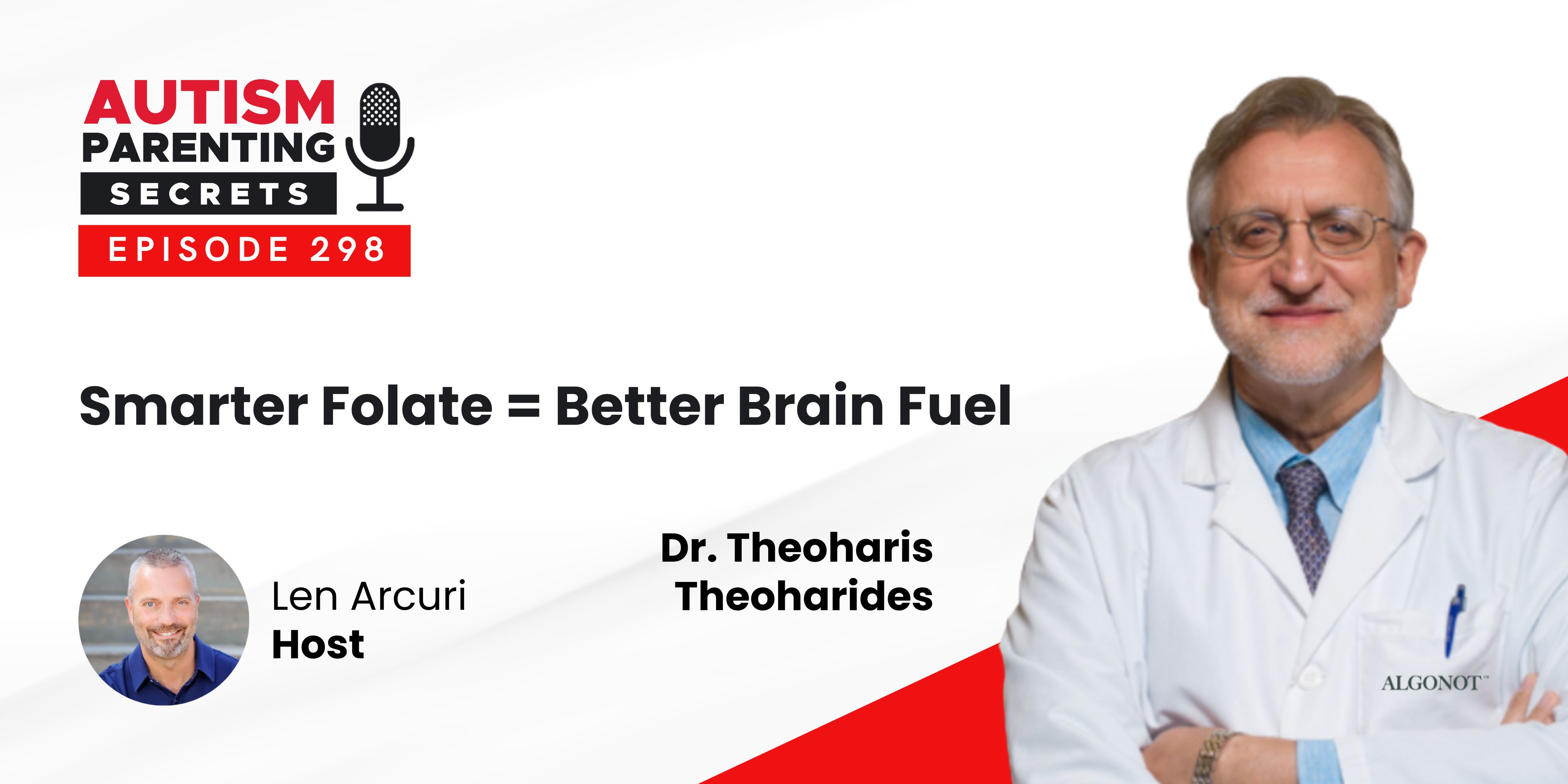
Episode 298 — Smarter Folate = Better Brain Fuel
Guest: Dr. Theoharis Theoharides • Date: March 12, 2026
Episode Overview
Dr. Theoharis Theoharides returns to discuss why the form of folate matters and how metabolic bottlenecks can impact brain health. This episode explores folate receptor antibodies, MTHFR mutations, gut health, and why precision matters before adding supplements.
About Dr. Theoharis Theoharides
Dr. Theoharis Theoharides is Professor and Vice Chair of Clinical Immunology and Executive Director of the Center of Excellence for Neuroinflammation Research at Nova Southeastern University. He is also an Adjunct Professor of Immunology at Tufts School of Medicine. Dr. Theo has over 500 publications and is widely recognized as a leading expert on mast cells and neuroinflammation. He is the Founder and Scientific Director of Algonot LLC and has received 37 patents and trademarks.
Learn more:
www.mastcellmaster.com
www.drtheoharides.com
You’ll Discover
Why standard folic acid may not reach the brain in up to 40 percent of children (9:21)
How folate receptor antibodies and MTHFR mutations change the equation (12:17)
Why gut inflammation must be addressed before increasing supplementation (18:23)
The difference between folic acid, methylfolate, and folinic acid (22:45)
Why folate supports language development but does not “treat autism” (50:51)
Referenced In This Episode
Full Transcript
Dr. Theoharis Theoharides 0:00
It's like a lock and a key. So the folate is the key has to bind to the folate receptor unlock it again inside. But what has not been known, and continues not to be known widely, is that about 40% of children have antibodies, meaning proteins that our body made, and we usually think of the antibodies as the good guys. We have antibodies to fight disease. Well, in many cases, the antibodies are not the good guys, but if those antibodies exist, they basically block the receptor. So folic acid, folate cannot just get in period.
Len Arcuri 0:34
If you're a parent of a child with autism, you are being called to rise with love, courage and clarity. This journey isn't easy, and most parents aren't equipped, but you can be. This podcast is your invitation to rise higher, because how you navigate matters. I'm Len, and this is autism parenting secrets, where you become the parent your child needs now.
Len Arcuri 0:59
Hello and welcome to autism parenting secrets. If your child has tried supplements that were supposed to help the brain but didn't move the needle, this episode may explain why. This week, I'm excited to welcome back to the show Dr Theoharis theoharitis. He is known to many as Dr Theo and he is a physician scientist with five advanced degrees and decades of pioneering research, long before neuro inflammation and immune driven brain dysfunction became widely discussed as they are now, Dr Theo was connecting mast cells metabolism and brain health. He is a true thought leader in this space, because he sees how these systems interact, and in this conversation, we explore why some children can't properly use standard folic acid, and how the right form of folate may support better language focus and regulation. So if you want to move beyond trial and error and fuel the brain more intelligently. This episode is for you. The secret this week is smarter Foley equals better brain fuel. Welcome. Dr, Theo,
Dr. Theoharis Theoharides 2:09
well, thank you very much. It's such a real pleasure to be with you again. I really appreciate your kind words, and all I can say is I keep on trying, and I learned a lot from you guys and the parents, and we tried to then introduce it back into the clinic. So wonderful. I'm very excited.
Len Arcuri 2:28
I appreciate that. And you're you've always been super curious, never you've never stopped learning. You're always trying to that is true. Better understand this space, and in that sense, I think you're a rare breed. So I'm excited for this conversation, and we're talking about folate. We're talking about this particular area. I'll I'll hand off to you as you're thinking about the parents who are listening, who want to make better choices, what is it important for them to know? And just as a backdrop, I know recently, there's a lot that's being thrown out in this space about the importance of folate, folinic acid, leucovorin being something that's been approved. And people hear that and they feel like, okay, I have to take advantage of this. But as we always talk about on this show, and I know you talk about every child so wildly unique, so knowing, instead of just throwing things at your child and hoping they stick, the precision really matters. So let me hand it to you to share.
Dr. Theoharis Theoharides 3:22
Let's start by the fact that pediatricians in general consider vitamins as an important add on, as they should, but they don't really differentiate any more than just these are the vitamins, and this is what the government has said there should be. And here is a multivitamin, pretty much. That's actually a very weak way, or poor way to go about it, because, number one, we have to absorb the vitamins. And if things are happening in the gut, and I'll get back to that in a second, they might not be absorbed. Number two, all vitamins enter various we call them pathways, ways into which they participate to help the body and the brain. But these processes, most of the time, require what they call enzymes, specialized proteins that do various tasks, and those enzymes may or may not be working properly. And as we all know proteins are made from genes, and the genes might be silent. And if the genes even are not silent, the proteins might be made by might be malfunctioning. So we have to think of that. And then, how does actually any vitamin get into the brain cells, or the cells where you will actually participate, we don't talk about that either, and in most cases, these vitamins have to be acted upon by enzymes that require other molecules to be able to do their function, in other words, to create the active form. Of the vitamins. So in the case of folic acid, about which we will discuss a lot, first of all, you have to get it from somewhere. It's available, of course, in nature, in green plants, etc, or at least in the United States, it is fortified in various foods, cereals, etc. Now in nature, folic acid exists as folate, even though folate and folic acid are actually interchangeable, the folic acid available for fortification or in vitamins, is somewhat changed to make it more stable so that it might stay for a long time, and people can get it off the shelf, you know, in a drug store or wherever. But both folate from nature and folic acid in the synthetic form required to bind on the surface of cells, especially the brain cells, on specialized areas called receptors, and once they bind, then they can get inside. It's like a lock and a key. So the folate is the key has to bind to the folate receptor unlock it again inside. Well, what has not been known and continues not to be known widely, is that about 40% of children have antibodies, meaning proteins that our body made. And we usually think of the antibodies as the good guys. We have antibodies to fight disease. Well, in many cases, the antibodies are not the good guys, and I'll give you an example unrelated to autism. But if those antibodies exist, they basically block the receptor. So folic acid, folate cannot just get in period. So no matter how much you take, it's not going to get in and luckily, there is a test called frat test, folate receptor auto antibody test, and it's available in many countries, and they will tell you if you've got antibodies, because if you've got antibodies taking folic acid or folate from green plants or whatever, it's useless. It's just not going to get inside. So let's say that it got inside, and then we'll talk about how to bypass the problem that has to be acted upon by a series of enzymes, the final enzyme of which is called MTHFR, and as most genes, you have two alleles. So you have one good and one bed, or two goods or two beds. So we call them homozygous if it's two beds heterozygous, if you got two beds or one bed. So in that instance, the enzyme is kind of struggling to make active form of folic acid, which is called methyl folate, or sometimes l5 mthf. We call it, why? Well, first of all, because it just doesn't work properly. It's like having a wagon with four wheels and two wheels arrested, so the wagon just doesn't move. But there's an additional problem, that in order to make the active form, you have to add groups that are called methyl groups, to folic acid. So you're methylating the folic acid. But in many cases, again, as many as 30% of the people don't get enough folate with the methyl groups. Why? Because they're just not enough methyl groups. So you have a good enzyme that doesn't have what we call the substrate methyl the methyl groups to methylate, and then you can have a bad enzyme that doesn't have the methyl groups, which makes it even worse. So in that case, we have to provide methyl groups. And we'll talk about what are the such sources of methyl groups. And about 30 to 40% of the children have polymorphisms or mutations on the mth of our enzyme so they cannot actually produce the methylated form, which is the active form. So the worst, it's a
Len Arcuri 9:02
double one, when you say 30 to 40% of the children. So when it comes to MTHFR, right, which has at least been pretty widely studied, and it's one that, if anybody knows anything about, you know, potential issues. You know, people have probably heard of MTHFR, and that's very relevant in my family, right? I have the double mutation. My son has the single. So what you're saying, though, is that, in general, in the population, 30 to 40% of kids have at least one mutation, like hetero that's correct, and that's for MTHFR, whether it's the A 1290, 8c or the c1, 677, that basically there's, a mutation which, particularly if you're of Mediterranean descent, very common, correct?
Dr. Theoharis Theoharides 9:45
Yeah, the C seems to be more involved than the A, but it depends on the publications, so it's hard to know. I just take that any mutation is bad. I've got to bypass it somehow, because I just don't know what is happening. Link in any particular body.
Len Arcuri 10:02
So 30 to 40% of kids may have an issue right in this area, right with this particular correct and but then separately, you started off talking about the frat test, and we're separately, people may have this antibody that so do you really there's these two kind of ways that we might be set up, and some people may have both, right? That makes it a much bigger area
Dr. Theoharis Theoharides 10:26
if you have both, and that's where my colleague, Dr Frey and his colleagues have published a lot, you have what we call global folate deficiency, or global cerebral folate deficiency, then you really have a deficiency, which might manifest in different ways. I mean, there are individuals who are not necessarily on the spectrum that do have folate deficiency, and they might have a lot of neurological problems, but not all fit into the category of the symptoms that are related with autism. So keeping your brain healthy is absolutely mandatory, whether you've been diagnosed with a problem or not. For instance, as we have been identifying many cases of chronic covid or long covid individuals, they notoriously have brain fog, and when we started searching for either the antibodies or the mutations on the MTHFR, it appears that many of them have the mutations as well. So it appears that a subgroup of the long covid patients might be worse because of mutations that no one actually identified and they didn't have any problem before, except maybe they were not really multitasking. Maybe they were not as fast as others, and now, basically you hit the tip of the iceberg, and you start searching as to why. So going back to the children of the spectrum, first of all, we use terms like precision medicine or personalized medicine, but really don't look for the problems. So three things that we have to absolutely look for before we start talking about how to actually help is number one, are they absorbing well, so if they have either full blown gluten enteropathy, or if they have actually leaky gut syndrome, those individuals are just not absorbing properly. And if their bacteria in the gut are not functioning properly, or there's a mismatch between the good and the bad bacteria, then that would not allow them to absorb the vitamins very well, including the methyl groups that are required to eventually methylate and produce the active form. So first mandatory I've got to know what's happening with the gut, and what I usually ask for is a stool analysis, not for parasites, which, of course, anybody can do, and we should be doing if there's a problem. But we look for Secretory IgA, immunoglobulin A because if there's a problem with a gut inflammation, that, if it is high, would be protective. If it is low, it would be a problem. We look for total histamine, that histamine might produce in the gut, which might indicate there's an allergic reaction in the gut. We could we look for cow protecting a molecule that indicates inflammation of the gut and eosinophilic cationic protein or eosinophilic neurotoxin, a both of those are released from eosinophils cells in our blood, usually associated with allergic reactions, but also associated with parasites and inflammation, et cetera. They will tell me if I have to address the gut before I try to even help with increased amounts of folic acid. So then we have to do the gene analysis for the MTHFR to know if, in fact, there are polymorphisms, and do the frat test as well. Now you can bypass all of that in a second, we'll explain that, but at least you have to know the results, because the results will dictate how quote, unquote aggressive we can be to intervene. I don't want to use the word treatment, because this is not really treatment. We're just helping the body recover, if you wish. So the first thing that my colleagues would do, for good reason, is to use methyl folate, or five mthf, because that's the active form of folate produced inside the cells. What is not known is that when it's produced, of course, in the cells, it's inside the cell, so it will act. But when we give it exogenously, how is it going to get inside the cells? Well, it still needs to bind to the receptors, so you've got antibodies against the receptors, even the active form is not going to get in so it's useless. And that is not being discussed at all. And most of my colleagues say, well, we'll give you methylfolate and hope for the best. Well, how much methyl folate Are you going to give if the antibodies are blocking, right?
Len Arcuri 15:09
Because you could, you could quadruple the dosage, and it still won't matter, right? Still not going to work. And the worry
Dr. Theoharis Theoharides 15:14
there is that in cases where you have antibodies, we tend to recommend as much as 50 milligrams a day five zero. But when you start reaching those levels, children become very hyperactive, at least in my book. So I've always been a proponent of starting low and slowly increasing as tolerated. And if we have the results, then of course, we can tailor it to the results. So what do we do if we cannot use the methyl folate someone has, let's say, the antibodies? So then we look at what is called folinic acid, not folic acid. Folinic acid, it's a natural form, different than folic acid, but it's got two benefits. One does not need the receptors to get inside the cells. It's taken up by a pump, and it does not need the enzyme MTHFR either. It bypasses by going through a different pathway. Now, is it as effective as if the methylfolate were to get in? No. But if the methyl folate cannot get in, then we're stuck. Therefore giving the folinic acid is very useful. And of course, if we knew the problem, then we'll actually give much more folinic acid. Now there are different terms for folinic acid that are very confusing. So folinic acid, of course, is what it is. But when we make a product for the market to keep it a little more stable, we make a salt of it, and therefore it is calcium folinate. So calcium folinate is folinic acid with a little calcium added to it to make a little more stable, same thing. So both I and other colleagues and my good friend Richard fry have been using calcium fully in aid for 20 years. This is not new, until, of course, it was picked up by Tiktok, and then it was picked up by the Secretary of Health and others, and for some reason, they mentioned only leucovorin, which is a trade name for calcium folly Nate, nothing more than that. Now, why they didn't say calcium folly Nate, and they said leucovorin? I don't understand it, because it's exactly the same thing. One is generic for the trade name. Now, when we usually say, take calcium Folin aid, and especially if you were to say, Take leucovorin. And leucovorin is prescription because it comes at higher levels. So calcium, folly, Nate or folinic acid, is available at less than one milligram, and we usually say micrograms. It might be 400 micrograms, 500 micrograms, half a milligram with prescription, either the generic form of calcium for lenate or leucovorin comes as 510, and 15 milligrams. Now, if you go with a prescription to an unsuspecting pharmacy, especially a local pharmacy. They might talk to someone, they'll say, do you have cancer? Do you have psoriasis? Well, why do you need that? And therefore, I have to remind everybody that a drug that we give for psoriatic arthritis, for sometimes lymphomas, is actually a drug called methotrexate, and methotrexate basically blocks the body from producing active folate because the cells need folate to multiply. Cancer cells multiply a lot, so one way to keep the cancer cells from multiplying is to deprive them from folate. But you cannot do this forever, and this is why we give as an antidote once a week, calcium folly Nate or leucovorin. So that's why a pharmacist might be confused. Why do you need leucovorin? We only use it as an antidote for cancer. So for anybody who's listening, don't worry, they don't understand it. That's what they've been taught basically in medicine. The other confusing issue that might come up is a physician might say, Well, why do you need that? We only give it to reduce homocysteine. What is that? Well, homocysteine is an independent risk factor for myocardial infarction, and the body needs folic acid to change the bed homocysteine to the inactive cysteine. And if you have polymorphisms like yourself, you should be watching out, because the homocysteine level might be high and you don't want. To be high, therefore we would use leucovorin to make sure that we change the bad homocysteine to sustain so again, a family might hear, well, which, what's wrong with your heart? Why do you need leucovorin? So we just have to be cognizant, and don't get scared the law of a sudden one might have cancer or might have a heart problem, because that's what most physicians actually know. So going back, if we're going to shoot from the hip, I would say, let's start with a little calcium, folinate or folic acid, folinic acid, leucovorin, whatever. But make sure that we know we absorb properly the MTHFR enzymes are not actually mutated, and we don't have antibodies, if we have the others, then we absolutely have to go folinic acid or calcium folinate. So you might ask, Well, should I be using both folic acid and methyl folate? Well, nothing is absolute in medicine, and even if we have antibodies, that doesn't mean to say that all receptors are blocked. So in my book, it's safer to give both calcium folinate and methylfolate to make sure that we actually provide the brain with enough support whatever the problem might be, and that's where the company algonod made actually a product called Vital folinic that has both calcium folinate and methyl folate in liquid form. So you can easily titrate it, depending how people are tolerant to it. So one drop contains about half a milligram of it, and then you can kind of keep on going however many drops. And the good part of having anything in liquid is, if you put it under the tongue, it becomes sublingual, and it gets absorbed almost 100% otherwise, if you go through the stomach, the acid in the stomach is likely to basically destroy it, which is a problem with any vitamin or supplement that unless it is enteric coated, much of it will be destroyed through one passage in the stomach. And again, they don't tell us that, and we keep on increasing the doses to try to overcome that problem.
Len Arcuri 22:19
Got it? No, I appreciate that expansive description. And, you know, I think the delivery method is key, right? Because sometimes, if especially for these kids, if they have a gut that's imbalanced and and you're putting something in there, then again, the odds of it doing what it's meant to do, which is why, if it's more liposomal or something that's more direct on the tongue could be much more effective. But everything that you're painting, by the way, maybe it makes sense right now to talk about the fact that you are primarily a scientist, right? You're not a pediatrician, a functional medicine doctor, but you mentioned about the research you've done with Dr Richard fry, right, who is quite in demand now. So I think what everything you're painting in terms of these options for a parent? Yes, you can try to piece it together, but it just underscores the importance of find a practitioner who does have a perspective and experience in this space, because it's never as simple as, oh, this is something that might be helpful. Let's just give it to your child and see what happens.
Dr. Theoharis Theoharides 23:19
You made a very important point, and let me expand on it, if you wish. So for many years, I was just doing research because I love research and because I always felt that through the findings of good research, we can help more people than we can do individually as physicians. However, there have been so many cases of complicated patients, complex problems, not necessarily in children, that it became almost impossible for individual physicians in different specialties to address them, because medicine has moved towards super specialties and unless specialists talk to each other, which hardly ever happens. Patients go from one place to another, and by the time we see them, they've gone through 1020 physicians with as many potential interventions, many of which might not, even you know, be proper because they interact with each other. What do I mean to say by that? So I basically reactivated my license, and I do see patients in Florida now after 30 years of having done it, because the demand is so high. So I'm not necessarily asking for more patients to see, but every third month, I apologize, every third week of each month at the clinic of the so called neuro immune medicine clinic at Nova Southeastern University at Davie, Florida, I see patients. On Tuesdays and Wednesdays with two wonderful nurse practitioners who themselves have a doctorate integrative medicine. So the best comments we've gotten is that we listen, and that's what it is you've got. We spent about an hour listening about all the issues, how they developed, etc. Then we talk about what labs might be required, and then we talk about intervention, because nothing really helps everybody the same way. And of course, the same is true with children. So I cannot physically see children myself because I'm not a pediatrician, but there are a few very good pediatricians that, you know, I would refer the children to, and we think the same way, so we bypass that problem. Now, we actually started seeing teenagers through the Department of Pediatrics, and I will kind of jump in as a consult, especially if it relates to also allergic, like problems and things of that sort, which very often occur in children on the spectrum anyhow. And as you may know, in fact, I shouldn't say may know, I'm sure you know, many of the providers for children on the spectrum are not even pediatricians themselves. Some are family medicine, some are internal medicine, like I am, some might be neurologist. The bottom line is you have to want to help and be willing to read and be up to date. And unfortunately, for many families, the only approach is take a little Abilify, take a little risk for dial and hope for the best, and we just don't search for anything more than that. And we should
Len Arcuri 26:45
parents search out the right resources, right? And you're right. It's not necessarily only pediatricians, although that's clearly where most parents are going to start,
Dr. Theoharis Theoharides 26:53
of course, and they should. Except that, you know, we've heard so many times families will go to pediatrician the child is, you know, three and a half having issues, and they'll say, Oh, it's a boy, you know, wait another year. You know, that's kind of the typical answer that I've heard, you know, for so many families. And it shouldn't be that way. We should be much more cognizant of the fact that might be issues. On the other hand, we get a different set of questions, such as the one that I'm struggling with, with one particular family, they've heard that stress during pregnancy might increase the risk that you know allergies are not immune diseases may increase the risk. So the question is, you know, how do I deal with all of these issues to make sure that you know my child might not have a higher risk for developing autism. Well, obstetricians don't really discuss these issues because it's not in their domain. Allergies. Don't know what to do because they don't deal with such issues during pregnancy. Many of the drugs are rated by the government as safe or not safe during pregnancy, but no one knows anything about the vitamins or supplements. So there's a lot of a gray area where we could help people if we just paid more attention and did the appropriate studies, so to speak,
Len Arcuri 28:15
right right now, that makes sense. I'm delighted to know that you're actually providing consults now, so that's great. I'll include all the links in the show notes.
Dr. Theoharis Theoharides 28:25
I unfortunately, we cannot do it with telemedicine unless we have seen someone physically first.
Len Arcuri 28:31
That was my next question. I know for I know certain states have certain rules like that, right? So you could do consults, but in order to do that, you either need to live in the state or you need to travel for that. For that first it
Dr. Theoharis Theoharides 28:43
is for the first time. Yes, now I've identified some colleagues in various other states where they have actually licensed to do telemedicine. In many other states, but they're mostly allergists. They're not in the domain that we are actually dealing with. So I still have not found receptive. Let's pull it colleagues who would be willing to dwell into this because, you know, it's complicated, it's time consuming. There are no, you know, good answers. There are no good treatments. So you're always walking on eggshells in terms of what you can do and what you should not do how often you should be talking to someone kind of, etc, but we need to. We need
Len Arcuri 29:27
to, no, it's such a big piece of the puzzle is finding the right people, if you're a parent, to put on the team to provide advice, to help guide you in terms of, what data does it make sense to collect? And once you get that data, what to do about it,
Dr. Theoharis Theoharides 29:41
what to do with it, right? And you know, for better or worse, if you were to go to some of them, sort of official sites, whatever that means, they indicate that, you know, 70% of autism is actually genetic. Well, that's not entirely correct. And. Because if you, if you really go deep into it, what it amounts to is that we're talking about genomics. Many genes might be more common in individuals with autism, but that doesn't mean that that gene caused autism. So yes, there is some, some genetic, maybe predisposition or something. So that's why we talk more and more about epigenetics, meaning, yes, we have the genes, and I probably have the genes myself, but in some individuals, these genes wake up and now they start causing problems, and that's where we are very interested and very active, because I believe that environmental triggers, and I include stress as an environmental trigger, can actually participate a very large extent. A study was published recently looking at mothers that had to actually move from one country to the other, whether they were seeking asylum or whatever reason, just the stress of that was linked to higher chance of children have autistic traits. And, you know, we swim in stress, whether it's economic, political, you know, personal, social, we just don't deal with it. And the second that is very high in my mind is that about 80% of the children come hyperactive to begin with, regardless of the autistic traits. And as you know, hyperactivity is not part of the diagnosis of autism. Sensitivities are but not hyperactivity. So we've got to figure out early on why a child is hyperactive, because the way we might address that could be very different, whether it's supplements or drugs or whatever. So the one thing, of course, that I do is request that in the gene analysis, we'll look for the genes that break down the neurotransmitters that are excitatory, so there would be epinephrine, norepinephrine, dopamine, you know, glutamine. If we don't break them down, that means they're high, and they're going to actually put us into a flight or fight reaction, you know, all the time. If they're high, then we have ways of addressing them. But again, this is a different topic altogether.
Len Arcuri 32:26
It's an important topic, though, because what you're alluding to, which is a constant theme on this show every week, it's about the idea that if you could focus more on what's at the root of what's going on with your child, and address there, right? As opposed to addressing the symptoms, so much more becomes possible. Absolutely, absolutely. And I think I love that you brought up like genetics, and that is the key concept, and really, simply put, right? We all have a genetic makeup. We may have a predisposition to certain to being, let's say, hampered by certain stressors or toxins, and that's what we're talking about. There's a whole bunch of toxins out there that could be impacting you and your child, and while most people are familiar with, okay, chemicals, pesticides, heavy metals, electromagnetic fields, more so now mold all these potential toxins, and what you're introducing is that stress itself can be a true toxin.
Dr. Theoharis Theoharides 33:23
Oh, my goodness. I'm writing an editorial for the New England Journal of Medicine. These days. They might might not accept it, but we always thought and taught that the mast cells involved in allergies matured about two years of age. That's why, if you go to an allergist, they're not going to do an allergy test, because they say, well, the system is not mature enough yet. I'm going to see anything well, the two papers published, one in nature, the other in science, within the last year, showing that the mast cells are actually mature in the developing fetus, but the second trimester, and they will respond to anything that crosses the placenta, and that increases, then the risk of a child being born with allergies, abdominal colicky pain and potentially autism, even though those publications were not talking about autism. So now we have to shift to much earlier as to when we should be paying attention before actually something develops. So very early on, neonateally, so that we don't allow it to develop, sort of, you know, full full blown. And the one thing that has absolutely stunned me is a colleague of ours from from Canada, published many years ago. That one, we call them short chain fatty acids. So propionic acid is made by bacteria in the gut. Here we induce propionic acid in the brain, and mice will become literally, quote, unquote, artistic. So we knew that from, I don't know, 50 years or so, and many other publications showed that. Propionic acid is neurotoxic. Now, imagine someone who has a little leaky gut, and the blood brain barrier is not working very well, so propionic acid now will get into the brain. They're going to have a problem. Well, what I didn't know the propionic acid is one of the most common preservatives in foods, drugs, supplements and cosmetics. So we're swallowing it every day. So if a child has a little leaky gut and a little, you know, blood brain barrier, you know, disruption, then we might be getting it from the food as well. But no one is linking that. So when I say environmental, I'm go way beyond just, you know, mold and heavy metals, because we have all these others that we just don't pay attention to because someone said we're safe. Give you an example, a lot of people hope are aware of glyphosate Roundup. So many studies have shown that Roundup is actually toxic to the brain, but many physicians and companies were relating back to a publication from 20 years ago that said glyphosate is safe. Well, two weeks ago, the paper was retracted after 20 years. So there you go. Yet it's still available. So even though we're struggling to find connections, some connections are just looking us straight into our eyes, and yet we're not doing anything about it. I mean, technically, a president can write an executive order and say, That's it, no more Roundup, and that's it. We'll be saved. A lot of people believe me by just doing that. And so again, I'm not criticizing that the President has or has not done it. Okay, she's done, you know, a lot of other good things. I'm just saying some things are fairly simple. We know something is bad, just out with it. I remember when I was actually studying at Yale, as you know, my both my MD and my PhD degree in pharmacology are from Yale at that point. As as you know, whenever we get an antihistamine, it will say antihistamine, then d, so Allegra, D, zEC, D, D stands for the congestion, okay, because it restricts the nasal blood vessel so you don't get run your nose, etc. So back then, a paper was published out of Yale, because then all the antihistamines had as a decongestant, phenyl propanolamine. And the paper published, it was an epidemiological study and showed that only in women, it was causing hemorrhagic stroke, so bleeding in the brain within one month, it was taken off the market. Okay, so this is the kind of thing we need. It's causing problems. Here is the evidence out with it, and I'm sure there are other sets. This is just an example I'm bringing up while we're struggling to make other connections, which are much more difficult to prove, if you wish, so sure,
Len Arcuri 38:03
no, but you're 100% right. There's a lot that can be done where the evidence is there, and I have to be optimistic that if any administration might take action swiftly, given RFK Jr in that role, there's a lot of reason for optimism, but there's a lot that is out there that is holding back. Forget about the diagnosis. There is a lot of stressors that are out there. There's a lot of interests that continue this more toxic soup that we're in. But again, with greater awareness, there's a lot that can be done. And again, it's because of curious people like you who keep trying to promote that greater enhanced awareness. Because, again, once you're aware, there's so much that you can do to play better defense. And I know you just recently published a paper. Can you talk a little bit about, you know, where your science currently is focusing, right?
Dr. Theoharis Theoharides 38:52
Right? So I'll talk about a paper and about what we're doing science wise. So the paper with, you know, two colleagues, but we'll probably have a different session about all of this, but I think it's an important paper because it addresses how small amounts of various toxins in the gut might have added an effect, and eventually detrimental effect to the brain. So we don't have to be looking for full blown infection, or full blown leaky gut, you know, or whatever else might be going on, because the mast cells exist in the gut, and they're affected by small amounts of toxins, and then they release molecules that travel to the brain, and they open up the blood brain barrier. So now other toxic molecules from the gut can get into the brain. So it's important not just to be measuring, as we say, sometimes gut microbiota, because the number of organisms might still be the same. Some papers say they're about the same in autism. Some papers maybe say some bad bacteria have raised their ugly. And you know, the literature is all over the place, but they don't measure what comes out of this bacteria. Because who might have, as I say about mast cell, you might have 100 mast cells and they're just quiet. You might have one mast cell that is behaving and still causing problems. Can we measure what is being released? That's why it's important to be measuring certain things in stool samples, because that is telling us what is happening, you know, right there in the gut. And as you know, we have the some of the good bacteria are the Bifido bacteria, because they break down histamine. So I'm always a proponent of giving probiotics with bifidobacteria, for instance, to make sure that they balance out whatever else might be happening, because the good bacteria make butyrate, and butyrate counterbalances propionic acid, so butyric acid counterbalances propionic acid. So there are ways to start healing the brain, by starting the gut, for instance, but not by taking, you know, horrendous actions, because I'm sure you've heard we're talking about transplant or microbiome, you know, from one person to the other to fix the gut, etc. Well, that has only worked basically in a contiguous C difficile colitis hasn't really worked in anything else. And as I said, the number of bacteria might still be the same. It's what causes them to actually be activated and release the molecules we shouldn't be having kind of in our gut. So coming back now to the folic acid, even though we we absolutely need folic acid for brain cells. And as I'm sure all your listeners know, it was added to 45 foods because it had been associated lack of folic acid had been associated with spinal bifida. It was the spinal cord was not closing properly, and I'm glad they discovered that, and they're putting folic acid in. But there's been a number of families where I asked actually the mothers who were about to become pregnant if they have ever been tested for either antibodies to the receptor MTHFR, they said, No one told us anything that is a critical period, because the mother needs the folic acid to take it to the child who is developing in the womb. So it's not important only to do the frat test in the MTHFR later after the child was born. It should be done in the mother, because if the mother has antibodies and if the mother has MTHFR mutations, she will not be able to absorb the folic acid. Therefore the growing fetus is not going to have the folic acid. In other words, if this is present, we should be giving calcium folinate to the pregnant mothers once we know if they have these problems. That's why I said we should shift the equation much earlier in life than after the children are born. Yep.
Len Arcuri 43:01
Well, that's where we might be in an environment now where that's more likely to happen, where we look at what's happening, what might help these kids who are to have challenges now and take that and then work on prevention. And how do you actually take this knowledge and set up this these future generations for the greater ability to thrive in what's going to likely be still a very toxic environment.
Dr. Theoharis Theoharides 43:24
I would urge every mother who is likely to get pregnant and who is pregnant to be tested, both for the antibodies and the MTHFR mutations. And if they're present, my God, they should get, you know, either just folic acid or folic acid together with methylfolate, which is exactly what this vital for lennic actually has,
Len Arcuri 43:47
All right, great. Well, Dr, thier, yes, we can continue, but we'll save it for another conversation in the future. And as always, I really appreciate you sharing your perspective. Is there one final message you'd like to just leave with our listeners, something that you think would be really useful for them to really keep top of mind.
Dr. Theoharis Theoharides 44:03
Well, number one, to keep on searching as they do. Number two, to absolutely request that their health providers do the both the antibody and the MTHFR test. And number three, that adding calcium folly Nate and or with methylfolate is important, but probably most important than all is to know what to expect, because the studies with methylfolate or calcium folinate were very significant with language development. They did not actually show that all the other aspects of autism necessarily improve as quickly as the language. So when someone, or some people, said leukovoren treats autism, I think it was such a bad way of presenting the evidence it does not treat. Autism. It helps with language development, it helps to keep the brain healthy, but it would require much more understanding to make sure that we address or improve all the other symptoms associated with autism. And even though this is not a parting comment, a paper was published a few months ago in Nature Communications, where they looked, I think, out of Princeton University, where they looked at both the autistic traits and the makeup of the genome, and they separated autism in four different, somewhat different categories from what we knew until now. I'm not going to go into it now. We can go into it some other time, but it's a step forward in the sense that in the worst case scenario, there were more of one bundle of genes associated, so maybe, but there was only about 10% of the cases, or 15, maybe at the most. So for about 10, 15% of the cases, there seems to be some strong association between the presence of some genes or the altered gene makeup. But again, even though it's important because starts doing such associations, I want to stress, for those who might have heard about the paper or read the paper, there was only about 15% of those who were really severe that seemed to make sense to be linked to certain particular genes.
Len Arcuri 46:35
Okay, got it. No. Thank you for sharing that. And again, I think that the whole conversation we've had has covered a lot of different aspects, and yes, it can be overwhelming, but at the same time, all this overwhelm and all this information ultimately leads to a clear understanding of what's happening, potentially with your child, and again, where to aim. And if you can, absolutely you can get to that point. There's lots of options, as you pointed out, some of them that might really help you not to treat any condition, but just to meet your child where they are, to get to the root of what is manifesting as these symptoms that we put a label on. And if you approach it that way again, you can get better and better at aiming and focusing your energy in the most productive areas. So as always. Dr, Theo, what you have, what you've teed up, is extremely helpful. I appreciate it, and we'll look forward to having you on again down the road.
Dr. Theoharis Theoharides 47:27
Thank you, Len, thank you. I congratulate you for all the work you do. And you know one, at some point, maybe you can bring a few people together, whether it's you know who's not, you know Richard, you know myself, etc. We've got to kind of at least give a more concerted approach to the basics, not to the complicated cases. But, you know, we should all agree that here are some of the basics. You have nothing to lose. Let's at least get those done. Two, three tests through, you know, three, four things you can do, and then you can expand into other things. Because many times I see colleagues jumping into the extreme without having to pay attention to the basics that might take care of most of the problem, if not all of it.
Len Arcuri 48:15
Yeah, that actually gets to the theme of the conversation I had last year with Dr Richard Frye when he was on which is, it is about, there's some foundational moves, some some things to do earlier
Dr. Theoharis Theoharides 48:26
points, foundational moves. That's a good one. I think everyone can kind of
Len Arcuri 48:29
agree, and I think that is slowly emerging. But again, for parents listening, yes, there's foundational work, I hope so, and data you can get, again, to maybe get to some of those more precise things you can do. But you can't ignore the importance of the guy as an example, as a key foundational area to focus on. And again, there's a few other power moves to make, but yeah, we'll look forward to continuing this dialog down the road again. Thank you so much. Dr Thiel, thank you, Len, your
Len Arcuri 48:55
child needs you running on all cylinders now, and the fastest way to rise is with personalized one on one support. Get started today. Go to elevatehowyounavigate.com.