
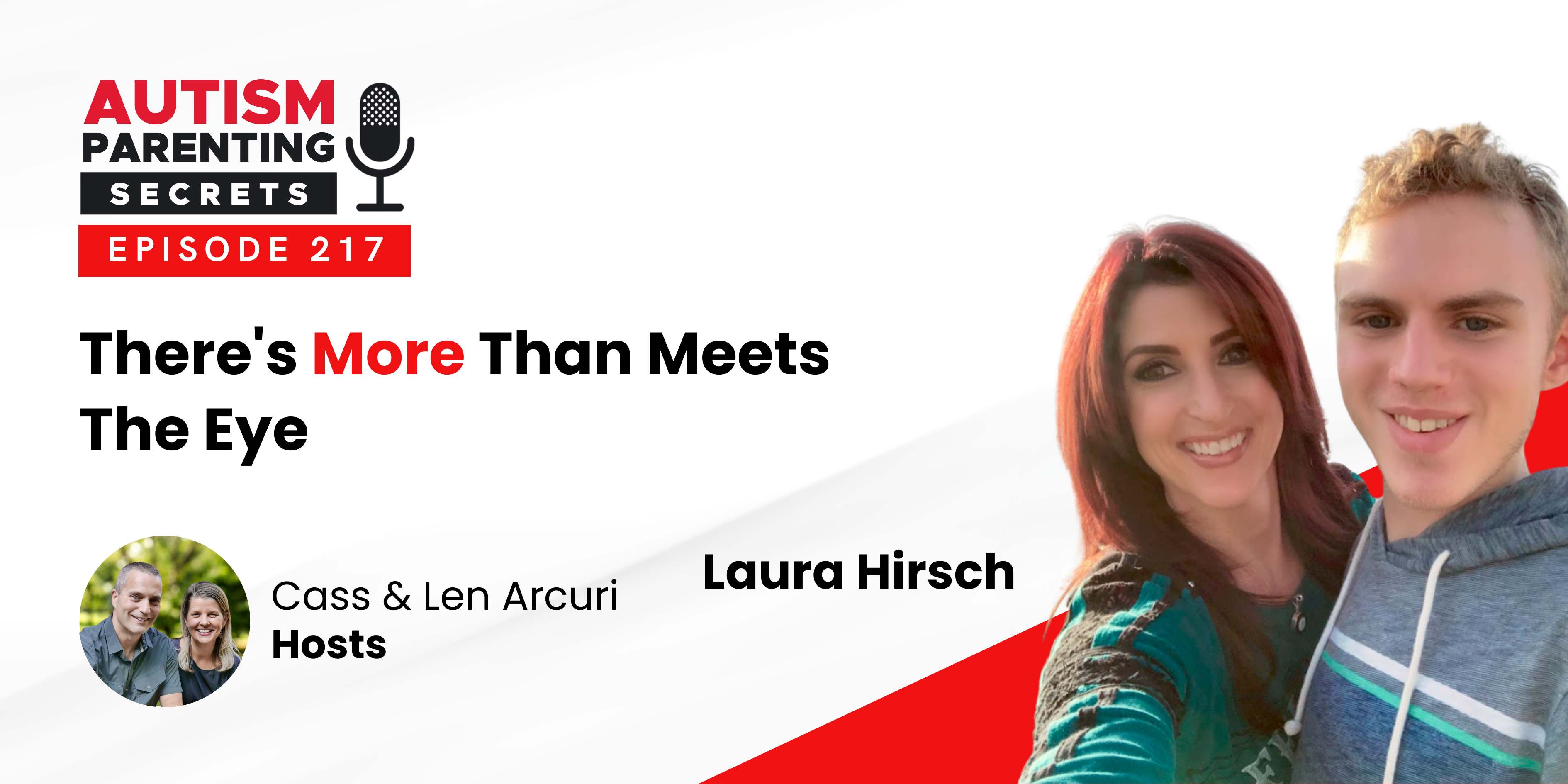
Episode 217 — There’s More Than Meets The Eye
Guest: Laura Hirsch • Date: August 15, 2024
Episode Overview
This week, we welcome Laura Hirsch, author and health freedom activist, whose journey with her son Trevor, a young man who defies expectations, offers hope and empowerment to parents navigating autism. Their book, "More Than Meets the Eye," emphasizes the potential of non-speaking children and is a valuable resource for parents seeking understanding and support.
About Laura Hirsch
Laura Hirsch was born and raised in Wisconsin and graduated from the University of Wisconsin-Whitewater with a Bachelor of Arts in Speech Communication. She is the author of numerous books, including The Other Side of Autism, Foundation of Discovery, and Widowed too Soon, and is a co-author and blogger for the popular autism organization, The Thinking Moms’ Revolution. Laura has been a health freedom activist for many years and was featured in the award-winning documentary Genetic Roulette about Genetically Modified foods. She is also a reformer pilates instructor and the proud mom of two incredible young men, Trevor and Damon. They live in the Reno, NV area.
Trevor Hirsch is Laura Hirsch’s older son and is now 25 years old. He was diagnosed with regressive autism at age three and is minimally speaking. He is finally having his voice heard because of Spelling 2 Communicate. He worked really hard for the past two and a half years and is now an open speller. Laura can ask him anything, and he spells out his thoughts on a letterboard. His journey over the past few years has been an absolute miracle. First, his musical talent, playing the piano and singing, became evident. Then, through Spelling 2 Communicate, his intelligence, thoughts, and feelings, and even his telepathic gifts that have been hidden all these years, came shining through. He is a musician, a horse whisperer, and a medium. He wants to share his story to inspire others.
https://www.laurahirschauthor.com/
You’ll Discover
Trevor’s Story and Why He Chose To Write This Book (4:57)
Some Surprising Capabilities That Trevor Revealed (9:20)
Why It May NOT Be A Cognitive Disability (16:43)
The Movement That’s Going to Explode (21:11)
Trevor’s Words Of Encouragement (27:47)
Incredible Communication Capabilities That Have Emerged (35:07)
The Two Therapies Trevor Says Helped The Most (43:35)
Referenced in This Episode
More than Meets the Eye: A Nonspeaker's Journey through Music, Spelling 2 Communicate, and Becoming a Divine Messenger by Laura Hirsch & Trevor Hirsch
Autism Parenting Secrets Episode 38 - Your Child Understands EVERYTHING with JB Handley
Full Transcript
Laura Hirsch | 00:00
Kids are just blowing... People's minds with what they're spelling. It's the whole community is just, it's giving them their life back. And it's giving their family their like hope. For their future. It's just, that's the tip of the iceberg right now. And I think this movement is just going to explode. And Trevor's, you know, kind of on the cutting edge of that. He started it pretty early when, you know, the whole movement started and he's just got a lot to say.
That's why I did the book. I mean, it was his idea. But I just feel like I'm a scribe for him. This is his book. And I'm the one with the voice to get his message out there. But he wrote everything. He spelled everything that's in the book.
Cass Arcuri | 00:43
Want to truly be the best parent you can be and help your child thrive after their autism diagnosis? This podcast is for all in parents like you who know more is possible for your child.
Len Arcuri | 00:54
- With each episode, we reveal a secret that empowers you to be the parent your child needs now, saving you time, energy, and money, and helping you focus on what truly matters most, your child.
Cass Arcuri | 01:04
- I'm Cass. - And I'm Len. - Welcome to Autism Parenting Secrets.
Len Arcuri | 01:21
Hello and welcome to Autism Parenting Secrets. It's Len. And the secret this week is there's more than meets the eye. And that is the name of the book that was co-authored by my guest, Laura Hirsch. And her son, Trevor. Laura is the author of several books, not just this one. And she's a blogger for the Thinking Moms Revolution. And she's a health freedom activist. And she's been at this for a long time.
So if you want to learn from someone who's traveled this journey, who has deep experience in how you can navigate your own journey to support your child in an even more powerful way, You'll definitely want to listen to this conversation. Welcome, Lark.
Laura Hirsch | 02:07
Thank you. Thanks for having me.
Len Arcuri | 02:09
Well, thank you. A mutual friend connected us. And I have to say, since our journey goes back Over a dozen years now, the Thinking Moms Revolution was always someone that we were aware of, a group of moms who were out there doing work. Unconventional things in terms of the types of information they were sharing and the role they were playing. Do you want to talk a little bit about that group to start.
Laura Hirsch | 02:31
With? Yeah.
So the Thinking Moms Revolution, I was in part two, the Team TMR. So the original team Group of 24 parents wrote a book and did a blog about their journey of healing their children. With autism. And again, like you said, that was unconventional routes that we went to, but we left no stone unturned after the blog came out, they were going to do a second book. And I was, Proud to be part of that book. And my chapter, my nickname is Oracle with them. And so I wrote a chapter for the team TMR book.
And then we did a grandparents book. My mom did a chapter for that book.
So We're not really blogging currently, but I love all those ladies and it was just a great part of my life that we all helped and supported each other.
Len Arcuri | 03:22
Absolutely. I think it was a great example of what a powerful community can do, both for each other and in terms of sharing information with other people.
So again, I have deep respect for what you all started. And when I would go to conferences to learn and to get knowledge, those were really helpful. But there's some dynamite. Quote unquote groups or organizations or support groups that could be really game changing with providing really useful support and information. There's a lot of groups out there that aren't that helpful Right.
So there's a lot of groups that may have autism in the name, but they're not very empowering and sometimes not something that really lifts you up as opposed to making the journey feel heavier. So I think the Thinking Moms revolution was unapologetic with putting out powerful messages. And you don't have to agree with everything, but I admired the directness and forthrightness that, that, you know, your organization was all about.
So yeah, some powerful, women in that group.
Laura Hirsch | 04:31
Wow. Thank you. Appreciate that.
Len Arcuri | 04:33
Super. So that's just a little bit of context in terms of I know one way that on your journey as you were looking to support your child, Trevor, you know, you're paying it forward and putting information out there.
So now fast forwarding to now, the reason we're having this conversation is not so much that you wanted to put it right author another book. This was more Trevor's idea, correct?
Laura Hirsch | 04:55
Yeah, surprisingly, yes. We started doing spelling to communicate We've been doing it three years now. And during one of our lessons, it was an open spelling. He's an open speller. One of the questions was name something that you like to do in your life. And he said it twice, actually. And the first time he said, I want to write a book with you. Which surprised me because he obviously knew I'm a writer and wrote books.
And then the second time he said it was more... It was, I want to write a book with you about my life. To inspire others.
And then I said, okay, you said that before. Well, what would you want to name the book? And he spelled more than meets the eye.
So he came up with the title and the idea. I hadn't written anything in about seven years. And once he said that again, I was like, okay, we're doing this. And that's where it started.
Len Arcuri | 05:47
Fantastic. And the book's behind me. It's a dynamite book. We're going to touch on it for sure in this discussion. But maybe could you just give a little bit of background with Trevor in terms of his unique journey and what got you to the point?
So I know many of our listeners, I'm sure, are familiar with Spelling to Communicate. We've done episodes with J.B. Hanley, with Elizabeth Bossler, and I'll put those in the show notes. But Spelling to Communicate as a communication vehicle For a person who is a non-speaker, so can you tell a little bit more about Trevor, his history and where he was, where he is now, a little bit of that would be just a high level and we can dive into the details as you'd like.
Laura Hirsch | 06:32
So Trevor's 25 years old now and he, Was born. Totally normal. He wasn't born with autism. He regressed at a year old. He had about 60 words. I have it all on his baby book. We kept track of everything he did. And he walked and talked at nine months. He met all his developmental milestones early.
And then after his one year of vaccinations, he lost everything. Lost his language, lost the ability to hold a fork.
So motor skill, you know, we're affected. And then we did so many different things to try to regain his health. And he did improve with a lot of different treatments. And the one thing he never got back was speech. He did have some words, canned words, that he was taught. Through ABA therapy and things like that, but he never had He would never ask questions. He could answer things like yes, no, say, I want to go so and so, you know, to a place or. Get his needs met basically.
So fast forward, Dude. To 2021, we started doing piano lessons and singing. And lo and behold, he can sing full songs. He can play his favorite song, Puff the Magic Dragon, and play it at the same time. I can't even do that. But he did a lesson once a week. Learn how to do it. And it just blew everybody away. Even his neurologist, my I've worked for Dr. Randall Gates for three years. And he came to watch him play and sing and he was just blown away. He actually did the forward to our book because he's known Trevor since he was 16 and helped those seizures and.
And then I started working for him. So then after he started playing and singing piano, we found out about spelling to communicate. I read JB's book and said, if he can learn how to play and sing the piano, play the piano and sing, he can do this too. And I saw these kids... Even in the Spellers movie, I was blown away. I was bawling while I read the book and I said, this is it. This is, this cracked the code. Of Lifting these kids, their voices back. And I'm like, we have to do this.
So we found a practitioner in California that we did remote with. And I was his CRP, his communication regulation partner.
And then I did lessons with him on the side. We did it again, like once a week. Within a few months, he was doing open spelling. And we still did lessons for a few years, which is how you... Learn how to become an open speller. And it starts off as probably a lot of people know with just spelling words in a lesson, then stuff that's in the lesson. Then it gets really interesting when you get into prior knowledge questions that wasn't in the lesson, but things they know that I didn't know he knew.
And then he becomes open spelling and math. I mean, he's a math whiz. I had no idea.
And then the most interesting part was after he became an open speller, We started going to do, ride his horse. He loves riding horses. And we found out he's very telepathic and can communicate with the horse. He's a horse whisperer. And he would always tell me what they talked about during their lessons. And when it really became real was when he knew things that no one told him, that the horse told him. For instance, that two horses died. And he said Blackjack, his horse, was sad because Buck died. And Blackjack was mourning because... Sully died. And no one told him. The horse told him, and then I found out later that it was true.
So stuff like that. And then he started talking to his angels and telling me what he was talking about to relatives that had passed away, even some that he had not met. In life.
So it just became... Mind-blowing the things that he's known his whole life. And this just consciousness that he has. And I would imagine a lot of kids are like that don't have a voice. They got to communicate with someone. And if you're, you know, if you're telepathic and or learn that skill, because you have to, I mean, it's no surprise to me.
Len Arcuri | 10:37
In so much of what you just shared, and thank you for sharing all that, there's a lot of incredible stories aspects of what you've shared. So just to go back a little bit... Particularly with music.
So when he's when Trevor started to learn learning how to play piano. Now, again, he's a non speaker for the most part, correct. And so how unusual was it that he could sing, yet talking was something that was more of a challenge. And what's your take on that?
Laura Hirsch | 11:09
Well, like I asked my boss, Dr. Gates, I said, how is it that Trevor can sing and play the piano, sing full songs, but not speak? And he said, it's a different part of the brain. One's on the one hemisphere and one's on the other hemisphere.
So that part wasn't damaged as much. So, and speech is a very fine motor skill. And just like with spelling to communicate, it's putting it into large motor movement using the arm.
That's why that works. Is it's using a different set of skills.
Len Arcuri | 11:40
Right. But in terms of Because so many parents, as you know, right, want language. They want to hear their child speak. I think it's just such a - Such an incredible concept that Okay, it could be that your child may be a non-speaker, that that's difficult because of the motor issues. Bye. The idea that for at least to try singing and seeing if music is something, I mean, that's just incredible that singing is something that was possible for Trevor and is right.
So it's like, does he ever just sing things to you if he wants to communicate or does it have to be kind of separate with music and in song?
Laura Hirsch | 12:19
No, he doesn't sing things to me. He will sing songs with me.
Like we have a piano here at the house, but it's a Clavinova. So it's got Some songs that are pre-recorded that has like the musical accompaniment in the background, but then they play, you can slow it down so it waits for them.
So it's a very special magic piano, but he still has a certain songs that he likes to sing and play with me. He does karaoke too. He just went to a karaoke party and he said he wanted, he said his favorite band is Duran. Which is one of my favorite bands of all time. And he started his whole life, but I didn't know he liked Duran. And so when we went to the karaoke party a few weeks ago, he said he spelled that he wanted to sing Duran. Two Duran songs, Rio and Ordinary World. We did. We sang them and we sang three other songs, but Puff the Magic Dragon, What was the other two? Bye. Gosh, I can't think of them right now. That's okay. But he memorizes them and sings them by himself.
Like a rock star. He sang in front of a hundred people and played the piano and, Callie, his teacher...
Like told his story ahead of time. And there were people in the audience crying, just blown away by this, Boy, this... That learn this skill. And it's very moving.
Len Arcuri | 13:48
Incredibly so. And I mean, I think there's so many parallels between your son and my son, Rye, especially in the music area. My son's learning to play the piano. He's really diving in. He's singing. He just had a performance a couple of days ago. There's something truly magical about the power of music. And again, I think it's just something that for any parent to explore to see if that's an interest, if that's something that their child can relate to. It is time well spent. But the idea, again, my jaw is still on the ground that he's able to sing. And I get it. It's a different part of the brain, but that's not obvious to most people, right? That that's the case.
Laura Hirsch | 14:29
It's another language to that, like music is a universal language and he sings, like Trevor told me, he sings songs in his head. Like when music's playing in the car, he was singing in his head. I didn't know that. But makes sense. You don't have to sing out loud to sing. I sing in my head all the time.
Len Arcuri | 14:46
Yeah, me too. Not very well, but I do.
So let's just cut to the chase of the big – The big aha, like the really big thing that your book's all about. And that the podcast episodes I mentioned earlier talk to, is this massive thing that's happened that isn't really widely understood. And the Spellers movie is a phenomenal way of helping people understand this. And I'll put it in my own words, and then you feel free to take it wherever you'd like. But the whole idea is that, especially for non-speakers, children or adults who don't have the words to communicate, Generally speaking, everyone missed the boat and just assumed that there wasn't... That these individuals were limited in terms of how much they were understanding and what skills and gifts that they have. And because of something like Spelling to Communicate, in terms of a modality that helps these individuals truly express themselves. We were totally missing all the gifts as parents and as a society. And it's just incredible how, not that perhaps you hear something like your child was smarter than people thought, but like the brilliance, how much they're taking everything in and just the gifts, like you're saying with your son. Being gifted at math and being able to now express himself with music and the nuanced understanding these kids have It's beyond anything we could have ever imagined. And it's only now becoming known through giving them a way of communicating that is something they're able to do. And it comes down to this, if you had to think of what the root cause is for the lack of words, it's a motor issue. It's not other things that people were maybe guessing it might have been.
Laura Hirsch | 16:44
Yeah, that's the biggest takeaway for me was once he started doing it, I realized that it is a motor planning issue. It's not a cognitive disability. People don't understand how smart these kids are, and they've been going through their entire lives being misunderstood and having people think they're not smart and they are. How frustrating that had to be for him and for all these kids just... Not being able to say what they had to say. No wonder they have behaviors.
So that lessened a lot once he started being able to speak his words. And he's been so much calmer. His nervous system is so much more regulated now. But it's been totally eye-opening. I feel like I met a new person, honestly.
Like I didn't even know who my son was. Until we started spelling. And he remembers everything from growing up. He knows things that I didn't even know he knew, like simple things.
Like he knows all of our family's birthdays, what our signs are. It's like he was at all the parties, but of course I remember everyone's birthdays. Why wouldn't he? But. It's just the little things like that just every time I'd spell with him, I was Like I called him Trevor stories. I'd call my friend that got us into the piano and I go my gosh, I got a Trevor story for you. And she's like, Laura, you have to stop being surprised.
Like I said, but I am, I don't, I'm like, this is mind blowing stuff. That's why I kept super great logs of everything. I wrote everything down. I have stacks and stacks of every lesson we did, every open spelling we did. And it's just truly amazing. And I think that so many families is like Trevor's 25.
Like imagine if this was available when he was younger, like his life would be different now. And it is different, but that's why I want to get his word out there to help younger people.
Like he even spelled, when the Spellers movie came out, they asked the panel on Del Big Tree Show, how old could you have started doing this? And they all said, you know, like five, six years old.
So these younger spellers that have their whole life ahead of them have this tool at their disposal that older kids like mine didn't have. And I think that's what Trevor's message really is. And he did, I told you, he wrote some stuff for when you're ready for it. To give message to his message to parents out there, but I don't know. Should I read them now?
Len Arcuri | 19:10
Well, let me hold that for a second. I just want to... For context, What I'm taking away from the stories I'm hearing, and again, tell me if you think this is true. And I know how proud you are of your son and how much love is there. It's so obvious. And I feel the same way where my son...
I mean, his gifts are shining through now. I know, you know, and I couldn't see it early on, you know, with him, especially when he was non-speaking.
So I feel like my son is brilliant, has so many gifts. Your son is clearly brilliant, has so many gifts. But I think the message here is, that I'm taking away is, It's not just that like you and I, the first neurologist we saw, by the way, who diagnosed after we had our diagnosis, he turned to my wife and I and said, at least you got a smart one. In other words, my son-in-law you know, had autism while he probably wasn't going to talk, but he seemed like he was kind of smart. And so what I'm taking away is that. These non-speakers especially That population, it's not like every now and then there's someone who's really brilliant. They're all really sharp, really in their own unique ways, like well above what we were thinking and so it's not just like you got a smart one, I got a smart one. It's like, no, these kids especially. And they're taking it all in. They're super sharp. They just can't express it and can't demonstrate it the way people are used to seeing it. And so they're immediately discounted, which is the big thing. Disservice we've done to that entire population and only now are they able to say what's really happening, like your son's been able to communicate to you.
So now I'm ready for his messages. But I just wanted to throw that out there that This is a large population of kids who have just been totally overlooked.
Yeah.
Laura Hirsch | 21:10
Well, they say there's 31 million non-speakers worldwide. And of the autism population, 40% are nonverbal. This is a huge number, huge numbers. And there's never been a tool like this available to give them what they need the most is a way to communicate. And kids are just blowing... People's minds with what they're spelling. It's the whole community is just, it's giving them their life back. And it's giving their family their like hope. For their future. It's just... That's the tip of the iceberg right now. And I think this movement is just going to explode. And Trevor's, you know, kind of on the cutting edge of that. He started it pretty early. And when, you know, the whole movement started and He's just got a lot to say.
That's why I did the book. I mean, it was his idea. But I just feel like I'm a scribe for him. This is his book. And I'm the one with the voice to get his message out there. But he wrote everything. He spelled everything that's in the book. In the spelling to communicate chapter.
Len Arcuri | 22:17
That's amazing. No, I'm excited for you to share, again, whatever messages he wants to convey, because as you said. To get this... In the hands of people even earlier. And I actually had some clients who started with us today. This was their first week. And they were curious about spelling to communicate and how early can somebody start because their child is four.
So I had to go to a website and see if is that too early. And that's about the earliest that you can actually start with spelling to communicate.
So they're excited because they have a young child who's nonverbal. And they're, of course, wanting speech.
So the fact that they could at least be aware of this option so early is such a gift, you know, for their son. So yeah, so the earlier people can know about this option, the better.
Laura Hirsch | 23:09
Yeah. Cause Trevor said he could read at two years old.
Like I read him books all the time and I didn't know that he was, cause that was after he had lost the language, but he was picking up everything. He, it was all there.
And then he said when he was like in school, he could have started immediately when he was in like kindergarten or So, but it just wasn't available.
Len Arcuri | 23:29
Can we just focus on that one comment, by the way, like the idea that Trevor, you now know he was taking in everything. Right. And he understood it. He was able to read. And we had a therapist who was working with us early on. And we after the diagnosis, we started having services and they whispered one therapist whispered, listen, don't say anything in front of you. Your son, you know, that you wouldn't want him, you know, to remember because, you know, assume he's hearing everything.
So we had that tip, which thank goodness, because there was no question. My son totally remembers things, you know, early on before he was able to speak.
So I know that was the case for him. You know, that was the case with Trevor. And I think for people listening, The smart money is on your child is understanding. Much more than you think.
So be kind with your words and be careful of what you say. And again, as we talked about in the episode that we did with J.B. Handley and Elizabeth Bossler and the concept that spelling to communicate is all about is to presume competence. And not just naive, false, you know, making, having an optimistic belief, just presume it because it's absolutely more than likely true. And from that place. How you are with a child, how you interact with them, everything changes when you assume more as opposed to assuming less.
Plus.
Laura Hirsch | 24:58
Yeah. And that was very evident in school when he was in school, like we'd have IEP meetings and he'd be in the room and they were basically talking about all the things he couldn't do. And like the speech pathologist said, he's plateaued.
You know, he's not going to get any more language. And it's like, and I said, well, why don't you try teaching him differently? He can type. Why don't you teach them typing?
Like I taught him how to type when I homeschooled him for a while. And I said, you're, Again, they're underestimating them. They're not presuming competence in him. And I was glad to get him up when he was out of school. He's blossomed more since he's been out of high school. And learned more in the last five years than he did in all of his schooling years. With me. Basically running the show.
Len Arcuri | 25:46
Well, and I think that's a key message, right, is that if you look at the school system and teachers, administrators, people at the IEP meeting, not that they're bad people, but they are absolutely coming at it from the opposite of presuming competence. And that's where it's up to you as a parent. You can decide what to believe. And again, I think the more and more you talk to people who have experienced what you've experienced, that type of transformation in how you were seeing Trevor, that, again, that just...
Totally changes everything and opens up so much more space for them to be able to really show their true gifts.
Laura Hirsch | 26:23
Yeah. Once one question I asked him one time was, an open question was, How do you feel about people when they talk about you in front of you? And he said, I don't mind as long as it's respectful.
I mean, everyone talks about them in front of them all the time. Like they're not there and they're not listening and they're not paying attention, but they are, they're the best listeners. They remember and picked up everything that happened. And now I sometimes get bad at myself because I'm like, man, I was swearing a lot in front of him. Luckily, we didn't pick that up. But yeah. No, it just makes you question everything. Once you know that they've been in there this whole time and they're They remember everything. And he's just so kind. And generous and like, it doesn't have, he has just nothing but love.
You know, A lot of us, a lot of the kids are like that from what I've seen.
Len Arcuri | 27:19
And I don't know what it's like to be you and with Fred and what that dynamic is, but it sounds very familiar because that's how I look at my son as well. He's all of, he's constantly teaching me love in so many different ways. And, and again, there's so much that's happening with these kids who just haven't had a vehicle or a way of conveying, you know, what's in their head, what's in their heart, And so now, yes, I would love to hear what messages Trevor may have put together for the listeners of this podcast, right? These are parents who so much want the best for their child and want to make great decisions, but we're all programmed to kind of fail in many ways, particularly with what we're assuming about our child that sometimes is the total opposite of what reality is.
So with parents who want to learn more, who are open, what are some key messages that you'd like to share?
Laura Hirsch | 28:17
Well, last night I asked Trevor to spell specific messages for this podcast today because it's hard to get them to just on demand, just start spelling, you know, I got to get them at the right time. And this, you know, so I said, what do you want to say to parents with non-speakers with autism? And he spelled... I want you to believe in your child. They have so much to say. I know they can do this. And I said, anything else for new parents thinking about doing STC? And he spelled STC. Just begin and see what happens.
I mean, short but sweet. But I mean, he's just so encouraging.
Like he said it before, if I can do this, I know everybody can do this. I mean, even I was questioning if he could do it when I first started. Doing it because I'm like, well, he's this way, he's that way. But no, he blew me away. And a lot of parents that have people that their loved one is starting spelling, they think that this is going to be the one person that can't do it. And... They're not. These aren't anomalies. It's just learning a new skill. It's creating new pathways in the brain, just like learning any new skill. Once they're there. Practice makes permanence. It's like riding a bike. Driving a car. Any motor planning. It's training the motor. Movements. And he did it with piano. It's motor movement. It's singing. It's all the same thing. It's learning a new skill. It just takes doing the work. Parents have to do the work themselves sometimes like I did.
Some people have practitioners that they work with one-on-one. But I'm the only one he works with now. It's amazing.
Len Arcuri | 30:04
I appreciate you sharing all that because it seems to me that this is one more thing that is incredibly powerful, but yet does require work by the parent, by the individual. And I just know, I feel like I was Early on in our journey, I was very much like I think a lot of parents were. I was allergic to doing work.
Like I wanted someone to do it for me, someone to fix my child. I wasn't qualified to do it.
So I was definitely looking for that magic bullet and that guru doctor who had all the answers. And as soon as I figured out along with my wife, Cass, that wait, there is no guru and there is no one thing. And that the idea of what's gonna help our son the most, none of it was convenient. All of it took work, but the art is to be able to figure out what the most impactful things you can do. And that's where it's very individualistic in terms of each child's different. Every, you know, every family dynamic is unique. But something like spelling to communicate, again, for someone who is like your son, who is just there and doesn't have the ability to express. This gives a phenomenal way. And as you said, it's not as if I know pretty much every story I've heard about spelling to communicate or RPM or any of those is that every parent doubts their child will do it. And of course, their child does it with ease. It may take a little time, but it's all doable, which is just so exciting.
Yeah. So yeah, the work is going to be required no matter what, in some way, shape or form. And so now with Trevor being able to communicate through the letter board, through the spelling to communicate type process, Does he have a desire to still want to be a speaker or is that not something that he even thinks about because he's able to express through the letter board?
Laura Hirsch | 32:15
I've noticed since we've been doing S2C, he's... Speaking less verbally, because it's harder for him to do that.
Like, he'll answer questions. Yes, no questions. He'll say where he wants to go and things like that. But for the most part, it's so much simpler for him to just get the letterboard and just have him Spell what he wants to say. I don't know if he in the future would, you know, want to learn how to speak verbally, but I, had tried the keyboard with him, like the handheld keyboard and, Because he said he wanted to try it, but then after he tried it, he wanted to go back to the laminated board because he said it's easier for him. It's like there's more motor... With the like the QWERTY keyboard that the letter board is alphabetical A through Z. And that's what, you know, he mastered that. But it's like the seesaw they talk about. When there's more motor load, there's the cognitive and the motor, like seesaw.
So when you put more motor demand on, They have to work harder cognitively. Toot. Get what they're trying to say out. Not that we won't go back to trying that again. I'd like to in the future, but He's just after we did the book, he just kind of needed to take a little break, I think, from everything and just be, you know, living his best life, ride his horse and, you know, go into healing centers and things like that.
So but we're still spelling like we just do open spelling. We don't do any lessons anymore because he said he doesn't need them anymore.
Len Arcuri | 33:40
And open spelling, just like lifestyle spelling, right? You're doing it as needed.
Laura Hirsch | 33:45
Right. So I'll ask him questions. If we go somewhere, you know, we went to the Monterey Bay Aquarium recently and I said, what was your favorite exhibit? The glowing jellyfish.
So we have conversations too after doing things or where do you want to go? What do you want to do? Giving him choices. But then he's every time we go do any healing which I talk about in the third chapter of the book, He always says he sees his angels and talks to them and he just has this whole other life going on in there that I didn't know existed. But it's really cool.
Len Arcuri | 34:22
- No, it's incredible, truly incredible, and that's where there's so many really jaw dropping aspects of the whole story. And again, so I encourage people read about it by the book and read about it. And, in terms of what's possible, what's going on that you're not aware of, but you've touched on now a few times in terms of his, Yeah. His capabilities in terms of what messages he's receiving. And I know in terms of the books you've written in the past, you've, dove into mediums and that kind of aspect.
So what can you share with our listeners about that? Like what you're what Trevor is able to do now and just your perspective with seeing autism from a very different perspective?
Laura Hirsch | 35:08
Yeah. So yeah, I had written a few books that were actually channeled about autism. One's called The Other Side of Autism. And it's friends of mine that are medium and a spirit artist. And we did like 27 chapters about, you know, the autism thing. How to help and what causes it and all this stuff. But, so the, I wasn't a stranger to that world. I had lost my first husband at 27 years old. And went to see mediums for healing grief. That's where that started. I was in my 20s. And Trevor... This is really interesting. He, whenever he goes, we go to the EE system, which is the energy enhancement system and another healing modality called the tachyon chamber. Every time he's in there, he goes into this like higher state of consciousness and says, he talks to his angels. And I say, who did you talk to? And he'll always say like my dad, my brother, my family members that he knew that passed, but he always says Darren. And that was my husband that passed that he'd never met. And so after he kept saying, spelling his name all the time, I said, how long has Darren been one of your angels? And he said, since before I was born. And I said...
So you planned to come to, he said, we basically said, I said, were you in a past life together or something? And he said, we've had many past lives together. And I said... Tell me something else. And he spelled He's been my number one protector.
So, I mean, that just opens up a whole other conversation, but he planned to come here and probably knew he was going to have a hard life with this you know, autism and not being able to speak. But then he was able to speak to people that were passed on and that were helping him and protecting him.
So he has this, like... Group of angels, he calls them, that are there to protect him and encourage him. And he says like, Grandpa Lambert, Grandpa Hirsch, Uncle Ricky.
And then my sister passed away. During the writing of the book, actually. And Trevor. Said the most beautiful thing.
So I said, well, you know, Auntie Kim's with the angels now. And can you talk to her? And he said, yes. And I said, what does she say? And he said, she says that I'm okay. And that I sent the Robins to mom. The morning she passed, we had like 30 robins in the backyard in the bird feeder. We never see robins here. Hardly ever in Nevada, but.
And then my brother-in-law passed away a few months ago around Easter, and he knew before I told him. That he died. He hadn't seen him in like 10 years, probably. And I said, Trevor, do you know if one of our relatives passed away recently? Just to see if he knew. And he said, yes, Uncle Timmy. And I said... Yes, he did. And I said, can you talk to him? And he said, yes. And I said, what does he have to say? And he said, tell my mom I'm sorry. She found him. And He said he's okay.
And then he sees him in the house. Like, this is the other weird thing.
Like, he can see them too, not just talk to them telepathically. But they were scaring him sometimes. And he'd like get upset for no reason. And we're like, what happened? And I'd ask him to spell and he said, I just saw Auntie Kim and I said, well, maybe we need to create a boundary.
Like, it's okay to see them when it's safe for you, but not. Pop up in the kitchen. I think it would freak me out too.
So, you know, I was having these conversations with him. About that. But so he is a medium I found out through spelling and he's a horse whisperer. He rides his horse.
That's why it's on the cover. He's on his blackjack, his horse. He started telling me, I'd say, what did you experience?
You know, when you went horseback riding, he said, blackjack and I talked about this and we talked about that. And then it really got real when he told me that blackjack was sad because Buck died, which was another horse. No one told him this. He said, I go, did you ever hear someone talking about that? And he said, no, Blackjack told me.
And then a second horse died as well named Sully, who was right next to Black Jack's stall. And we went to go visit him on a day that we didn't ride. And he didn't even come to us. He just kept his back to us. Could you communicate with Blackjack even though you weren't writing him and he said yes? And Blackjack was mourning because Sully died. No, we didn't know that. I didn't know that. And he said Blackjack told him, so... There's just this and everyone at the Center for Adaptive Riding is where he rides. They are just blown away by what Trevor's doing and they can't wait to hear what he and the horses talk about. And now he rides a horse called Dude. And he talks to dude and he's like, we have great conversations. He really likes me. Just, it's just a whole other world.
Like he's not just up there riding a horse. He's having a whole communication with these animals that are just beautiful creatures and brilliant and, Yeah, it's just so beautiful to see the other aspects that came through after we started doing Spelling to Communicate.
Len Arcuri | 40:09
That's absolutely incredible. And again, if people were like there was a camera on him while he's riding Blackjack or one of these horses, that's There'd be no... Obvious evidence that he's having these conversations.
I mean, it's all happening on a totally different realm. And, again, just something which is hard for, I think, people to hear and kind of say, could that possibly be true? But you're mounting lots of evidence that he's getting these insights that there's no way he could get.
You know, any other way. And I, and I'm just in such a, powerful way really comforted by the fact that As he was growing up, you must have really thought in many ways that he was like so alone and wanting to enter his world, find a way in. Little did you know, he had a support network that was all around him and still around him.
Laura Hirsch | 41:04
Yeah. That's very comforting.
Yeah, there's just, like you said, the evidence. It's probably hard for a lot of people to wrap their head around that, but... Another big thing that blew me away was the lady that was running the Center for Adaptive Writing. Found out that she was pregnant with triplets. And had to step down. Trevor didn't know this. No one told Trevor this. But his horse told him, I said, what did you and Blackjack talk about today? And he said, we talked about Nikki being pregnant with triplets. What? How did you know that? Did you hear someone talking about it? No, Blackjack told me. And I told Nikki about it. She's the lady that had, she just had the triplets actually. And she was just mind blown. She's like, there's no way he would have known that. And that's the whole thing that all the things that there's no way he would have known. And those are the evidences. Those are the proofs that he's actually doing this.
So... That's all in the book. And there's a lot more.
Len Arcuri | 42:10
Well, a lot to take in. And again, I'd encourage people read the book. You're only scratching the surface. And again, there's so much in there. I think that would be really useful for parents to be able to digest and to read. And again, you get to decide how you want to show up for your child. And again, there's ways that you can show up that really help you to be there for them, to meet their needs, whatever their unique needs are, and to, again, to basically just show up with love, with acceptance for who they are now, not who you want them to become. And so I think your story and Trevor's story, thank you for putting pen to paper and for putting it out there. And again, as a parent of someone who has a child who's been diagnosed on the spectrum, so much of this comes down to you and how you're showing up.
So anything you can do to get clearer, to get more loving, to get more equipped will really help you find the right answers for your child. And I know, Laura, I know in your book, you listed all the things, quote unquote, the interventions you've done. It's quite extensive. And we did many of those as well.
Some worked, some didn't. But again, it's not hard for you to really get tuned into what your unique child needs and to pick the few things that can help the most. And if you have a child who is a non-speaker, giving them that gift of being able to communicate and to have their voice be heard, there's nothing more powerful than that.
Laura Hirsch | 43:40
I agree. And actually Trevor spelled after, He was an open speller, which, because I said we did like over 40 different things that we tried. And I said, which modalities were the most, that you did you notice the most healing from and he spelled homeopathy and hyperbaric oxygen therapy Wow. Not HBuck. Hyperbaric oxygen therapy. He spelled the whole thing.
Len Arcuri | 44:07
Okay. But there's no difference, right?
So basically, okay.
Laura Hirsch | 44:11
Yeah. The shortened version, he wrote out the whole.
Len Arcuri | 44:14
Yeah. Yeah.
So he thought those were the two biggest ones. That's a phenomenal question. I'm so glad you brought that up. And again, just from his perspective, that's powerful. Homeopathy is probably not only saved our son's life, but that basically resulted in the biggest change for my son, which, you know, the old version of me would have said that's totally impossible. It's total nonsense.
So, again, who's to say what's going to be that right? Thing that your child needs most. And, but those two that you mentioned are powerful ones. And yeah, just, Tune into what your child needs and if they have challenges from a communication standpoint, there's definitely things now that are available that weren't available a few years back.
So that's the exciting part. It's a little bit overwhelming with all the interventions and all the roads you can go down. But the positive is that there are many more options than there ever were for you to find what's going to be a fit for your child.
So, yeah. So thank you so much for sharing your story. And again, I'd encourage people to definitely... Take the time, read the book. There is a lot of incredibly useful information in there.
So just don't hesitate to invest in yourself. To be the best parent you can be, presume competence with your child. And any other final message that you'd like to share with our listeners, Laura?
Laura Hirsch | 45:41
If they want to see what it looks like spelling to communicate, they can check out my website. I have videos of him singing, playing the piano, spelling. Even spelling to Dr. Gates for the first time on my website, which is, Laura Hirsch author.com. I'm sorry. Yes, laurahirschauthor.com. I like changed it once.
The IASP website and the Spellers.com website where you can find out more information, local practitioners, They have free lessons on there. It's just the best resources out there to find somebody to work with your.
Len Arcuri | 46:21
Child. Fantastic.
Well, thank you for sharing that. It'll all be in the show notes, but otherwise again, Lord, thanks so much for taking the time to share your story. Thank Trevor for us and wishing you and your family only the very best. Thank you again. Thanks.
Laura Hirsch | 46:35
For having me again.
Cass Arcuri | 46:37
Want to learn more? Go to elevatehowyounavigate.com