
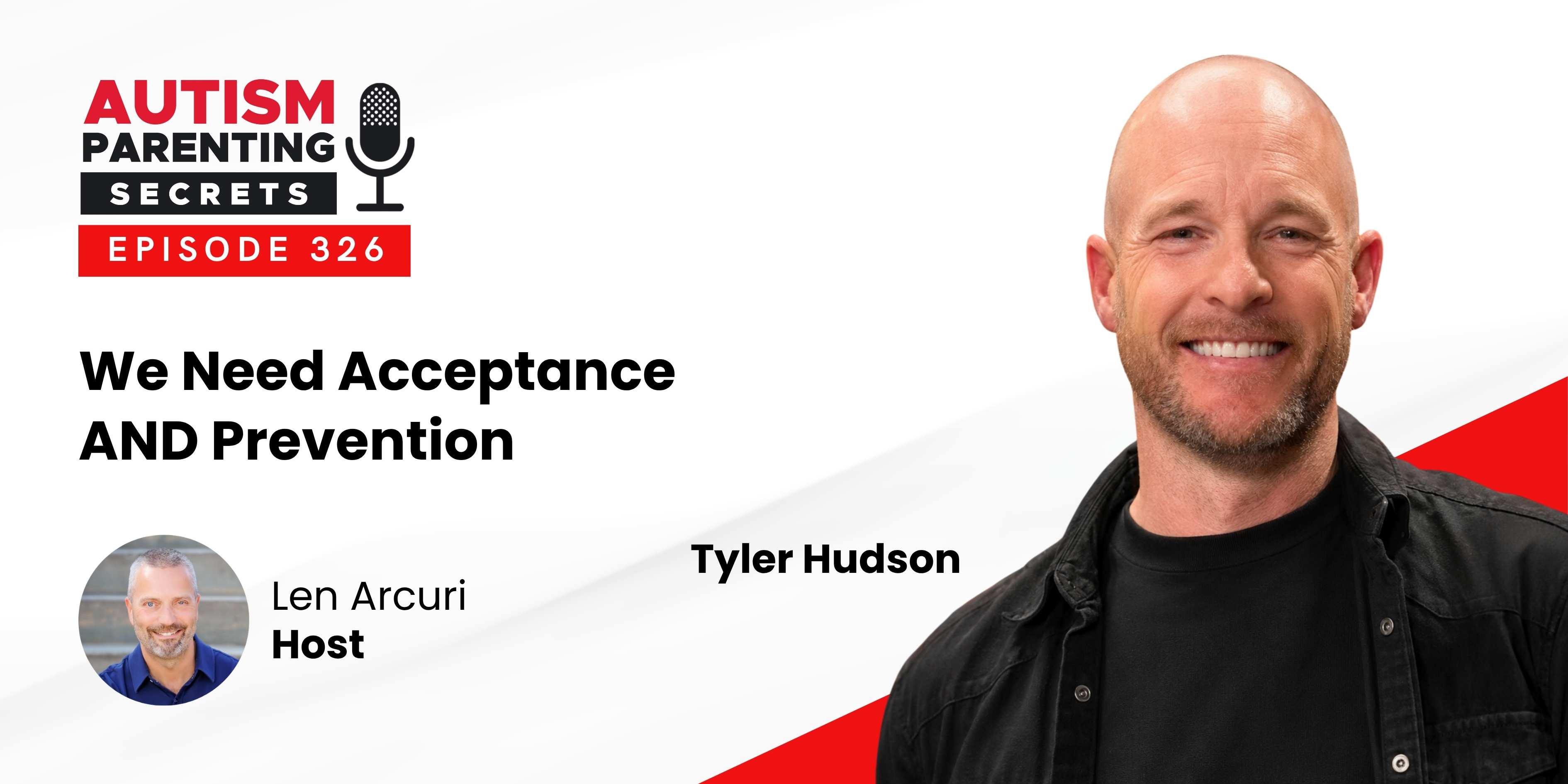
Episode 326 — We Need Acceptance AND Prevention
Guest: Tyler Hudson • Date: September 24, 2026
Episode Overview
Tyler Hudson is a husband, father of three, musician, and advocate for families living at the deep end of the autism spectrum. In this conversation, he shares what 18 years with his son Lyric have taught him about grief, acceptance, advocacy, presuming competence, and why supporting people with autism today must coexist with pursuing answers and prevention for future generations.
About Tyler Hudson
Tyler Hudson is a husband, father of three, musician and advocate for families living at the deep end of the spectrum. From Texas, now living in Tasmania, Tyler speaks openly about grief, disability, and the responsibility we owe future generations.
You’ll Discover
Why Hope Changes As The Journey Unfolds (3:11)
How Grief Can Lead To Acceptance (13:22)
Why The Autism Spectrum Needs More Distinction (22:10)
The Difference Between Being Nice And Doing What’s Right (39:56)
Why Presuming Competence Matters So Much (47:33)
Full Transcript
Tyler Hudson 0:00
You absolutely can celebrate people with autism, but we equate that with celebrating autism itself. Autism becomes a superpower, and we so what do we do with the anger and the emotions that we feel watching this disorder get sanitized in society? In all, in the name of inclusion, those of us that have kids that are profoundly affected, well, our experiences get diluted out of the conversation, and that makes me furious. And I have to process that as a parent. So my advocacy largely it's based around what's happening inside your internal world. I don't offer any advice towards mitigating the struggles, but I more come alongside you as a parent and affirm the the struggles that you're going through because they are valid and they deserve to be heard.
Len Arcuri 0:47
If you're a parent of a child with autism, you are being called to rise with love, courage, and clarity. This journey isn't easy, and most parents aren't equipped, but you can be. This podcast is your invitation to rise higher, because how you navigate matters. I'm Len, and this is Autism Parenting Secrets, where you become the parent your child needs now. Hello and welcome. It's Len, and today I'm here with Tyler Hudson. Tyler is a husband and a father of three, including his 18-year-old son Lyric, who has profound autism, and more recently, Tyler is the author of the book The Missing Lyrics: A Father's Story of Autism, Grief, and a Society in Denial And rather than waiting until the end of the episode, I want to just be very clear up front: go and buy this book and listen to it as well. Over the last 20 years, I've read dozens and dozens of books about autism, and I've interviewed more than 300 guests on this podcast. And I can tell you, there's nothing I've read that's more impactful than the Missing Lyrics. It's powerful, intelligent, and incredibly relatable. Tyler is a gift from taking complicated and emotionally charged ideas and expressing them with remarkable clarity, he puts words around things many of us have experienced, felt, and believed, but may have struggled to articulate. So it's the kind of book that you can give to a family member or a friend, and say, if you really want to understand this journey better? Read this, and Tyler and I have sons who are about the same age. And while every journey is unique, there are a lot of commonalities in ours. And there's a lot that we'll likely cover today: grief, acceptance, the impact this has on families, the sacrifices we make, and the courage it takes to question things and to do what we believe is right for our kids. So, underneath all of it is a really important distinction. Yes, we need to accept, love, and support the people who are here today, but at the same time, we need to really keep asking why so many children are struggling, and to pursue answers and do everything we can to prevent unnecessary suffering in the future. So those things are not in conflict. So the secret this week is, we need acceptance and prevention. Tyler, let's do this. Welcome.
Tyler Hudson 3:18
Oh, two minutes in, and you're already making me cry, Len. Thank you. That was quite the intro. I I really appreciate it. That that's very kind of you to say that. Thank you.
Len Arcuri 3:27
Well, it's very kind of you, and takes a lot of courage to put into words into that book what I know for fact really moved me, and it's I'm just so excited for all the parents who are going to really benefit from listening to your story, and again, it's not hyperbole, super well written, really, really to the point. And I guess you know, I'm trying to think of the best place to start off, but I think, I guess, if before we get into the book, if you were to meet someone for the first time, you know who might be earlier in this journey, you know what would you really want them to know about you, Lyric, and the journey that brought you here? What comes What comes to mind first?
Tyler Hudson 4:14
Well, I'm an old guy. I'm a little bit further down the track than. Well, but I think there's a wisdom that comes from listening to someone that might be 10 years further down the road than you are, and a lot of the times the advice I have for them isn't advice they want to hear, but it's advice that I think is necessary. That this is not a short detour. This is like autism, particularly with someone profoundly affected. In those early days, you hold on to hope for the miracle cure, and and even still, and we'll talk about this. You still hold on to hope. You just hold on to it a little bit more loosely than you did in those early. Days, because your capacity as a parent grows along with your child. And I had someone reach out to me, just a tradie here in Australia. Is like he said, "Mate, my son's four. If you could go back and talk to yourself 15 years ago, what would you say? And I said, "Well, number one, I wouldn't have listened to anyone because I'm the master of my own universe, and I'm gonna get my son healed. I'm gonna get him cured. I'm gonna. I wouldn't listen to anyone that that warned me about what lie down the path ahead because I just rejected all of that. Because that's as you go through the process of grief, that's all a part of you know. That's the very clearly in the denial stage, which is the first stage of grief. So, it's almost is really difficult to listen to people pontificate about what life's like further down the road because you're convinced that's not going to be your story. But, um, so I suppose if you're unfamiliar with our story, I'm I'm just a dad that's done his level best to document what this process has been like for us, and I don't offer prescriptions. I don't get into the fine brushes of the things we've tried, the unique therapies we've tried. I will never show you, oh, you've got to do this because it unlocks so much potential, I'm just not going to do that. I take a step back and I look at the trajectory of my whole life, and particularly as it relates to the grief process, because it's not something that society wants to talk about, but it's something, particularly as a parent, to keep yourself together, you need to know how difficult. Number one, you need affirmation that what's happened to your child is sad, and it deserves to be grieved. But society wants to prevent us from experiencing that because we that we want to repaint the the imagery of autism around a superpower, and it's to be celebrated. And as we'll talk about in the conversation today, you absolutely can celebrate people with autism, but we equate that with celebrating autism itself. Autism becomes a superpower, and we so what do we do with the anger and the emotions that we feel watching this disorder get sanitized in society, in all in the name of inclusion, those of us that have kids that are profoundly affected, well, we get diluted, our experiences get diluted out of the conversation, and that that makes me furious. And I have to process that as a parent. So my advocacy largely it's based around what's happening inside your internal world. I don't offer any advice towards mitigating the struggles, but I more come along come alongside you as a parent and affirm the the struggles that you're going through because they are valid and they deserve to be heard.
Len Arcuri 8:02
You're touching on, I think, what makes your book really, really unique. And again, there's so many parents who have had the courage to put their journey into a book and to share it. And I think that is dynamite because that takes courage no matter what. And you know, yeah, sometimes the details of a particular journey are important. But again, I think that's where I think you kind of had a really good balancing act of sharing some of the details and the examples and the the incidents and and all that, but always with the view of the overarching insight as as opposed to maybe too much information on your specific situation. And I frankly don't read a lot of the books that other parents write because, you know, like that's just their story. Their story is not my story, and I'm, you know, am I really going to benefit from learning that they did X, Y, and Z? Where I tried those things and it didn't work, and you know, maybe I'd start feeling like I missed something, and and you know, so I don't necessarily want to hear other people's stories, but that's where you know. I think our mutual friend Brian Hooker, Dr. Brian Hooker, is who connected us, and and again, he wasn't the only one. So many people in my, you know, people who I really respect, all within a span of a week and a half, said, "You got to, you got to talk to Tyler. And again, after now listening to your book and and having your your book just arrived today, but I listened to it before I received it. There's so many key insights that you did articulate really well that I think are going to resonate with virtually all parents, even if their child's got very different challenges and maybe a different diagnosis. So I really, you know, I applaud you for really sticking the landing on those key insights, which is all about the internal game of the parent.
Tyler Hudson 9:46
Well, thank you. Yes, I I just I started advocating about a year and a half ago. Like I have not been in this game very long, but I just did not see my voice being represented anywhere. Inside the autism space, and I and I didn't go seek out. Oh, what's everyone saying? I just my immediate world, my sphere, the people in my bubble. Like no one talked about autism the way I felt about it, and I just put my voice up to say, hey, this is these are my thoughts, and I just began articulating that, and the amount of people that have shown up for the conversation since then has been incredibly humbling, and that's when I thought, man, maybe I should maybe I should put all this down and write a book just about our process. Because particularly as it relates to grief, I look back on the previous 17 years of our life. Like lyrics, he's 18 now. He's just become an adult, and we've had his diagnosis since he was two. And it's it's again, you've read one book, you've read them all. They're all the same story. Okay, so like, my child is progressing totally normal, and then he just suddenly stopped. It's like, yeah, yeah, I've read that book. I've lived that. I don't need to read that book again, because number one, society just denies that that that that is happening. We deny that kids are regressing into autism, as Toby Rogers says. He's a political economist. He says 315 kids every single day in the United States alone regress into autism. How that is not headline news is an absolute shame, and I believe will be considered a crime against humanity when we get further down the track and we look back on this era. We'll go, how, how, how, how was, how was society not up in arms about this to research causation and study these kids, particularly these kids that regressed, they should be treated as medical emergencies. But instead, we're just given the label: it's just autism, nothing to see here. Good luck, good luck sorting it out. Bang! Slap, slap it with the label, and then you are literally abandoned by the medical community, and parents then have to go and become the experts on what happened to their child. And the medical community is not interested in helping because it's just autism. It's yeah, if you've met one kid with autism, you've met one kid with autism. Well, we should be studying these that regressed so that we can prevent this from happening to future generations, and I think that's where I landed with my book. I'm now like my our course is set. I I don't hold on to hope that my son's just gonna miraculously one day just shake it off and go, "Whoa, that was wild! Hey guys, how's it going? What have I missed out on? And just begin talking and go get a job and go live a full normal life. I don't. I don't believe that will happen. But now, I think about my daughters who are neurologically typical. They're going to be raising their own kids probably within a decade. And I look back to where we were when we first started having kids, and society is no closer to pinpointing why this is happening to our kids, or they're no closer to admitting why this is happening to so many kids. And that's where I just, as a future granddad, had to stand up and go, right? This is this is madness that society's not up in arms about this, and we need to be bringing this conversation to the forefront.
Len Arcuri 13:26
Well, I couldn't agree with with you more on everything that you just said. Only adding that, and I think you'll agree, there's a lot of reason to be optimistic based on what's been happening over the last, let's say, two years in terms of what is actually being made known, what what with having people in the government having people actually saying stuff out loud that people were afraid to say not that long ago is encouraging that we're moving in the right direction. By no means are we home free, right? It's still going to be a battle, and and just everyone who's impacted to be vigilant, to be forceful, to ensure that yes, what's happening gets the attention, because I think you know society doesn't want to recognize this, and I and that's what you talk about in your book, where it's a society in denial.
Tyler Hudson 14:20
Yeah, and so that's where I relate. I look back on my life past those 1617, years, and I could see myself going through each phase of grief. I didn't realize that's what I was doing at the time, but but once I got to where we are now, which I believe is very much largely in the acceptance phase, that life this it it is what it is and I'm at peace with it. I can look back and go, huh? That was my denial phase, and that's when I thought, no, no, no, this this won't be life. I'm going to get my child healed. I'm going to get him. We're going to get the right combination of medicines, supplements, doctors. Spiritual healers, whatever, whatever, and we're going to bring him out of this. Like that's that was my denial phase of grief that that this was going to be our reality. And then after several years of living in that space, like I would say, the first seven years of my son's life, I lived in that space, and then I started. Oh man, started getting angry. This isn't working. What's happened? Why God? Why God? Why me? Why us? And then you get into this bargaining phase, and I believe that that's where society is right now. That they're stuck in one of the first three phases of grief, and the bargaining phase of grief, as it relates to autism, I believe, is society participating in these mental gymnastics to convince ourselves that autism is a blessing, or or we've whitewashed kids like ours, where we society doesn't think about our kids when they look at autism anymore. They think about Elon Musk and Sheldon Cooper, and this they see the superpower aspect of it. That's all part of the bargaining phase of grief. You're like, oh, must be bad for them. But hey, look at this. It's it's this it's this mental reframing and this mental gymnastics that we participate in, to keep ourselves from coming to the next phase of grief, which is depression, as society, once we realize, holy crap, this is avoidable and preventable for so many cases of what is currently being diagnosed as autism, 100% is preventable and avoidable. Once society accepts that reality, oh man, there's going to be mass amounts of depression, mass amounts of anger, and those of us that have already gone through that process need to be there to help society through that grief process. And I feel like that's one of the reasons why I've I've written this book because I'm I'm foreseeing what's coming. That society's going to begin to wake up, and I believe we are waking up. But it's to help help us come all the way through, all the way through to acceptance. Get there as quickly as we can, so that we can be of assistance to future generations rather than kick the can down the road.
Len Arcuri 17:17
Yep. Now the way you frame it, I think, is very powerful, and you have to look at it as an overall system, like at a higher level of of what's happening, and you know, basically that acceptance, right, is hard because if you really come to terms with what's really happening, the actions that are required are really hard, right? They require real, you know, culpability a little bit like, and people like, hey, we did this. This was wrong. Here's what needs to change. And obviously, we're not really good at shining a flashlight. You know, with with with clear transparency, saying, hey, here's what we need to change. Nobody wants to be left holding the bag that they did something wrong. You know, take any so many of the issues that are so controversial come down to you know really good people people with good intention not being willing to even comprehend the concept that they recommended something that turned out to be not great and and so no one wants that on their watch.
Tyler Hudson 18:20
Well, and parents they own that as well. They say, "Oh, it's my fault, and that's where I I just want to come and alleviate that responsibility from you. No, you were being a good citizen. You trusted the powers that be. Then you you in took it in faith that they had your child's best interest at heart, and that's what we want to believe as good members of society. So we go along with the authorities, and but realizing that they don't always have our individual best interest at heart. And I use this analogy in in my book. I live in Tasmania. Fish farming is the the number one industry in this in this in this state, and they grow Atlantic salmon in massive sheds in dry in sterile tanks where there's no environment at all. There's no pathogens you would encounter. You you can't you don't develop an immune system as a as an Atlantic salmon in a shed, and then when they migrate from freshwater out to saltwater, they put them in these boats that pump them through, and but then they get before they head out to the open ocean, they give them a cocktail of vaccines to protect them against these natural pathogens that have always been here that they are not prepared to live with, and so they've got this artificially induced immunity out in the open ocean in this big sea pen. They live inside of a net because it's the efficiency of the harvest is what's most important, not the health of the individual fish, and that's to me parallels with. Our human, modern human experience, so much we care about society as a whole more so than the health of the individual, and all we're asking for, and it it could be a tiny little tweak in our practices to say, should these products be recommended for every person without without fail? Should we and as Sabine Hazan a couple weeks ago on your podcast said we she believes she's developing the ability to test which individuals are likely to be susceptible to experiencing an injury if they have these products? Like, would that not be a game changer. Would that not be science advancing? And we'd look back on that and go, "Oh yeah, that totally makes sense. You can't just give one product to everyone and expect everyone to have a monolithic response to it. So we do a pre-screening. It's as simple as that. A little blood prick. Oh, these. This is what this unique immune system is shaped like, and we should avoid doing this. Great, thank you. Wonderful, and we we would look back on that and go, how how come you didn't do this 50 years earlier? And we didn't because we refused to admit that there was a problem, and that's where society needs to come to. We need to come through all the way to acceptance and accepting the fact that we have a problem.
Len Arcuri 21:25
No question, and it sounds so simple, right? If you could do a test to see who might be more compromised, therefore maybe go be more cautious. It sounds so simple, but once you introduce that, you're you're basically saying, you know, we should have done this a while ago, and perhaps some people were harmed because we didn't do this a while ago. So that's where, again, I think everything is framed on self-protection. Yeah, and and and and because of that, people dig in in in situations where it's pretty easy to see, hey, here's some reasonable steps we can take that are win-win for everyone, and and again, there's just so much that's keeping people from coming together, which again, a lot of it can can be improved from Washington, right, with the right people, starting with policy. But I know your book is is so focused, and so is my work on. Yes, we need to you know do things from a prevention standpoint, that's important. But more importantly, we need to help these kids now, who are struggling now, and that that brings, I think, to another aspect of your book that I think is powerful because it wasn't really you illuminated it so well, where the term itself has been co-opted, and and things have shifted, and and and basically, I'll leave you to kind of go deeper into that. But particularly, kids with more profound autism are kind of being ignored even more because the label's been taken over by people who are actually using
Tyler Hudson 23:00
it as as a self identification, almost in a way of pumping themselves up. Yeah, and here's what often goes gets misconstrued about my advocacy because I would dare to say things that so many people just aren't willing to. I have absolute, honestly, honest to God, I have absolutely no problem with people using a label that they've been given, and I do not hold higher functioning autistics responsible for what's happened in this space. I don't, because that's the label they've been given. Also, that's the label we've been given, and our experiences could not be any different. So my problem is not with higher functioning autistics using the label. My problem is that society that thought that that was a good idea to allow this this concept creep into the creation of a spectrum. What what scientific advancement over over the years produces less distinction? We always are producing more and more and more distinction in society, but with the spectrum, it's gone backwards. We've broadened it so much that it's now a diagnosis in collapse that doesn't mean anything. Because honestly, it's it's nearly a useless diagnosis because you don't even have to have a diagnosis. You can just identify as being autistic. Okay, so number one, we should reject that framework as acceptable, and I believe that the DSM six will correct these. Hopefully, you know people love to point out, oh, it's a spectrum. Well, you know what? It wasn't always a spectrum. It became a spectrum in 2013 when they folded in other. Diagnosis into autism. Autism stopped being a thing. Autism became the category of neurological disorder. It's now the title of a category. So you say you have autism. What does that mean? It's like saying I have I have a car. Okay. What type of car? Was it a Volkswagen? Is it a Ferrari? Well, no, I have car. Okay, cool. What do you mean? And that's what autism has become. No one, society doesn't recognize it. And always, those most profoundly affected are the ones who pay the price in society because their advocacy voice is limited because they don't have access to their own voice. And then we let the higher functioning, who do have access to their voice, control the space. Now that's it. That is what it is. I'm not angry with them. They're just using the title they've been given. What I'm advocating for is splitting of the spectrum. To I think nonverbal or limitedly verbal or unreliable speaker has to be a main criteria in splitting the spectrum. People that don't have the capacity of functional communication shouldn't be in the same diagnostic category as people that do, and we can. There's no clear place to draw a line because you've got other issues happening. There's biomarkers that are happening inside those that are profoundly affected, but we diagnose autism based on behaviors. But where's the diagnostic criteria? Where's the Sabine Hazan saying this is exactly what's happening in the microbiome of these people that are profoundly affected? We don't do that because of what you've said, because then that would point the finger at oh how did this happen, and then we have to come face to face with the reality that oh our modern practices produce that microbiome, and it is preventable and avoidable. And so, back to the prevention thing. This is this is where we come to that autism becomes such a celebrated cohort of society because we love these people. We honestly love these people. The talk of prevention they equate with eugenics. That oh, you wish I didn't exist. That oh, you want to, and they're they're saying oh they want to round us up and put us in institutions and euthanize us. Like that's the the delusion of what's happening on on this end of the spectrum. That's not what's happening. But you, as you do, have made it about yourself and autism, like I mean this with all due respect, it's the root word is autos from the Greek meaning self, and it was used to describe a severe inner focus, a being trapped in one's own self world, and unfortunately, that tracks because most high-functioning autistic people that I interact with, they are only capable of thinking about themselves.
Tyler Hudson 27:47
They don't have the empathy for their brothers and sisters on the deep end of the spectrum, and they just want to be accepted in society as is. And they don't want autism to be talked about in any way that paints it as a bad thing, or that that is a disorder. They reject the idea that autism is a disorder, even though it's in the title of the category. So, what to me makes most sense is to split the spectrum, where if you identify autism as a disorder, that's one thing. If you don't, you can have something else like I believe that the spectrum is scientifically accurate but socially unworkable, and we have to navigate in the advocacy space what we do with that. How do we move forward? And it's it's a minefield to try to navigate
Len Arcuri 28:36
it. It is as all the comments that you get on your social media posts are a testament to right where the most innocent thing. It's amazing the the the the strength of the comments you get in opposition to what would seem like you know simple you know messages of truth. It's a it's amazing how people can construe that in their own way. I I just want to kind of comment on the fact that yes, in terms of the label and maybe splitting the diagnosis and looking at the spectrum and breaking it up in some way that makes perfect sense, I would I would argue more for more of a root cause type approach to that diagnosis, right? So particularly for someone like Lyric and so many of the the the kids who are benefiting from spellers and the spelling method and S 2c and and the like, you know, we're talking about motor issues, right? So maybe that diagnosis has something to do with motor and and that's relevant. But there's just many different ways. But you're right, the current huge umbrella, this autism spectrum, is just so vast to be basically meaningless. So I do think it's it's going to be useful for more clarity be to be given there. Although in a lot of the work I do with parents, whatever the diagnosis is. I tend to suggest to people just ignore it because it really, whatever the label is that society's giving you, really doesn't matter. And you talked about in your book it means nothing. What really means something is what are what's going on with your child uniquely? Are there root causes of why they're challenged in the way they are? And just every single parent would want to meet their child where they are and to help them thrive by addressing those root causes. and And it's funny where if if I talk about that on a podcast or other people talk about addressing root causes, there's people who get up in arms about that because of what you're saying, where they take it as an assault on them. It's all just so unnecessary, which is why we have to be getting to where that the the labeling, whatever labeling is given, is at least better than what we have now.
Tyler Hudson 30:50
Yes, yeah, and you know I I talk about that with the first and second voices of advocacy. Like I say, that's where we hold together intention. We have to make life better for people with autism. Absolutely non-negotiable. Their course is already set. We need to make make their experience in this world as pleasant and as easy as possible. But we should also seek to avoid having future generations that require as much help as the current generations, and go talk to an educator, go speak to a teacher. Like my wife's learning support aides, she says in even in the last six or seven years, the amount of kids that need help in society, in school system, is has just gone through the roof, and we either have to redesign society, and we may have to we may have to redesign the school system to teach neurodivergent kids that actually this doesn't work anymore. Sitting in a class listening to a teacher talk anymore, like we might have to redesign how we do schooling, but also to ignore the fact that where I live in Australia, one in six school-aged boys is receiving funds for autism spectrum disorders. One in six. So, at what stage does that stop? At what stage do we have to ask what's going on? How do we? We're either, or but we're either overdiagnosing this, or we have no idea what's going on. Like, but we have to come to to terms with the the reality that we can no longer afford to keep on the same path that we've been on. We have to change tack, and unfortunately, it's going to mean that we're going to have to come to some difficult truths in society that we should be seeking to prevent this where possible, and the biggest the biggest point in that is the the idea that autism is solely genetic. Well, number one, what do you mean when you say autism? You're talking about a personality quirk? Yeah, that could be could be totally genetic. This kid's got something totally different, but which is also called autism. But like my son, he cannot sustain healthy gut bacteria, no matter what we try. Which is why I'm so interested in what Dr. Sabine is having to say about the bifidobacteria and all that. No matter what we've put in him, he cannot sustain a healthy gut microbiome. So we know there's a medical, and they say, "Oh, it's just comorbidity. I'm like, "Yeah, but it also exists handily alongside autism. So, which came first? It's almost like autism is the state of being vulnerable to disorder, and that should bother us. We should seek to avoid that, and it's just yeah, it's just we have to we've got to we've got to come to common sense in society. I believe. Yep,
Len Arcuri 33:47
and I think we're moving in that direction. But again, it takes people being vocal, being truthful, asking hard questions, being able to take the heat, if you will, where there's going to be a lot of people who are going to have issues. And yeah, I was I was really shocked. I was being interviewed for some other podcast right after RFK Jr. made that comment about you know children with autism who will you know never drive a car, never go to school. Like he made that comment, and of course he clearly he clearly was talking about profound autism, and and everyone was just flipping out over it. Like, how dare he say that? And then he clarified it afterwards, but that didn't make any difference. People still ran with the narrative of being offended that you know he was speaking for them. And again, those people, how they're presenting is wildly different than your son and my son, etc. So again, it just it just that was that was shocking to me, and that's where the more we can really kind of get to a place where people can have an honest dialog, and I honestly feel like we have to get to a point where, when people get together, you kind of have to call a truce and stop trying to. Convince the other side that you were right. Stop digging in, and if we can just really rally around, what's going to stem? What's going to turn the tide? What's going to help these kids? What's going to prevent this in the future? And again, I think there's some positive things going in that direction that I never thought would have. I was hopeful would happen, and now are coming to fruition. But there's so much further to go to get to that point of honest dialog to really help these kids and to prevent this happening in future generations.
Speaker 1 35:29
Yep,
Tyler Hudson 35:30
and that RFK speech is what ignited that book, and it's it's honestly gave me the wind and the desire to go. You know what? There there is a there's a possibility we could actually affect real change if enough level-headed people just raise their voice and say, "Hey, this guy's not crazy. Number one, he was describing my child. I listened to that speech and went tick, tick, tick, tick, tick. Where's the lie? Like he was just speaking reality about our lives. Okay, appreciate it. Thank you. And then to see the media manufactured outrage, it just sent me over the.
Len Arcuri 36:01
Did did it catch you by surprise, or did you expect when you heard it and you were so validated by what you said? Did you think, hey, now everyone's going to understand this, or were you surprised by the reaction?
Tyler Hudson 36:11
I honestly was relieved. I'm like, oh, I don't, I don't have to be the big disruptor. I don't have to try to get people to pay attention to this because we've got elected officials who are doing it. Fantastic! This is great news. This is fantastic. And then I hopped online and saw the media manufacturer outrage. I saw the response from within the autism community, and that's to be honest. When I realized, I'm like, oh, okay, we we've got people protecting their preferred narrative about what autism is, and you've got someone like RFK Jr. calling out what its most profound expressions can entail, and then being asked to apologize for speaking honestly about what life is like for us. It just-it's the-it's the tale of two stories, and when I didn't see the those in my immediate sphere support those efforts, I was yeah I was pretty pretty outraged, and I thought, damn it, I'm gonna have to I'm gonna have to lend my voice to try to try to just turn society's head just slightly just to say, give this guy a chance. I get you don't like him, I get he's with Trump, I get whatever. But autism shouldn't be political, and I don't care what side of the aisle you're on. If you're pointing out the realities of the most profound expressions and seeking to limit those, I I will support you no matter what party you're in because it's not political. Our children don't have the luxury of participating in politics, so but we do, and and that's just where it just becomes about us. It's just about selfism, and it's not about those most profoundly affected and future generations. So I feel like Len, what I'm doing is, I was like, okay, I'm going to stand here at the gate. I'm going to hold this gate open, and for the next few years, I'm going to wave people over as best as I can. I'm going to invite them into seeing this as a different way. Come, come towards sanity. Let's look to prevent this. And then there's the thing is, like on this side of the fence, we those of us that know know we know how our child got here. We've talked to each other. We've had to become the experts because we've been abandoned by the medical community. So no, we're not scientists, but we're damn good listeners, and we can we can identify signals that require further investigation. Okay, so we know what's going on, and we're inviting other people to over to our side of thinking to just say, "Hey, all is not as you would believe it to be. Come with us. We're actually working towards helping these kids. But the reality is, I'm not going to stand at this gate forever. I'm just going to save as many people as I can, invite as many people over as are willing. Occasionally, I'm going to lift my voice. I'm going to yell. I'm going to get a bit angry because I'm getting tired of standing at this gate. I want to move on with my life, but I'm trying to I'm trying to bring as many people towards sanity as as I can. And I think that's that's probably the picture of my advocacy. And I I pray that I've got the patience to stand there at the gate for as long as as as necessary to to make a real difference.
Len Arcuri 39:28
Great. No, I I so appreciate your advocacy. And again, I think as parents, we all, in some way, at some point in this journey, we all pivot to trying to pave a better way, right? To to help people who are behind us, and I just love what you're doing. And I know, you know, recently there was a lot of attention on the IAC strategic plan, and then there was a lot of like a lot of dissenting voices who are trying to prevent real change. Now the deadline for that's passed. I know you know you. Myself, lots of people, you know, made sure we made our our voices heard in that, and I'm very optimistic for what might come out of that. But again, I think it does not. It illustrated how there's lots of forces at play. This shouldn't be political. This shouldn't be controversial in many cases, but it is, and and the key now moving forward is you know how can every parent in their own way be part of a solution? And I know that's the and maybe the last thing I'll ask you about is in your book you talked about the concept about the difference between being a nice guy and a good man. Can you talk a little bit about that with the aim of people who are listening, if they want to understand more powerful ways that they can start helping us move in the right direction, what might they be?
Tyler Hudson 40:50
Yeah, I got that inspiration for that from Matthew McConaughey poem. It was in his book Green Lights, phenomenal audio book, by the way. He had said, "A good man has ideals and has to stand for them, and he's he's he's willing to risk social exclusion in order to stand for something, whereas a nice guy will just go with the flow and not not disrupt society. And that that hit me like a ton of bricks. I'm like, that's exactly where I am. A nice guy will listen to the Autistic Self Advocacy Network, who advocates about advocates strongly against RFK Jr. or anyone that seeks to limit the prevalence of autism in society, and they a nice guy will listen to that and go, "Oh yeah, I hear it's terrible. Yeah, it's really bad. And a good man will go, "Hey, listen, you don't speak for my kid. You don't speak on behalf of those most profoundly affected. You've not exhibited any ability for empathy towards your brothers and sisters on the deep end of the spectrum. I actually have a moral obligation to disregard what you're saying because your autism has become solely about you, and a nice guy won't do that, but a good man will. And I'm, I'm strategically positioned out here on the edge of the wilderness, Len. Like I'm, I've, and it's one of the reasons why I came down here. I live in Tasmania, and all I've got to do is pull this little plug right here, and I'll just move on with my life. If it gets too hot, boop, unplug, and I'm I'm off. Goodbye. See you later. You'll never find me. But that's not where. That's not the society I want to leave for my daughters. I want to try. I want to try to use the systems in place to make to effect meaningful change for them, and and that's that's the tension I'm living in right now. And you know, good man versus nice guy for you might be affirming that person and the way they speak about their autism and how it's a superpower, and it might be just pointing out that there are people that don't have those luxuries, and we need to advocate on be on their behalf as well. And I bet that they would like help. You know, it's pointing out when people sanitize this disability. For instance, it's calling out the cognitive dissonance like a good man would, like someone said of my of my child. Well, he's serving his purpose. Every life has a purpose, and he's serving his. And I said, all right, would you willingly swap places with him? Would you have your voice taken away, and then imagine hearing someone speak over the top of your life that you're serving your purpose, and you're not a let you can't you don't have the ability to say actually I'd really like to get a job, get married, have kids, ride a ride a freaking bicycle, whatever. Like because you don't have the luxury of your voice, you can't tell me any other any different. And a good man speaks up on behalf of that person to to try to give them the freedom to do those things, and most importantly, prevent anyone else, future families, from having to walk the same path that we did. It's not because life's terrible and we we we just we just can't cope. It's like no, I do not want my daughters to have this experience with their own kids. I want them to have a different experience, and a good man will admit that. A nice guy won't. A nice guy will want to reframe everything where it's all rainbows and butterflies and sunshine, but a good man says, "No, this actually this is the state of society. Look at the numbers. Look." What's happening to our kids, and let's do something about
Len Arcuri 45:04
it. Yeah, I thought it was a very powerful way of framing everything. So, if you want to learn more about that concept, I know Tyler just gave the high level. His book is phenomenal in terms of going deeper into those concepts, and I would agree. I think most parents start this journey being nice guys, right? Like, kind of okay, going with it, kind of doing what we're told. But ultimately, that's a complicated journey, and if we really want to show up strong for our kids, that means doing uncomfortable things and ultimately doing what's right. And that's what a good man will do. So, I think that's a great concept for us to end this discussion on, I intentionally didn't go deep into your story because I think parent people were listening read Tyler's book. He went from Texas to Australia to Tasmania. He's kind of off the grid, which I think a lot of parents in this journey, there's definitely times where we want to be off the grid, right? We want to be in our own area, and you basically are are doing that now.
Tyler Hudson 46:04
Yeah. Well, and I, as I tell in the book, I I ended up here in my depression stage of of grief. I sought isolation. I sought trying trying to keep my worldview together meant just simplifying life and trying to figure out how to be happy, and that's what's led us here. And we we may not be here forever. I don't know, but I just I just speak honestly about what life has been like for me, and and hopefully, like what I'm trying to do is send a lifeline to parents that are further that are that are only just beginning in this, and say, hey, I know it's not comfortable. Here's some things you could expect. This is what my experience has been like, and for the point of I want to get you through this grief process as fast as we can, so that we can actually affect meaningful change for for the future. And it it has no timeline. Like I still grieve every day. It's like 1000 tiny cuts a day. Like the journey never ends, and but parents need that. They need that affirmed in their own lives, so they don't feel like they're something's wrong with them or they're going crazy. Unfortunately, it's just part of the human experience at the moment. It is,
Len Arcuri 47:13
but to understand it in a deeper way, I think that's where your book is providing a huge service to enable parents to do that. I mean, you and I have been at this around the same amount of time. We've learned a lot of the same things. I think there's a lot in your book. I didn't learn a lot of new concepts and interventions from your book, but reading your book or listening to it helped me have a deeper understanding of my own journey and my own experience. So it's really hard to describe, which is why I'd encourage anyone. Yeah, definitely buy the book, support Tyler, get buy the book, give it to friends, lend it to people to to read to better understand. But but especially listen to this book, listen to Tyler reading his own story. It's it's it's even more powerful that way. And again, I really appreciate you responding the way you did to that that press conference with RFK Jr. And again, I'm looking forward to having you on down the road because there's so many other topics that we could have touched on. But maybe the last question I'll ask you, Tyler, is just if you can bottom line it to you know one if if you could help parents understand one key thing, one concept, even if it's repeating something you've already mentioned, what would that be?
Tyler Hudson 48:26
Well, this is a new revelation for us, and if I if I could go back and actually told this tradie that asked me the the importance around presuming competence, and if you didn't have access to your own voice yet. Everything was getting in. How would you feel being in a room where people were talking about you like you weren't even there? And through spelling to communicate, like we're only two or three months in, I have had the haunting realization that holy crap! This kid has heard every word I've ever said. He's absorbed it. What things have I said in his presence out of frustration? Just assuming he wasn't listening or couldn't comprehend what I was saying. God forgive me. And so I would just, I would say, presume competence. Talk to your child age appropriate, like, and I've begun talking to my child like he's an 18-year-old man because that's what he is. He's just trapped in his own body. But you know what? He's still an 18-year-old man, and he deserves the dignity of being spoken to like an 18-year-old man, so that that's that's probably one huge regret of of my life is not presuming my child was there because he he gave us zero indication that he was, and that's that that's probably where I'd leave that one. Presume competence.
Len Arcuri 50:00
Well, I appreciate you sharing that, and I've I've heard that from so many parents who do have children who learn to communicate with S 2c or with the Spellers method, and and again, I I have regret myself over kind of how what I was saying and how I was showing up early on with my son, but we had one therapist who basically gave us that message saying, "Don't say anything in front of our, you know, our son that we wouldn't want him to hear. Right? You know, and it's easy to do. And I'm so thankful we got that because even though we had no indication my son was absorbing anything that we were saying, he since demonstrated he he took it all in. So I think I think that's where not to underestimate your child, but again to meet them where they are. And again, if you want to get even deeper on your own experience and perhaps even step into a a stronger, more regulated, more loving, calmer version of yourself with respect to this journey. I think there's so much in Tyler's book that would be beneficial. So thank you again for writing it, Tyler. Definitely look forward to having you on down the road.
Tyler Hudson 51:09
Thanks for listening. Thanks for reading. If there's anything I can do for you all in the future, let me know. I'll be out here in the wilderness to Tasmania, with my hand on the plug, just ready to pull
Len Arcuri 51:19
it. But if they do want to reach out to you, tell them where they can find you, particularly on on Instagram.
Tyler Hudson 51:25
Yeah, Instagram's is Tyler Hudson music evidence that I didn't set out to become an autism influencer. I just used the platform that I had. I make a living playing music just at pubs and clubs and weddings, and it's pretty crazy living I get to have. Not a lot of music content on there these days because I'm busy advocating. Tyler Hudson Music on Instagram, Tyler Hudson on Facebook, or my website Tyler hudsonmusik.com.
Len Arcuri 51:50
All right, fantastic, Tyler. Thank you so much for this conversation. Again, we'll look forward to having you on down the road. Good luck with everything. Thank you again for everything that you're doing. Absolutely, thanks, Len. Appreciate it. Your child needs you running on all cylinders now, and the fastest way to rise is with personalized one-on-one support. Get started today. Go to elevatehowyounavigate.com