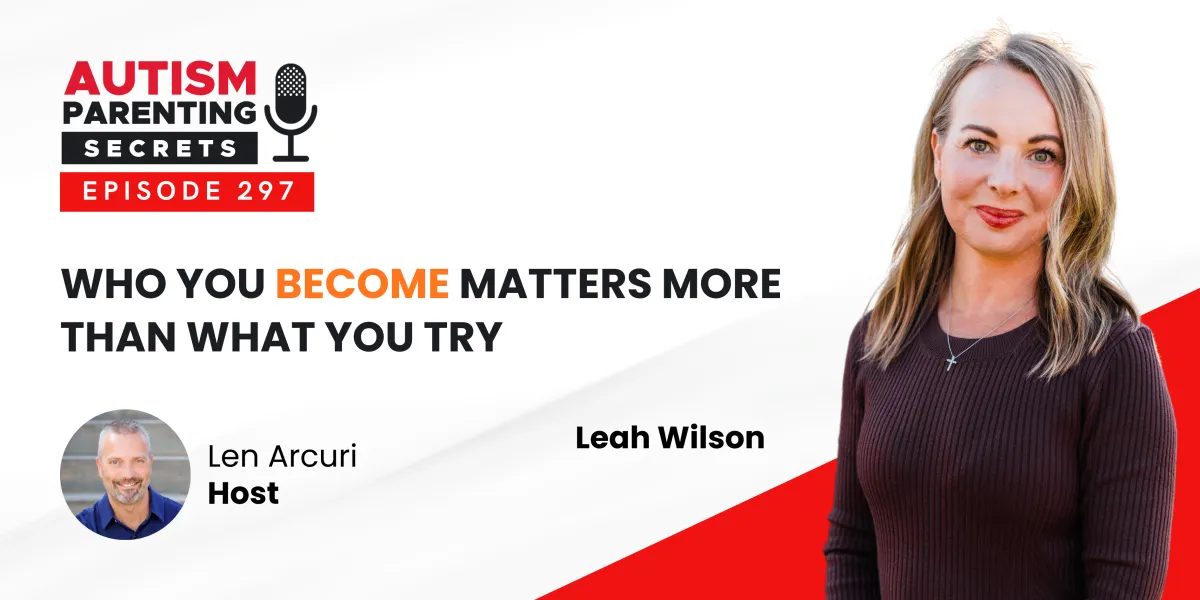
Episode 297 — Who You BECOME Matters More Than What You Try
Guest: Leah Wilson • Date: March 5, 2026
Episode Overview
Leah Wilson returns to the podcast to explore how parents reclaim authority over health decisions in a system built on symptom suppression and compliance. This conversation centers on identity, trust, and what it means to cultivate vitality rather than manage illness.
About Leah Wilson
Leah Wilson is the Executive Director and Co-Founder of Stand for Health Freedom. An attorney with a background in complex litigation and advocacy, Leah has spent more than a decade working on child welfare and parental rights issues.
Her work was shaped by firsthand experience in the foster care system, where she witnessed the widespread use of psychiatric medications as behavior management and the enforcement of one-size-fits-all medical mandates. These experiences led her to expand her advocacy beyond foster care and launch Stand for Health Freedom in 2019 to protect informed consent and parental rights nationwide.
Leah is also an educator and sought-after speaker on holistic health, religious liberty, and family sovereignty, and is the co-author of Reclaim Vitality.
https://standforhealthfreedom.com
You’ll Discover
Why Following Experts Can Feel Safe Until It Stops Working (4:21)
How The Body Can Be Devitalized And Revitalized (9:02)
The Three Principles Of Vitality And The Seven Virtues That Guide Decisions (10:46)
Why Root Cause Thinking Still Misses The Point If Healing Is Interfered With (24:14)
The Risks Of Whole Genome Sequencing And Predictive Medicine In Healthy Newborns (28:24)
Referenced In This Episode
Full Transcript
Leah Wilson 0:00
And I think where the snare comes in is it feels safe and secure to follow the experts, like lifting that responsibility off of ourselves as people and as parents. It's like, oh, well, I find security and just simply following the experts until you have an experience that teaches you otherwise. And my desire is that we don't have to wait for people to have dramatic harm or loss in their own lives or their own families, to have the paradigm shift that we can reach people in advance of devastating harm to you know, ask that first courageous question, which is, Who am I trusting with my health, and if the answer is anyone other than God who designed the intelligence within you, then you have some work to do.
Len Arcuri 0:49
If you're a parent of a child with autism, you are being called to rise with love, courage and clarity. This journey isn't easy, and most parents aren't equipped, but you can be this podcast is your invitation to rise higher, because how you navigate matters. I'm Len, and this is autism parenting secrets, where you become the parent your child needs. Now.
Len Arcuri 1:14
Welcome to autism parenting secrets. It's Len, and today I'm excited to welcome back Leah Wilson. Leah is an attorney, a mother, a foster parent, and the co founder of stand for health freedom. She's been on the front lines advocating for informed consent, parental rights and health freedom, and she's lived this work personally, inside her own family and through foster care. Leah is the co author of the new book reclaim vitality, which challenges the idea that health is something we manage or outsource. Instead, it invites parents to step off the conventional path and reclaim the body's God given ability to heal. What I appreciate most about Leah's work is that it doesn't just critique the system. It asks the deeper question, what does a parent need to become in order to lead their family well in a world that profits from confusion, fear and dependence? And that's exactly what we're going to explore today. The secret this week is who you become matters more than what you try. Welcome back. Leah, thank you so much. Len, it's great to be here. I love speaking to your audience and the parents. It's my it's my absolute favorite to talk to moms and to dads about how we can situate our kids for more success than we've had, because we know that our health rates, our health statistics right now are not something we want to settle for, that there is more. There's more for the future generations. And how do we help create that cultural shift today? No doubt. And the beautiful thing, right, is that there is so much that is within your control as a parent, as a decision maker. It may not feel that way because of all the forces working against you. So that's why I'm delighted to have this conversation. So you feel so passionately about this that you decided to write a book. So talk a little bit about the inspiration and and what went into that being a way that you really want to reach more people. Nick and I, my husband and I, who wrote the book, we have helped 10s of 1000s of families exit conventional medicine and view the body differently. And seeing the impact that has on their health, on their children's health, on being able to fulfill their God given callings, is earth shattering. I mean, it's truly life changing, and that's something that we want people to have the opportunity to recognize that we can't simply live in whack a mole, health care and use oregano instead of harmful antibiotics and get different results. You know, it's going to take a paradigm shift of how we steward and manage our next health decision, and not just making some swaps. You know, it's not necessarily finding the next best supplement or the next best protocol, but understanding that the body is designed to heal and that there are some virtues that go in embracing embracing that principle as we live day to day. Absolutely, that resonates with me on so many levels, and it does come down to print like first principles, principles of health, principles of empowerment and and I know we're wildly aligned on the body's natural ability to heal, and therefore, with that as a principle there, it really changes. You know how you even look at what's happening, and therefore what might help, but a lot of it does even come back to an earlier principle, which is that parents or just individuals, have the ability, even though other people aren't telling you that have the ability to discern for themselves what makes sense for them. And I say.
Len Arcuri 5:00
That, because it's the default model, is just follow the conventional path, don't step out of line. Kind of do what you're told. And that those forces are so prevalent across the board, so it's hard to even step off of that and entertain something different.
Leah Wilson 5:18
And I think where the snare comes in is it feels safe and secure to follow the experts, like lifting that responsibility off of ourselves as people and as parents. It's like, oh, well, I find security and just simply following the experts until you have an experience that teaches you otherwise. And I My desire is that we don't have to wait for people to have dramatic harm or loss in their own lives or their own families, to have the paradigm shift that we can reach people in advance of devastating harm to you know, ask that first courageous question, which is, Who am I trusting with My health is, if the answer is anyone other than God who designed the intelligence within you, then you have some work to do, because it's you can't trust Dr Jones with your body's ability to heal. It's that belongs to God. And from there, we begin removing what's interfering with that design such things like food by man or toxic inputs and how you move and breathe. And if we remove those interferences and put our trust in the right place, we're going to see dividends paid just from that small, courageous step right there.
Len Arcuri 6:34
Yeah, that's really powerful, and then beautifully said, going back to maybe how you started, though I know I personally in my own journey with my wife Cass our moment where we couldn't just blindly go complying and following the conventional model, when we realized that, oh no, that won't work, was our son's diagnosis of moderate, borderline severe autism, and that was that when He was 18 months, and he's 19, now, wildly unrecognizable version of himself. He's progressed so much, but I know with certainty I would never have jumped off that conventional path unless I had my oh shit moment right, personally with my son, and even for myself, I probably wouldn't have shifted if it was just my own health. But something's very different when it's your child and you're you're the decision maker for them. So I know it would have been hard for me to have shifted how I was thinking about it unless I had something major. And I'm guessing it was the same for you, where you had something that happened that kind of prompted you to make this shift correct,
Leah Wilson 7:42
going into full time advocacy, there was a prompting, for sure. I mean, I guess I sometimes I ask, God, I'm like, Why? Why was our family spared? You know, we, my husband is a chiropractor, and so he has taught me the principles of health and healing from the time that before we were even married, and so by the time we had children and had made our own health decisions, we were on on this wavelength of natural health. But my husband, you'll read in the book, if you read the book, he had a diagnosis. Some some doctors called it Crohn. Some called it irritable bowel. Some called it, you know, all these different things to describe blood in the stools and runny stools for, you know, 15 times a day. And he had that moment to recognize, oh, wow, I need to take control of my health, because I'm an athlete, I'm a personal trainer. I care about my health, and I'm losing it at a very young age, you know, in my 20s, and so he had that moment of a wake up. And years and years later, we connected the dots and put together that what he was experiencing was a side effect from Accutane, an acne drug that were was given when we were in school, when we were high, middle school, high school students, it was given to so many of our peers, and then they were told go once a month and get your liver levels tested, because this can completely crash your liver and congest your liver. It can shut down your kidneys. And parents were just giving this to their kids to cure acne with these dramatic side effects, and now Accutane, poisoning is widely known as devastating to by the time a person's 30, their ability to move and function and digest food, and so that was a big wake up moment in our family that put us on a path to chiropractic care and to nervous system First health care and to understanding that the body can be devitalized. You know, we can do things to our body that downgrades its vitality, but it can also be revitalized, and that everything that the body is doing is working toward that state of revitalization and firing on all cylinders.
Len Arcuri 9:58
And there's ways of. Of taking actions and making decisions, where it's easy to inadvertently get in the way of that natural process,
Leah Wilson 10:08
absolutely, and we don't sometimes, in the moment, we don't recognize it. We don't recognize that, Oh, I haven't been able to sleep for two months. Like, what changed that caused that sleep disruption, you know, just looking at the timeline, looking at the factors of what's going into us with our thoughts, traumas and toxins. It's not just toxicity. It's not just slips and falls, but it's also our thoughts and what has changed about what we're entertaining in our emotional and spiritual world also.
Len Arcuri 10:40
And I think that's where your book comes in, in terms of focusing on this kind of identity shift, right? What is the opportunity for somebody to go from where they are, which, again, may be very educated, very aware that we live in a toxic world, very much understanding that health, freedom, the ability to make decisions about what's right for you and your family, all those things are important, but yet your operating system isn't aligned with that understanding, right? Because it's easy just to defer, let's say so. So talk a little bit more for someone who's listening. And by the way, I know that your book's on its way to me, I will actively be reading it, but I know enough about it in terms of the key principles that you talk about in there that are just so super important, and nobody really teaches this. So talk a little bit more about the principles in your book about this identity shift.
Leah Wilson 11:33
Yes, we talk about the three principles of vitality. You know that there's a different way of looking at this, because we're taught in allopathic medicine, which by default, if you are born in this nation, you are in an allopathic culture. I mean, you are saturated with everything you see and hear on TV, your teachers, your pastors, like we're saturated with allopathy. And what does that mean? It means that we look at the body as something to be solved, and we look at, you know our health as bad genes, bad bugs and bad luck, and staying stuck in that system, because we can recognize that natural health is good or that healing is possible, but still be victims of genes and luck and bugs, and when we stay There, we find ourselves on these windy roads of destruction that are extremely frustrating. And so that paradigm shift from bad genes, bad bugs, bad luck and managing every cell in your body actively to that the body is designed to heal, that it can be devitalized in every intervention must align with revitalization, and I think that's the key we get. We feel like we're backed up against a wall, and it's like, oh, well, I have to take the antibiotic, I have to take the conjunctivitis cream. I have to and it's like all these I have TOS with a belief that there are no options in the moment, that you are in a situation where you're either being told or you believe yourself that there are no options and no hope. It's time to step back and dig deep and and search. Do some searching for what is true about the situation and what options actually exist. Because it's rarely, rarely, rarely true that there's no options. And I don't know who, what man on this earth has the authority to tell you there's no hope. You know that's not really something that man is in control of. Doling out is hope. So you don't have misplaced hope or false hope, that that's an oxymoron, like hope is outside of what we can see, outside of what our intellect can know. And so you have to look at what's true. And in the book, we walk through the seven virtues of a vitalist, like what it means to have mental fortitude, what it means to have food temperance, what it means to live in alignment with your nervous system first. And you know, there's, there's seven of these virtues that help put someone on a path to not being so easily tricked the next time they have a health decision to make, of feeling confident in the direction that they're stepping and how they're nurturing their children, and that confidence is something I desire for everyone. I mean, we find ourselves in situations, don't get me wrong, where it requires digging deep, it requires prayer and thought and going to the people that we trust for help. But if we are aligning each decision with these virtues and principles, we're going to find ourselves in a position where we have less fear, less bad decisions and better outcomes, and understanding that everything we experience is ultimately for us, and when we can operate at that level, then we don't have to fear a diagnosis or think that we failed because we have a diagnosis. That's not the point. The point is, how are we responding, and are we operating out of fear or out. Have a place of confidence.
Len Arcuri 15:01
That's, I think, in addition to that, the the alignment piece that you mentioned is so critical that ultimately, any decision you make, you do want to ensure that they're aligned to the virtues, they're aligned to your values. And I, again, I think it's hard sometimes for people to do that, because there's a more than the desire to make good decisions. There's also the desire not to look foolish and not to be judged by other people that what you're doing is reckless. How dare you not take that antibiotic or how dare you do you know there's so much that's out there, and I just feel like it's natural for people to to feel, perhaps more concerned about the judgment of others than about I'm going to do what's right that's aligned to what I believe and and so I that's, that's where your book does a I think the focus on helping parents to see that more clearly is, is A very powerful preliminary step that most people miss.
Leah Wilson 16:03
Yeah, and when you buy the book, buy one for your friend too, because this is not something we want to do alone. You know, it's something that your friend's opinions or who you allow to speak into your life matter enormously. I mean, I know, with my last birth, I I've, I've, my oldest is 14 and my youngest is two, and with my youngest, my one parameter was, anyone who's going to be a part of this journey has to expect it to go well. I mean, I had had enough infertility and devastating losses to be fully justified in medicalizing and operating out of fear. And I said, Absolutely not. This is not what we're going to do. We're going to expect things to go well. And by God, it went well. And it was, you know, it was refreshing to have to have an experience where my faith was just fully put in God's hands and not in what man could improve about the miracle of life. So it's, it's, it's a situation where who is speaking into your experience is enormous. Think about a family member or a loved one who has a cancer diagnosis. People are intolerant of not going the chemo route. No matter how many people they've seen slaughtered by chemo and radiation, they still think that you are reckless if you don't do that. Like, well, you have to. You're in this situation, you would be insane not to. And it's like, but wait. Like, let's let this person pursue the healing path that they feel is best for them, and support them in that. Like, whatever it is, if it's conventional, non conventional, if it's a mixture of all of those. And we talk about that really delicate topic in the book, you know, I've I've lost my mother and grandmother and aunt to cancer, to horrible cancer battles, and so it's not something I take lightly whatsoever. I've journeyed it in my family. But I think that it's one of the issues that we have to confront and decide where we stand on it well in advance of having to make decisions.
Len Arcuri 18:06
First of all, I'm sorry for for your losses, and appreciate so much the journey you've been on. And using cancer as an example is a great example, because there is that concept that that is what you have to do. And and again, if you just look at it objectively, a reasonable person would look at that option and say, well, not so fast. It may not be as effective. It may not be right for me. And so again, there's this space for parents to step into a clearer place where they can object objectively, determine what's right for them, what's right for their family. And again, it's, it's just hard for sometimes parents to give themselves permission, if you will, to be that decision maker in chief, right? And that's where I again, I believe the principles in your book really help make that opportunity so much clearer.
Leah Wilson 19:00
And I had one of my friends say, you know, can it really be this simple, like when the light bulbs start to go off, of what it means to live in a way that is congruent with healing, a continual healing? You know that, yeah, there's continual onslaught against my body, but my body is also brilliant and continually healing. And to grasp that principle and how we situate ourselves to be resilient is it's so freeing. There's so much freedom in it, and to reduce it down to simplicity, kind of disarms the public health overreach. It disarms the force and coercion from a doctor when you can see things more clearly. And I think that, you know, God didn't put us here to be confused or to lack clarity or feel like we don't have a route. And I desire that, you know, people have this information at their fingertips, so that they can see clearly through the trees, so that they can guide their children into how to think about their body healing. Look, I mean, you tell your kids the first time that you have a toddler that gets a little scrape. A cut, and you encourage them watch your body repair this. It's going to close it up and suture it, and you wouldn't even have to put a band aid, because your body makes band aids and and then they watch that, and they learn to honor that brilliance, and they learn that, oh, that's happening on the inside of me too. So it's just they're exciting principles to that bring a whole new energy to the subject of health and to the subject of sickness, even like when you're sick, your body's actually doing something insanely smart and protecting you and keeping you resilient and exercising those muscles of immunity. And it's just it's an exciting shift to live through, because I think that more and more families are hungry for this paradigm shift and hungry for permission to look at the journey of health differently.
Len Arcuri 20:51
Yep, I fully agree. And if people are in that state and they're waiting for someone else to give them permission, that's a horrible strategy, right? Because you can give yourself permission, and you can do it now and again, get to a much clearer and a much more effective way of understanding what's happening. And if you do that, then the options of how you can proceed, to allow your body to operate the way it's intended, to respond to a challenge, whatever you're having, those options become radically different as long as you step into that different perspective.
Leah Wilson 21:28
Yes, and that's been so key when even talking to lawmakers and talking to people who we want to change policy, to have a different landscape, because you get in front of you, and you're like, look, we need to get rid of all the medical mandates. We need parents to know that there are options, that the state is not in the exam room with them, that they can make decisions for their child. And they're like, Yeah, Leah, but what about Super lice? And it's like, What do you mean? Like, there are, there are homeopathic remedies or natural remedies. Like, you don't need to force a Lice Treatment on a parent, they will want to take care of the lice, trust me, like, like, but what about severe conjunctivitis? And you're like, Yes, I have healed overnight severe conjunctivitis in my child with natural remedies. Like, there are always options. You don't have to think that our hands are tied to force antibiotics on people, to force prophylactics on people, but that we can trust parents to want their children to heal and to access those options within their own communities.
Len Arcuri 22:29
Yep, no, agreed. And I think maybe it makes sense just to go back a little bit what you were talking about before with the allopathic model. And I know many of our listeners are aware of this, but for those who may not be, yes, if you are living right now, that's all you know in terms of what conventional medicine is. But if you're 120 or 130 years old, you would understand that. Back then, there were allopathic hospitals and there were also homeopathic hospitals that had more as the underlying premise about the body's natural ability to heal. So it's just in relatively recent memory, it only seems like there's this allopathic model, which you described it well, but I would even bottom line it, saying it's all about symptom suppression or management, right? There's nothing about the allopathic model that really reveals, let alone addresses, the root cause, and that's where, when you talk about natural approaches, it sounds kind of new agey, but it's like, no, no. It's just, hey, there's simple things you can do, and many of them are truly natural, that can actually help restore vitality, to restore health, to get to the underlying root causes. And that's the opportunity for for parents, and there's lots of different slices of natural approaches with homeopathy be one of them, and that changed everything for my son. But the key is that the current allopathic model isn't designed and set up to get to the root cause of anything.
Leah Wilson 23:55
And I would even add the root cause of interference with healing, because if we're chasing the root cause of diabetes or the root cause of neurological decline, like we're still thinking that we know better than the body, you know, but if we're looking at the root cause of interference to healing, it's really reduced down to three things, thoughts, traumas and toxins. What is interfering with my body, healing or reaching homeostasis, it's you can assess those three T's, take an honest assessment for yourself and get to the bottom of it. And when you said, allopathy is reduced down to symptom suppression, I think I love that you say that, because if you ask yourself, Am I suppressing symptoms? It doesn't matter if you're using a drug to do it, or if you're using a supplement to do it or a homeopathic remedy, it's still symptom suppression. Like, do you trust your body to fight a cold? You mean, do you trust your body to navigate a flu bug? And that's resilient. I mean, I have friends who think they're they're so proud because at first symptom of Little Susie, I gave all five family members ivermectin, and it's like, why'd you do that? Why'd you interfere with your body? I mean, ivermectin is an antiviral, anti parasitic that messes with your microbiome, that it can create dysbiosis. And so when we recognize how brilliant the body is and how it wants to mediate things for you on a cellular level and to strengthen every system and every function while it does it, then we stop fearing that the inconvenience. And I think that a lot of even naturally minded people, they don't necessarily fear the fever or fear the vomit. They fear the inconvenience of being sick, and it's like friends. This is part of the human experience. Your body has to have seasons or moments of purge and recalibration and heating up and and pruning in order to be resilient next year and in 10 years and in 20 years. And it's like embrace the resilience, embrace the fact that your body responds with a fever, that your body purges the unnecessaries, and we're going to end up somewhere wildly different, because we're not going to be tricked anymore. And that's what I'm excited about, is I think people are starting to be less trickable, except when it comes to genes, we're going to have to have that hard conversation about what we can attribute to genes and what the gift or savior of personalized medicine is going to is going to mean In a few years, because the biotech industry is rising up to far surpass the vaccine industry when it comes to being the savior of our children.
Len Arcuri 26:49
Yeah, well, let's, let's dive into that a little bit deeper, because that that it's great that we're not talking about where is everything going, and there's a lot of pros and cons in terms of, hey, we have more ability to understand what's happening, and more information, more data, generally, is a positive thing. So talk a little bit more about where you see this going, what parents need to be on the lookout for, perhaps mistakes to definitely not make, and when you've mentioned about genomic you know, I've recorded several episodes with guests to talk about, you know how getting more data on your genome, on your functional genomics, is a useful thing to be able to have that data to maybe inform Hey, what? How's your child or yourself? How are you wired? And if you know how your genes are kind of set up, then that could help you make better choices with respect to foods or supplements and that type of thing. So there's functional genomic testing, just getting that blueprint and seeing what does that reveal. And I've found that that can be very useful to help inform steps you can take. But that's not what you're worried about. You're worried about something very different.
Leah Wilson 27:58
So I would say that yes, that can be useful depending upon how you use it. You know, if you're going to use this as a tool of empowerment to say, hey, look, here's a vulnerability of mine, or here's something I should avoid and use that as an added tool in your tool belt to have more resilience. Great, that's fantastic. If you are going to use this to label asymptomatic individuals, healthy individuals as predisposed or as a risk based on the presence of a gene, then we're signing up for a lifelong sentence of biosurveillance. And what I don't want to see happen is even for functional genomics, I don't think that public health should get involved. Get involved. I don't think this should become standard of care day one of life for every child to have their DNA read to their mother. And that's what we're looking at right now with the promise of personalized medicine and whole genome sequencing is to expand newborn screening. So go from measuring, you know, a handful of biomarkers, or a couple dozen biomarkers, to now looking at three to 700 genetic markers to foretell this child's future. And there is a lot of concern with that. I mean, imagine a world where your child's entire genetic profile is uploaded the day that they're born with no permission, no choice, no way to delete it. It's in a centralized federal database, and the federal government is following up with you on making sure that you're following protocols for little Johnny's gene editing, and gene editing has massive, red flags with how harmful it can be. I'm not saying it will never, ever have promise, but we need to have all of the information. We need to know. What does this gene actually tell us about a child, and what are the options on the other side of that?
Len Arcuri 29:54
Yeah, no, it's all about what you do with that information. Who has access to that information? I. No, I couldn't agree more. And the, you know, I think also, when you think about how this is likely to play out early on, it means every single person is going to have some diagnosis, right? There's going to be something that they have. So, like, the level of disability will, like, from the get go, will be a much higher, like, everyone will have a disability, which is great for many institutions who love the fact that there's all these people with disabilities that they have products for to help people cope with them again, nothing to actually help people to live a vibrant life.
Leah Wilson 30:35
And yes, and what the moms will be told that you know, either in their prenatal care in preparation for this testing at day one of life or day two of life, they're going to be told like, wouldn't you want to know if we could save your child from a miserable, short life? You know, that's what you're like, of course, absolutely I'd want to know that. But what they're not told is that many carriers, in some instances, like 85 to 90% of carriers of this gene never develop symptoms and live a normal lifespan without symptoms. They won't be told that some standard tests produce misdiagnosis. They won't be told that long term outcomes with treatment are unknown. So even if we find the gene, the only treatment we have is radically experimental, and so that's what we have to understand, like we're going to be told. Wouldn't you want to know? But it's know what the genomics project, the Human Genome Project, did not produce what they wanted it to. They wanted to find one gene equals one disease, and what they found is almost all of them are multifactorial, and in many cases, the gene is a bystander, not the cause. They haven't shown genes as cause. They have shown some genes as bystanders. And so it's it's just questioning, what does genetics offer us as individuals and as mothers, and then knowing, well, I mean, wouldn't I want to know for what purpose, what promise you have for me? And then on the other side of it, I'm giving up my child's privacy from day one of life. So it's just it's having our eyes wide open with whole genome sequencing of healthy newborns. We're not talking about a newborn that's failing to thrive and they need to save its life. We're talking about healthy newborns that the mother should simply breastfeed and hold close and take home and plan for that baby to have an amazing future.
Len Arcuri 32:29
Yeah, and at that moment, instead of allowing that, it's very likely that moms, more and more will be given information and these prognosis based on what's happening that immediately dysregulate her nervous system, which again, has a huge impact on the mother, the child, the entire family. So you know, there is reason for caution and for people to understand that, yes, understanding more about your genetic makeup could be a great thing. It's what you do with it. And I love that you touched on the idea that, yeah, we all have genes that are set up in certain ways, and you could have a quote, unquote defect or a susceptibility, you know, in a particular gene or gene pattern, but that doesn't mean it's ever going to express, which is why all The things about minimizing toxic exposure, one of the 3t that you mentioned why that's so critical that if you could play better defense, and there's so much of that that you can control that, that that's the key thing. And your genes, you know, if you're doing that work, what your genes are programmed to do or won't do may not matter that much, because they won't express
Leah Wilson 33:42
That's right. And understanding that, you know, what we expect to happen is powerful. What we speak over our lives is powerful. But also knowing what scientific integrity is there behind genetics, you know, and we go through this in the book. We go through what genetics are and that you are not. Your genes are not they're not a light they're not a death sentence. They're not a life sentence in just helping people truly understand epigenetics and the expression of life that each of us have in front of us. So even in our family, I wouldn't automatically consider a gene mutation as a mutation, it could be an adaptation that is there to serve you. I mean, even the baraka gene, which has been villainized, protects against dozens of other cancers. And so it's sometimes genetic mutations are a smart adaptation, especially because we we're seeing all of these novel mutations that neither parent have. And so it's like, okay, so why do we see this in the child? And it's genetic, but neither parent has it, so there's just a lot of questions to be asked before we are funneled into highly experimental biotech solutions, and that's why we spent a whole chapter in the book talking about understanding your genetics. Wonderful.
Len Arcuri 34:59
Well, I will. Forward to reading that. And again, I think the topics you're covering, the principles, are super important. So So yeah, I'll pause our discussion here. Encourage everyone to buy the book and read it. Would love to have you back on down the road, especially as you continue to move forward with not just the book, but with everything that stand for health freedom is doing? Is there any one thing that you leave our listeners like an internal shift, that you think might be the most important rather than doing some kind of intervention? What would you say that some listener right now could do that could create the biggest positive downstream impact for themselves and their family.
Leah Wilson 35:41
My prayer this year has just been that as things are exposed by the federal government by other institutions, that everyone who chooses to remove their faith from man and man systems will then, in turn, place it directly in God's hands. And when we put our faith in the right place, and we give ourselves permission to have a sound mind when making decisions, we're going to find ourselves with radically different results. And you know that is available to each and every one of you, and that's the exciting thing. So thank you so much, Len for having me on and sharing reclaim vitality with your listeners. I hope to meet many of them and to engage with them at Stanfield, freedom.com and they can find us also the one dream podcast is where we have a lot of these deeper conversations. So thank you so much, wonderful.
Len Arcuri 36:31
Thank you Leah, and thank you again for the light that you are shining your child needs you running on all cylinders now, and the fastest way to rise is with personalized one on one support, get started today. Go to elevatehowyounavigate.com.