
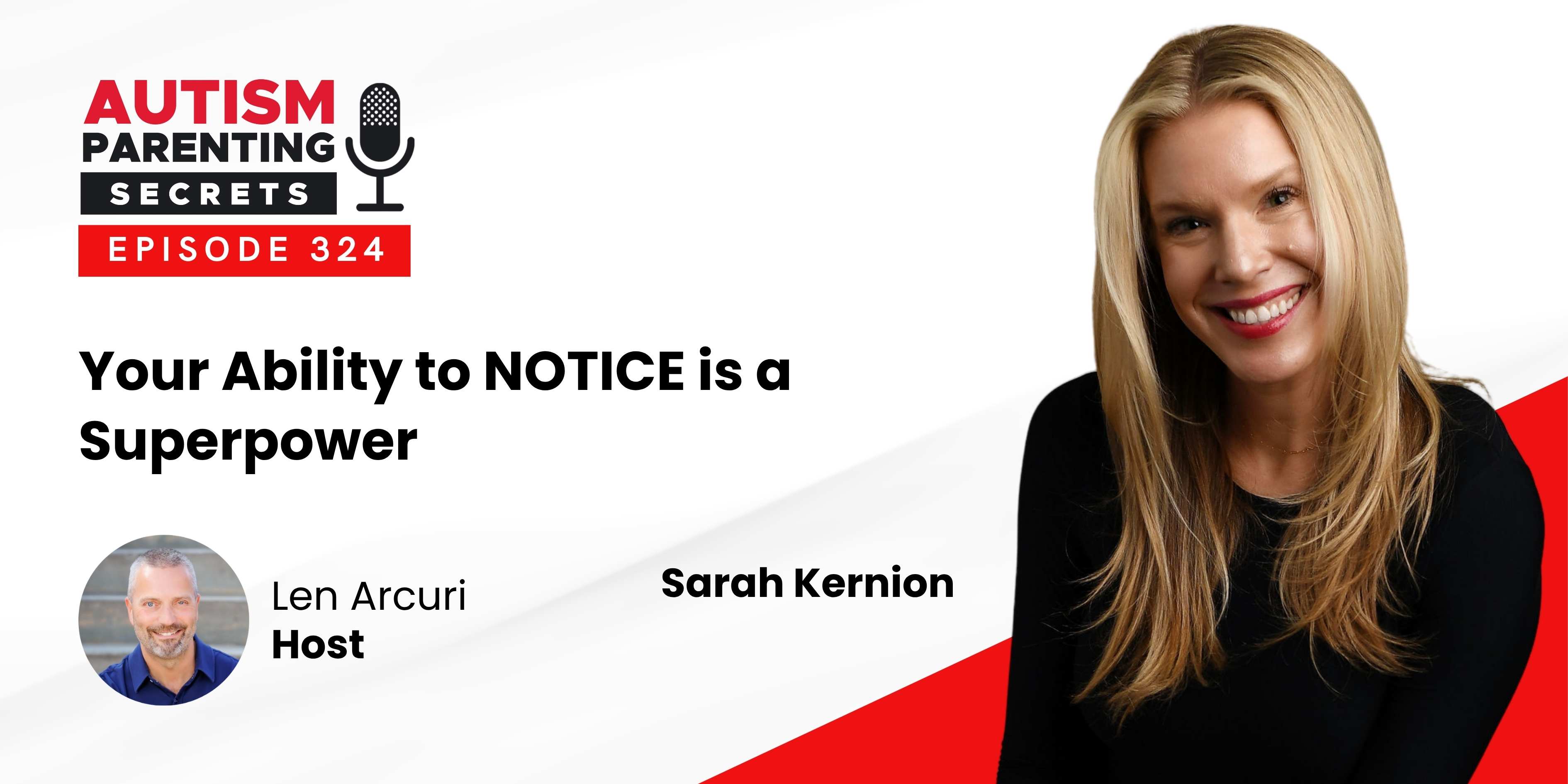
Episode 324 — Your Ability To NOTICE Is A Superpower
Guest: Sarah Kernion • Date: September 10, 2026
Episode Overview
Sarah Kernion is the founder of INCHSTONES, host of the Inchstones podcast, and a national advocate for families raising children with profound autism. In this conversation, she explains why what you notice about your child matters and why your observations deserve a place alongside clinical expertise.
About Sarah Kernion
Sarah Kernion is the founder of INCHSTONES, host of the Inchstones podcast, and a national advocate for families raising children with profound autism.
She is the mother of three children, including Milly and Mack, who both have profound, non-speaking autism and whole body apraxia.
Through honest storytelling and conversations with leading researchers, physicians, and fellow caregivers, Sarah explores the intersection of science, advocacy, and the lived reality of raising children with the highest support needs.
Her work invites parents to notice the small moments that often reveal the biggest truths because inchstones, not milestones, change lives.
You’ll Discover
Why your observations about your child are incredibly important clues (3:53)
How to show up differently in conversations with practitioners (10:21)
Why becoming a better observer changes your role in your child's care (21:07)
Why asking "Why might this be happening?" can reveal more (31:36)
Why inchstones deserve to be celebrated alongside milestones (39:02)
Full Transcript
Sarah Kernion 0:00
That identity shift, I know, can be both empowering and very, very scary to a lot because it feels like you're stepping into a power role that you didn't choose, and none of us chose. I did not go. None of us woke up. You know, like I was in New York City with my oldest. I didn't wake up in New York City thinking I had two children with profound autism on my bingo card of life. That just wasn't it. Yet it's asked me to rise, and I believe that my mission continues to be is asking and challenging so many other mothers and women to do the same. Because as you know, as a coach, and as I do as well, I can't do it for you. I can't give you the blueprint, but I can tell you right now that if you own that primary positioning of being the the most well informed person about your child, and you tell it to yourself, and you rehearse, and you think about the logical and critical ways to express that in those meetings and observation rooms, it does something to change the terrain, and I believe it only benefits your child.
Len Arcuri 1:02
If you're a parent of a child with autism, you are being called to rise with love, courage, and clarity. This journey isn't easy, and most parents aren't equipped, but you can be. This podcast is your invitation to rise higher, because how you navigate matters. I'm Len, and this is Autism Parenting Secrets, where you become the parent your child needs now. Hello, and welcome to Autism Parenting Secrets. This week, I'm talking with Sarah Kernian, founder of Inchtones, host of the Inchtons podcast, and a national advocate for families raising children with profound autism, as a mother of two children with profound non-speaking autism and whole-body apraxia, Sarah's learned that the smallest observations often reveal the biggest truths. And through honest storytelling and conversations with leading researchers, physicians, and fellow caregivers, she helps parents recognize the unique value that they bring to their child's journey, and to trust what they're noticing. In this conversation, we explore why parents should never discount their own observations, why their perspective deserves to stand alongside clinical expertise, and how paying close attention to the small things can lead to life-changing decisions. The secret this week is your ability to notice is a superpower. Welcome, Sarah.
Sarah Kernion 2:26
Len, thank you so much for having me in that very generous introduction. I appreciate that.
Len Arcuri 2:30
Absolutely. Well, I appreciate everything that you're putting out there. I know we're aligned, wanting to serve parents, wanting to be useful. You and I both know this journey is extremely challenging, and I know I wish someone gave me a playbook early on, which doesn't exist. So I know you have lots to share, and you're doing that. I guess something that jumped out at me about what you're putting out there is that you've said that parents simply aren't participants in their child's care, and that often they're the most they're the first and the most accurate pattern recognizers. I love that term that you've been putting out there. So overall, I mean, everyone knows the parents important, but you know their observations gathered over 1000s of ordinary moments really not only deserves to stand alongside the experts, whoever they might be, but even to be at the very top, you know, in terms of what's going to guide a parent, and definitely not something to to be underneath anyone else's opinion. So, tell me more about that concept, because I couldn't agree with it more strongly.
Sarah Kernion 3:32
Okay, well, where to begin? So, let me let me rewind a bit. You know, I am the mother. I always say of three beautiful and healthy children. Right, I've got a typical developing 13-year-old daughter, and then my youngest two, Millie, who's 11, and Mac, who's eight, are both profoundly autistic and non-speakers. And you know, for years I was waiting for milestones because that's what we celebrate as a typical you know American mother does. And something sort of so organically and authentically happened where I was realizing that our lives were actually being changed by something so much smaller, and you know, five seconds of eye contact or a new sound or you know a gesture towards another human to engage those were moments of shared joy and they weren't really milestones, so Inchtones is where that name came from. Just to give everyone an understanding of that, because it's really personal, but it's also very concrete to any parent on this special needs or a regular parenting journey. So that that's where Inchtones began. I believe that we realized at some point that our lives were just not going to have the same trajectory, and so that missing language is what integrated first for me. And then to answer your question, to share more about this being a pattern recognizer, the inchtones, it was almost as if all those little moments that I was seeing that as my children were growing, I. Say like these kids are growing. They're not just in a corner, you know, just receiving sunlight and and food, right? They are actually deeply developing in a structure, in a household, in any sort of environment that they're in. It just is so atypical that we have a lot of friction as a conditioned, typically developing human, and so those patterns. When I was starting to just log them and bring those to whether it was the the developmental pediatrician or the neurologist or a GI doctor or an allergist, all these different things, it didn't seem like I was placed as upstream as I should be. It didn't seem like the data, which felt so scientific to me. It is. I believe it is so scientific. I was recording in live time the moments of connection that were happening, the moments of growth or skill development that were happening, that actually were reality. It was the truth. I I wish I could just you know have meta glasses for my eyes and say take a picture or take a take a recording, but these things were happening, and so when I repeated them to the clinicians, it was as if that data didn't exist, and so I just kept pushing that, saying, "Help me understand how I'm not being gaslit by what I'm actually seeing. I have no reason to share this with you. There's no reason for me to make this up, I'm actually seeing this help me understand how we can integrate this into understanding their neurology, their skill set base, and then by having two, especially having a girl and a boy, they're separated by two and a half years. It it allowed me to almost solidify that yes, I was seeing all these things with my daughter Millie and the things that I was seeing in my son Mac years later were different. The growth was different. The skill sets were different. But that was still such a deep internal knowing that I had that I was calibrating to. That I was even getting better at seeing. So I believe it's become just this launch pad to have mothers, caregivers, parents, fathers, anyone that's just logging all of this data about their child, to know that there is power in that. You shouldn't feel so. I hate to say the word right now because it's so popular, but like gaslit by your reality. And I think that that's really what's rising in a lot of my work is that we should be able to sit in truth and reality and bring that to the table as the top part, the most upstream point for our children in a clinical setting and in and in a generalized home setting as well.
Len Arcuri 7:31
Couldn't agree more. And I guess if you just go back to those times, right, where you felt like, let's just say, for lack of a better word, that what you were bringing to the table was being diminished or not heard or not not appreciated. You know, obviously, the conventional medicine world has a lot of flaws, but is it that you know practitioners generally don't care, or is it that they don't have time enough time to care to to take in that data? Like, if you look back and you just say, okay, how can we change? How can we help be part of the change where the parents' input is really, you know, respected and and welcomed, not just tolerated? You know, what do you think? What do you think was going on then, and what do you think is happening now in that environment?
Sarah Kernion 8:17
You know, it was eight years ago, I guess nine years ago, almost that I was bringing my three-month-old son, who I was starting to see these little micro stims while he was nursing, and breastfeeding, and bringing it to Millie's developmental pediatrician, and I luckily had a personal connection with her. I have a moral and obligatory pillar here to share with you what I'm seeing, and she was very open to it, but also pushed back so very typically in like a Western medicine way of Sarah, what you're sharing makes sense, but the DSM says this, and he does not fit the five different categories to receive a diagnosis. Let alone Sarah, he's 12 weeks old, and I said, great, he's going to be your youngest diagnosed patient here one day, and that's not me trying to manifest this. This is just sitting in the reality of his behaviors and what he was showing me, and you know, in talking with more you know root cause practitioners and functional medicine doctors and neurologists, I think that what they're doing, which is what every physician I think should be doing, is taking each child as each child, just like every child with autism, is one child with autism, and what those characteristics are, even within a family, can be so different, but still be used as a way to navigate and guide. It's. I don't think it's giving the power or the the medical treatment angle to the mother or caregiver, I just think that that's that's that's conscious integration, and I just don't understand how we can divorce those two if we are really truly being the best guides for our children, and especially for the for the physicians too.
Len Arcuri 9:54
Yeah, no, I agree, and I we could take it in a lot of different directions now, but I think if you go to that moment, right. Where a parent sitting there with a practitioner, a pediatrician, developmental pediatrician or integrative pediatrician or whoever, it's just very easy because I think the entire system is designed where there's an authority being the clinician, and then the parent who's not at that same stature. So I think in terms of parents showing up, at least I showed up being very deferential, right? Hey, I'm not an expert on this. Let me, and so it wasn't like I was intentionally discounting my intuition. And and and my wife Cass at the time, she had no problem not discounting her intuition, but at least how I was bringing myself to the table was more deferential, and I think when I look back on that, yes, it's easier to be deferential. It's easier to be told what to do, but I think the undercurrent for me also was, hey, this is some serious stuff going on. I don't want to mess this up. So I had like a fear underneath it all of making a mistake, and and it was easier just to say I'm going to just defer, and and not that I was intentionally handing my authority over, but in actuality I was.
Sarah Kernion 11:09
Yeah, I think well that's again you know you become parents. I was in my you know late 20s when I had my my oldest daughter, but I was in my 30s. I mean I was decades long conditioned to the Western medical system before any sort of neurological diagnosis or disorder was even placed into my reality, right? So I think about that makes so much sense, Len, when you say that. Of course, why wouldn't you be like? There's no, there's no, there's no manual for you handed as a father when this, you know, when these behaviors and communication challenges start to become so serious that these interventions happen. I think that one in the age of AI, I think it is wonderful and for parents to take use of tracking and just putting in notes to categorize for a doctor's office visit. You know, I am a very flowery language verbal woman, and my voice notes are long, but if I can put those into something to help me get like a note generated form of like, okay, what are the patterns that I can then bring to a doctor? I would really encourage parents to use that to help clarify their thoughts because even the most basic AI is going. If you can just say, "Help me clarify what I'm trying to tell a physician here and get a few bullet points, and really ask and say, I know it's it's so uncomfortable because that the system is set up for them to be in this position of power. And again, I was born in the you know early '80s. Like this this whole idea that we can sit in a position that's similar because of our knowledge and what we actually live should be taken into account with our children is hard because physicians and doctors were held in a very very high authority and they still are and they should be because of their credentials. But I think if you can get over that ignition energy of saying, "Hey, would you mind letting me share this to be documented so that you can take this as we go about their care? It goes so much farther than you think, and what I think it does, Len, and I think you'd agree, is that it changes the terrain of that room. I think when you are a parent that can even in one or two sentences attempt to bridge the gap between the physician and you in a way that is deferential to their expertise, but as but also reminds them that you are not just a you know an adult who built a human body and then here you go like tell me what this child is like we are of them, and I and I think that a lot of what we can do is to utilize the things that we have in society now to help organize those thoughts, so that you do go in when you do have that very precious one-on-one face-to-face time with these doctors and share. And it doesn't have to don't think it has to be so much. It doesn't have to be pages and pages. It can be. This is what I've noticed over the last nine months, this is what happens every day after school. This is what happens every time when we leave the house. That you know, and making note of that because that integration, those patterns, if you are with a good physician, should matter.
Len Arcuri 14:15
Yeah, and and to your point, it it can't be multiple pages, right? The clinician just can't take all that in, so more is not definitely better. And I wish there were AI tools back when I was, you know, early on in my son's journey. Because getting getting all those thoughts clarified, it's amazing what you can do now. But again, but the raw data for it is still what the parents observing, and and those are incredibly important clues, and so there is incredibly.
Sarah Kernion 14:46
That's such a great that's such a great line. They're incredibly important clues. Why would we not look at them?
Len Arcuri 14:51
We can't dis. I mean, that the last thing that you can do as a parent is to discount that, right? So you have kind of the two sides of this, which is how can a. Parent, better notice, disseminate. You know, get their information out there, make sense of it. You know, if you're relying on the clinician to to pick up on the patterns, forget about it. That's your job. And so, the more so on the parent side, we can do a better job of going into those practitioner visits with the few critical questions, with the key observations, not a laundry list, but then the other side of the equation is also very important. Whereas on the other side has to be a practitioner who actually has some qualities that I think it's easy to miss when you're hiring to bring on your team. Right? They have to actually care. They actually have to be curious to some degree
Sarah Kernion 15:42
and have a desire to aggregate that data, right? This has to be when, when we build science, because this is what I I think is missing so much from the current conversation, is these patterns that we recognize being an integral part of your child's care, documenting, collecting almost behavioral reports or just log notes, logging notes that can be seen. I believe is science. I do believe that, and again, it's not something that you're going to be, you know, it's got going to be validated through someone else coming in and doing the exact thing with your child because they can't with the number of hours, obviously. But when science can learn to recognize that parents have been noticing all what they've been noticing all along. I do think that might be the future of care, and specifically in the autism space.
Len Arcuri 16:28
Yeah, no, no doubt it is relevant data. Perhaps the most important data, and yes, that can be considered as you, as a parent, are coming up with a strategy of how to meet your child's needs, what what makes sense? What root causes to focus on? So again, I think that's where it's it's it's just key to keep in mind those two pieces. Parents, we can show up more prepared and more equipped to get a lot of out to get more out of those conversations. But again, on the other side, you know, choose the people on your team wisely because not every practitioner has those qualities where they're going to be in a position to take what you're sharing and and help you inform what makes sense for your child. So it's likely that practitioner may not be the one who's nearby. You may have to do cast a wider net to find that person, but it's those intangible qualities, as I mentioned: curiosity, humility. Right? There's a lot of qualities that were not in any way on my radar. All I cared about is what's where's the diploma from? Where'd they go to school? Are they in some top doctor? We were living in New York City at the time. Are they the top practitioner? If they're not, I don't. That's not who I want to go to. So I had a criteria of what I was looking for. That you know now it's wildly different compared to like what I think. What are the qualities I'm looking for in a caregiver for for my for my son? So it's just interesting that it's something I didn't give a lot of thought to initially, but I wish I did.
Sarah Kernion 18:04
I think also, you know, even going a little earlier on in the timeline too, what you're noticing and sharing from an early intervention standpoint, you know, before they're three, if you if you're in the waiting list, you know, to get into to even get a diagnosis, there's we know that this country is sitting on like I don't even know what the numbers are, but you. I don't think you're going to meet an autism parent. I said, "Yeah, I started noticing behaviors, and I gave early intervention a call and had an appointment that Friday. Like that just doesn't that that's not the trajectory of this life and diagnosis path. And I would encourage because I wish I had the playbook back then. I wish I was encouraged, even in those earlier moments, to ask greater questions, even through the fear and uncertainty of what the possible diagnosis would be. Because, again, let's really dive into science and the data that the earlier the intervention process is, the better the outcome. You know, neuroplasticity under the age of five is so so much higher, and is is a critical time. And I think I I know personally that that was like in my head so much. And let's do this diagnosis and get these therapies up and going. Like I'm missing critical time. I think that the parents' ability to share what they're seeing, even with like an early intervention team, and to you know just keep like moving past that little bit of friction point to say, yeah, but I'm also noticing this too, or have you seen this whenever you're attempting to get them to stack a Duplo block? Are you noticing just anything, and just to be able to share that earlier on, not to say that it changes the trajectory, but I do think that it would give a more peace of mind because there's so many parents in this waiting phase, and I don't want to discredit that that part of the population here because I remember what it was like to even wait a few months, right? And I remember what how scary that was. I remember thinking before my son. Was even I was putting him in front of a developmental pede and still being told, "You're absolutely out of your mind. Look at him; he's looking right at me. He's making great eye contact. Right. So, utilize even the time that feels deeply uncertain to challenge the assumptions of those around you and stay curious.
Len Arcuri 20:17
Right, and and and so that curiosity, sure, it can get too extreme, right? In terms of if you're overreacting to every little thing, so there's a balance here. But but but I think either the extremes don't help. It's about being tuned in, and and I think going to the concept of noticing, right? So there's the noticing and and trusting that what you're observing matters, but then that's even part of a bigger shift, which is really, and I think as you, I phrase it differently, but I think you call it more of an identity shift, right? In terms of how the the parent and particularly moms see themselves in this. So whether that's with respect to how you see yourself in the consults with practitioners or clinicians, pediatricians, or even sitting in IEP meetings, or you know, with therapists who are working with your child, you know, there's a lot to be said about how you even see your role. So, can you talk a little bit about your thinking and and how you help parents, particularly moms, step into a different identity.
Sarah Kernion 21:24
Yeah, great question. I love answering this. You know, most advocacy-the word when you think of you-you think of an advocate. You think speaking up, right, for something, not not not not standing in the in the in the background, right? What I attempt to do is to invite parents to become much better observers because those are different identities. Being an advocate and being a better observer, and you know, mothers when it comes caregivers, especially, I talked with a lot of them that are prepping for IEP meetings, you know, and then extending that to appointments or therapy consults. They believe most believe their job is just to ask questions, right? And I like. I hope I remember everything. Like I, I hope I explain this well enough. Or as you mentioned before, like the professionals know more than I do, so I'm just going to sit here and I'm going to take it all in, and then I'm going to process it and leave. And what that does is it it creates such an unequal relationship before anyone has even sat down to have a dialog, the clinician becomes the expert. You become the parent, sort of becomes like like a historian, I guess, to the process. And I, what I hope is that Instance, as a platform in any of these settings, offers is that that identity shift as knowing that you are the primary observer of this very complex human being-that's a completely different posture in in a room. And when I prep mothers to go into IEP meetings, because I always say, like, yes, I could be a in the room advocate for you, and I probably would do it better than anyone else that you just pull from the hallway in your kid's school, just because I know the the content of and the and the diagnoses, but I would never be able to convey all this information the same way. So you're not superior to the clinicians in in that regard. You're and we're and to be not adversarial, but to simply hold yourself in a different, very high regard. The you've seen this child wake up every morning. You see the way a new vocalization happens after exercise or swimming, or if their GI is regulated by you know some some sort of new food or or or diet. I think your identity can shift, and I challenge you to shift it to be and to elevate that you are right there alongside them, staying as curious. And also, when you are able to put those observations and to take that that that identity shift from just being the mother and the passive reactor into being an active agent for your child's care, it does something to the terrain of that room. It it and and you and I both know that, but it's hard to to to speak it and into like you know language. But think about it: if you come in and you are emotional, you are on the verge of tears, you are scared. You feel hopeless. All that situation is going to do is bamboozle you, and to just have you quite literally survive. You're just going to survive. You're going to get through it and survive, and it's going to do nothing to move the needle where you are sitting as this vessel of insanely amazing information about your child, that would help them grow and develop, and so that identity shift, I know, can be both empowering and very, very scary to a lot because it feels like you're stepping into a power role that you didn't choose, and none of us chose. I did not go. None of us woke up. You know, like I was in New York City with my oldest. I didn't wake up in New York City thinking I had two children with profound autism on my bingo card of life. That just wasn't it. Yet it's asked me to rise, and I believe that my mission continues to be is asking and and challenging so many other mothers and women to do the same.
Sarah Kernion 25:17
Because as you know, as a coach, and as I do as well, I can't do it for you. I can't give you the blueprint, but I can tell you right now that if you own that primary positioning of being the the most well informed person about your child, and you tell it to yourself, and you rehearse, and you think about the logical and critical ways to express that in those meetings and observation rooms, it does something to change the terrain, and I believe it only benefits your child.
Len Arcuri 25:49
No, I think that that's powerful. I think that identity shift, what you're talking about, it really falls into the categories of of your mindset. You know, the parent mindset coupled with their beliefs, right, and the beliefs being the stories we tell ourselves. For me, and that's a huge part of this podcast. We talk about those concepts all the time, and even the advisory I do. It's all about really those two components together. If they're not aligned in a way that's helpful for you or your child, that's where all the friction comes from, and and so this identity shift that you're talking about, claiming that role, claiming a more powerful role, not saying again that you're better than anyone, it's just that you clearly have a seat at the table, and and everyone else is there advising, but you're the decision maker. So I think I think to step into that role, what I found helpful personally is that while I was not a pediatrician and did not have a medical degree, or I was not the principal of a school and didn't understand all the intricacies of the school environment, you know, I I could show up there credentialed. Yes, you know, intuition and an expertise on on my son was part of it, but I I personally also took on that I am the expert from a root cause perspective, and the reason I took that mantle on was because I knew nobody else, all these other people on the team weren't really looking at it from a root cause perspective. A conventional pediatrician is not looking at root causes. If you start moving to functional medicine and maps type practitioners, they are. But even then, they're still advisors to you. So I think by by adopting that kind of role as the the root cause expert, together with with my wife Cass, and us saying, okay, we're going to now really take the lead at owning what root causes we focus on, whether it's medically or socially, et cetera. That that gave me more of a personal permission to say, "Hey, I belong here, because all these other people, none of them are having a true root cause focus, and I personally believe that's how we help move the needle significantly for our child is by devoting some of our time, energy, and money on the underlying root causes to however our children are presenting or being diagnosed. There's root causes behind it all.
Sarah Kernion 28:14
Yeah, I mean the current system, and you and I are trying to change this, but the the system accidentally trains this dependence of the parent just on the experts. Experts, right? So from the moment of diagnosis and beyond, it's like okay, they know, and I just report based on what they're asking me to report on. And then over time, if you don't change that identity or change that position, they end up telling you they're bringing expertise that doesn't fit your child's need, and then you begin to distrust something that's equally valuable, which is your own very careful observations. And I think you're absolutely right that that what you've done and what I've done and what I encourage others to do is to actively change that system to evolve for to to include you and and again it it will only benefit the child. Now again, there's going to be potentially more work. So there's obviously when you destroy anything, when you destroy the typical flow of what's going to happen, there might be some friction originally. But I think once you get again, just like anything, just like making that first statement, just saying anything about what what you have to add, getting over that like ignition energy of what that might take to change it, will pay massive dividends as the road goes on. It's just that you're changing a system that has always been rewarded for staying the same, and so you go from being this like consumer of your child's data to an actual contributor.
Len Arcuri 29:44
Yeah, and again, it all comes down to how you're seeing your role there. And again, yeah, and and it's never going to be comfortable, right? There's going to be uncomfortable conversations. There will be people who will not be excited about your contributions, what you say. But again, as long as we can. Show up strong, respectful, clear, prepared. Also, again, it's going. It's it's it's inherently going to create. It's going to be challenging or difficult at times. And again, I think it's really helpful just to really understand that these people who are surrounding you, they all have very specific roles. They have their playbooks. They have how they do things, and again, doesn't make them wrong. It just it's helpful as a parent to know nobody has the objective that the parent does, right? Because nobody truly knows their child as well. Nobody truly has as much data as the parent. And again, I think that well-intentioned people may just have different objectives that aren't so relevant. I guess I go back to IEP. I go to I go to IEP meetings where there was one in particular where I sat there as everything was presented. I think it was like 12 specific goals that they wanted to work on for my son, and they had how they were going to measure, and it was all very well thought out. But frankly, none of what they were presenting really got to what was most important for my son, which was really at the time socialization. So I heard everything. I said, "Hey, you guys want to do all that and measure all that? Great. Can we come up with a goal regarding socialization for my son, you know, and it's because the school model-they don't get evaluated based on socialization. They're getting-they're getting evaluated based on academic type goals. So it-it was a kind of an aha for me, although it shouldn't have been that. Oh wait, their goals and what they're evaluated has nothing to do with what I care about. So in those IEP meetings, then I would advocate for can we add these things that I think are really important? And the earlier version of me would have felt too reluctant to say, "Hey, can we add something? I would have just said, "Hey, that's really great. Thanks so much, and left. Which is why, again, I think we all show up differently, but to be active and engaged and to ask for what you want is absolutely essential on this journey.
Sarah Kernion 32:02
Yeah, and I and I want to go back. You were talking about you know functional medicine and these root cause, and you know the current medical system is always just asking the question of like, well, what is this? Is this autism? Is this apraxia? Is this you know epilepsy? What what they're asking? What is this? And I, the question that I love as I've explored more functional medicine goals and pathways for my own children is, they all seem to ask a better question: is what might this be? Why might this be happening? Like why might this be happening? It's not what is this. It's like why, and I think it's just such a better wh question because it's it's it assumes that every doesn't assume that every condition has one hidden cure or that that everyone's biology network is going to be the same, and so I think that that's what root cause and functional medicine is starting to address more is that yes? What is this? Okay, it's autism. Is it gut motility? Is it you know mitochondrial dysfunction? Is it inflammation? You know nervous system regulation? Like what is this? And I think that if we can ask what is this at a more network biology based way, we are going to open up abilities for families to not only be valid in what they've been seeing or use those observations better in a in a scientific way, but that becomes integrated as a whole for the for the entire you know population that's affected by this. And that's I know this you know this country. I mean, in this world, is like we're in this global village, and AI is just like taking over. I don't know. I don't. I don't tend to think of myself as like a toxic, positive optimist. But like, there's some really good stuff that could happen that can be integrated from a population like this with all the information of these different families who present so differently that could really be an aggregate and helpful. I don't know what you thought about that, but it's the it's the like the silver lining for me and in this all this whole AI crazy world we live in.
Len Arcuri 34:11
Yeah, no, there's a lot to be apprehensive about, but also a tremendous amount of yeah sincere informed optimism about what we can learn, how we can use these powerful tools, and again, things are shifting so radically. Yeah, it's easy to get unnerved by it, but again, I I have sincere excitement as opposed to anxiety, and yeah, and I know you and I both are actively working with Meadow Health, particularly because that's an organization or a platform now that's available to to parents who can really kind of get the care that they need while retaining their role, and so that's where Metal Health John Slattery was on the podcast, Dr. John Catanas. I'll put those in the show notes. But again, I think they're an example of an organization that. The opportunity ahead, which is helping parents like you and I, and those who are listening, really get more equipped to address root causes, to to leverage their own power into this, because the dynamic up until now has been way too too lopsided. So, so I'll include those in the show notes, and I know that philosophically, you and I are very aligned to what they're looking to create.
Sarah Kernion 35:26
Yeah, I mean, what Meadow is doing is they're not stopping at just this diagnosis. You know, they're asking what else is happening in this child's biology that might be affecting how they function and engage with the world. And as a parent, I don't think there's a single autism mother out there that would disagree with wanting that for their child, right? Like that's a pretty I can I can say that pretty boldly that you know as a parent I want to know and have a team that's asking those questions, and I'm sure that you would stand by me when I say this next thing too is as a parent, autism doesn't just happen in these isolated rooms, right? It's it's sleep at night, it's movement, it's immune function, it's all these things. And I think what I appreciate so much about Meadow is that it's their commitment to the whole child and to using very, very, very incredibly clear evidence to investigate those systems, rather than just assuming that every challenge for every autistic kid, has the exact same explanation, and the irony is that I think that your very beautiful irony is that your your platform, as well as as a coach and mine with Inshtones, is that it's helping parents notice those patterns in different ways, and that's what I think Meadow is doing the same.
Len Arcuri 36:37
Yeah, no, absolutely, in a in a very ambitious but very very needed way, and so I guess let's let's just go. Maybe we can end with going kind of back to how you we started, where your podcast and and and what you're about inch stones that term you explained it right that that most people focus on their child's milestones, and you're saying, "Hey, wait a second! You know, those milestones are great, but we can't lose sight of the inch. So when I hear inch stones, and I love the term, where I related to it was that I recognize my own pattern as a father of never being satisfied with my son's progress. So in other words, he would progress. He would improve, and maybe I might notice it. Maybe I wouldn't. But even if he improved in some way, it's like, okay, what's next? What's next that I want that he's not doing? So the idea of backing off of this milestone concept, particularly you know what other people you know might look at and and and say, hey, that's a milestone that your child should have reached. To back off of that, and again, to appreciate the gains that are being made, to to take the time to notice, appreciate the journey, is is I wish somebody would have whispered that in my ear earlier on because I created a lot of anxiety and stress for myself, and presented my son someone who wasn't so pleasing to be with because of my obsession with milestones?
Sarah Kernion 38:04
Yeah, I mean, and it's no fault of of your own, right? This is, I mean, I I I say I give a lot of keynote talks and say often that word milestone. I mean, you come home from the hospital with a baby, you're at the pediatrician's day one, and they're handing you a milestone chart from like you know, zero to 12 weeks, so it's not only in a in a time that's so sacred, right? Of a mother and father's journey with a baby. These are things that just get primed to have such weight and hold on it. And so milestones are informing you, and from these very early moments of what's happened to your kid. And I had the kid that typically developed, and you do feel a sense of pride. You don't think that you do, but you do, and you get this. Oh, I could write a parenting book right now on these milestones. When I sit, and any any autism parent sits in that in between phases, you realize that the inch stones, these small, minuscule, monitor. behaviors or moments or connectivity, which I believe all comes down to just unconditional love for the child that you do have. They will inform and remind you how you get to that next milestone. Because I'm like you, it's like something hits. All right, what's next? Well, if we don't hold space for realizing how we got there. We are going to honestly miss out on the present state of what is happening, and I believe that our children really are, like all of us, built inchone by inchstone. And it doesn't have to mean that that the milestone that's hit isn't to be celebrated, but the inchs should be too. And you know, the loudest voices in autism would say that there's so much, you know, we have so much more to go, and that you know we need all these more truer translators for what's happening in families and science. But I think that I think that we can be the individual heroes of our own story and our children's story when we rely on focusing on the inchtones of the moment and what we are seeing. Because it will, I believe, emotionally and mentally carry you to the next whatever destination that is. I believe that this is beyond even special needs parenthood, but it can these instincts can always create a fuller picture of who that child is versus any one milestone.
Len Arcuri 40:20
Yeah, I think that's beautifully said, and I especially like the idea that with focus on the inch tones, the the the minor shifts, the the little victories, that is a way that you can add fuel to your tank. Yes, and to to to to again to take the time to feel that gratitude, and yeah, I also love how you brought in a really great topic to end on, which is really by noticing the inch tones by by taking more delight in those those victories and how your child might be progressing. And maybe it's not at the pace you'd like, but it's real num real nonetheless. That that ultimately is the greatest expression of unconditional love.
Sarah Kernion 41:02
Yes,
Len Arcuri 41:03
right. I couldn't agree
Sarah Kernion 41:04
more.
Len Arcuri 41:05
Well, that's a powerful concept. I'm going to continue to think about, but I really appreciate you taking the time to to share your thoughts. Keep doing what you're doing, and and again, I really I'm delighted to have this conversation. We look forward to having another one down the road.
Sarah Kernion 41:20
Fantastic. Thanks for having me, Len.
Len Arcuri 41:22
Your child needs you running on all cylinders now, and the fastest way to rise is with personalized one-on-one support. Get started today. Go to elevatehowyounavigate.com