
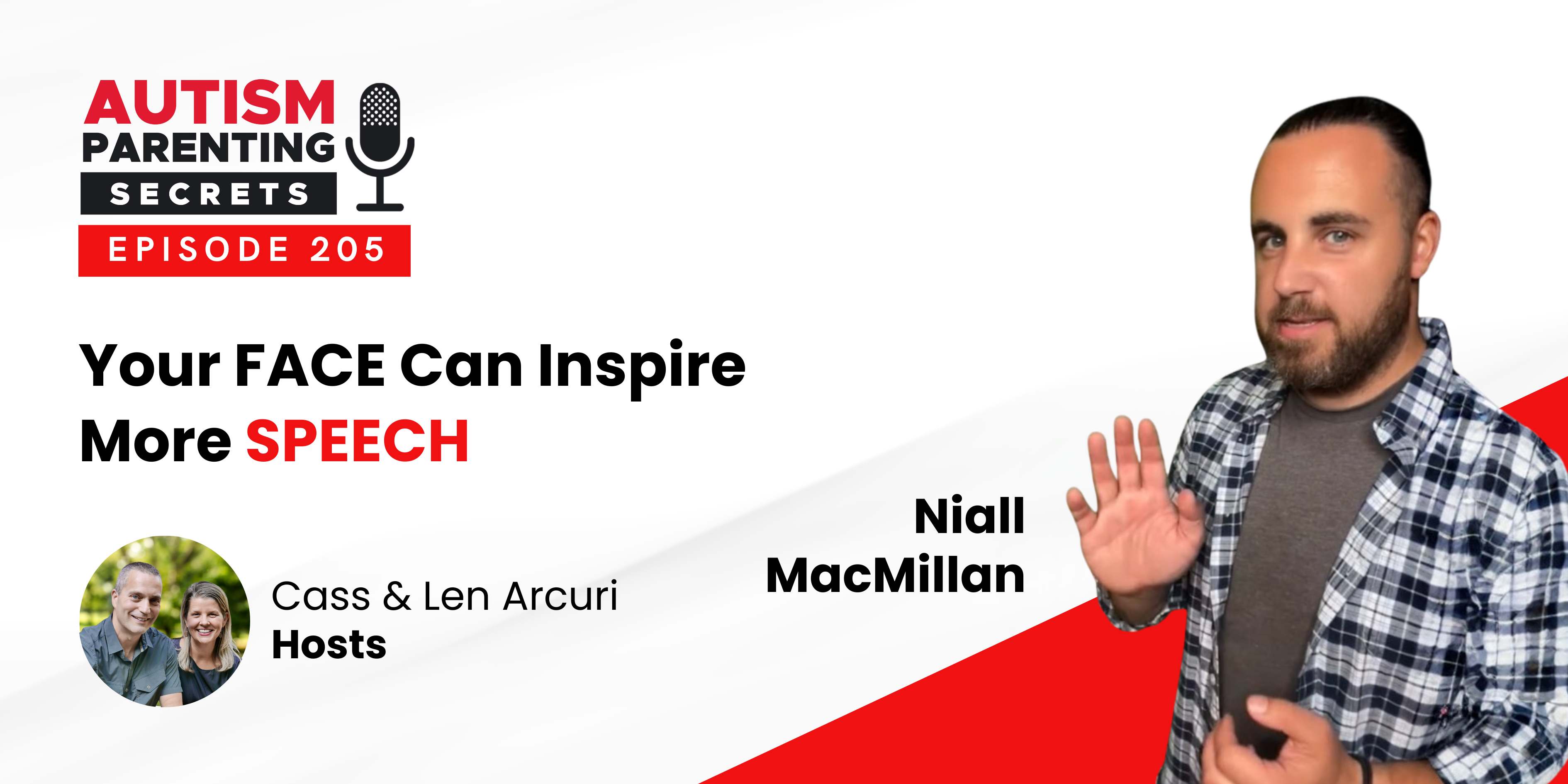
Episode 205 — Your FACE Can Inspire More SPEECH
Guest: Niall MacMillan • Date: May 23, 2024
Episode Overview
This week's guest, Niall MacMillan, a social media star with millions of followers, known for his non-verbal character on TikTok and Instagram, discusses his unique bond with his non-verbal autistic son, Ellison, highlighting the power of non-verbal communication.
About Niall MacMillan
Niall Macmillan is a dad of three children and one of social media’s most popular content creators, with 8.5 million followers across TikTok and Instagram. Niall has become Gen Z’s answer to Mr Bean thanks to his ‘Awkward’ social media character. Niall lives in the UK with his wife and three children and works a 9-5 job as well as creating his hilarious social media content, which has seen him work with the likes of Amazon, Sony, Universal, and the BBC.
Niall MacMillan on TikTok (@niallmacmillan)
Niall MacMillan on Instagram (@niallmacmillan)
You’ll Discover
One Dad’s Perspective On The World of Autism (4:54)
The Birth of a Viral Social Media Sensation (12:24)
How To Supercharge Your Words (18:41)
How Timers Can Help With Transitions (21:09)
The Freedom Of Not Caring About What Others Think (25:11)
The Facial Expression That DOESN’T Work (28:40)
How To Work Your Way Into Your Child’s World (31:15)
Practical Tips for Using Facial Expression (35:40)
Where To See Facial Expression In Action (41:58)
Referenced in This Episode
Full Transcript
Niall MacMillan | 00:00
You've got to enter into their world. If you want to have a relationship with them, you need to get within the world that they're within.
So my way of doing that is to kind of, it must be to force my way in by just being this loud and playful, singing, dancing, rhythm, repetition. And that's my way of getting in. And, you know, certainly at the comfort of your own home, there's no reason why you can't certainly try it. What's the harm in it? Certainly just be playful with it. Get in there, get the arms going, get the faces going. And yeah, just try to with as much energy as possible.
Cass Arcuri | 00:36
Want to truly be the best parent you can be and help your child thrive after their autism diagnosis? This podcast is for all in parents like you who know more is possible for your child.
Len Arcuri | 00:47
With each episode, we reveal a secret that empowers you to be the parent your child needs now. - Saving you time, energy and money and helping you focus on what truly matters most, your child.
Cass Arcuri | 00:58
- I'm Cass. - And I'm Len. - Welcome to Autism Parenting Secrets.
Len Arcuri | 01:14
Hello, it's Len. I'm so happy you're here. And I'm joined today by someone who's having a huge impact on social media. Without saying a word. My guest is Niall McMillan, and he's a dad of three. Last year, his youngest son, Ellison, was diagnosed with autism. And Niall and his family have been on a learning journey ever since. Niall has millions of followers on TikTok and Instagram. Where he portrays a character that doesn't speak and communicates through facial expressions. And that's been one key way that he's developed a really strong bond with his son who is nonverbal. The secret this week is... Your face. Can inspire more speech. Welcome now.
Niall MacMillan | 02:00
Hello, how are you doing? Hi, Len. Hello, audience.
Well.
Len Arcuri | 02:03
Thanks for being here, Niall. And this episode or this podcast is really about... Helping to share insights with other parents to help them step into an even stronger version of themselves a more loving version of themselves to be a you know, the true light for their child. And I think I'm excited what we're going to talk about because something as simple as facial expression isn't just like a minor thing. It's huge in terms of what our child's receiving from us.
Niall MacMillan | 02:32
Yeah, sure. Well, first of all, anybody who's familiar with me on social media, I just want to apologize now because you probably feel really uncomfortable hearing my voice. And I completely understand that. But at the same token as well, this is a very vulnerable situation for me to be in regards to I'm very new to this world of autism.
So if I stumble on a few words, if I say something that doesn't sound quite right, just have the patience and understanding to know that I'm very green when it comes to my understanding of this wonderful world I now find myself in. So just to kind of tell you my story. So essentially I am a father of three children. I have a, 10 yard. Now I'm thinking on the spot, trying to keep up the ages, 10 year old girl. I have a five year old boy. No, I don't. I have a seven year old boy and I have a four year old boy. My four year old boy, my youngest is Ellison. Ellison is the one who's been diagnosed, with autism and, you know, being a parent with two other children, I kind of understood. I felt like I knew parenthood. I kind of thought, you know, another one, this will be easy. This will be a doddle. We had our other one and it was during the lockdown period when the world, went weird. It was during the lockdown period that, we started to notice that, our youngest son, wasn't behaving or I don't want to say performing. Performing is the wrong word. But he certainly wasn't functioning the same way as the other children. The main thing we noticed, everything was fine up until about a year and a half, everything as you expect.
And then all of a sudden, there was no noises, there was no noise. Expressions, there was no emotion, it was complete numbness. Almost the best way I can describe it is, you know, when a child, you know, falls over or they have an accident and they go into a state of shock. Maybe not even a child, anyone really. State of shock where they're just you know, just like almost like a zombie. Later did I learn that term is called regression. They regressed. At the time, though, during lockdown, I put this down to he's a lockdown baby in regards to, you know, no one was going out, no one was socializing. He wasn't going to childcare. He wasn't interacting with other children.
So at the time, being I think very typical male, you kind of brush everything off and just think, " it's fine." I put it down to him being a lockdown baby. Luckily my wife didn't listen to me and continued pursuing things, which, which, Thank God she did. We pursued things. We went through the same path that probably everyone else has to go through a year and a half. You have to see this person. You have to see that person. You go through this. We went through speech therapy and we're, We always read the horror stories in regards to how long it takes to get the diagnosis. In fact, we're actually really lucky touch wood really lucky in regards to how long it took us It probably took us about a year and a half. I think because he was younger it was a little bit easier for us in regards to i think when they're older and more settled and if they're in mainstream schools and stuff like that len pull me up if i'm saying things or you want me to translate because i know i'll be saying acronyms or words that may not be the same you've probably heard a lot more than i have but certainly if i say something you don't understand what it is because there's a You know, your audience from across the pond, please pull me up on it.
Yeah, ahead.
Len Arcuri | 06:13
Fire away. Absolutely. I think our audience is going to pick up on it all, but go.
Niall MacMillan | 06:17
Good. Great. Okay.
So then, yeah, he got diagnosed. We pretty much got the diagnosis. And it's just, it's a nice, it's almost like a nice confirmation. It's, you know, it's not nice. You don't want your child, you have that worry at first. I know I did, is that you don't want to be labeling that child for the rest of their life as something just in case it is because, you know, whatever they're going through. But by the time we got the diagnosis, it was kind of like we needed to hear it. We needed to know this is, where we're at. And since we had that diagnosis, we've taken things a little bit further. We've got this thing called an EHCP over here.
So it's an educational funding. That's another thing which we, when we were reading, we read was going to take a real long time to get. We've been very luckily, we've gone through all the steps and we're at a point now where we've got the funding and we're able to, is now at a point where He's a very happy little boy, very happy little boy. And the best way I can describe it being a parent Off. Ellison, an autistic child, I mean, they're all different as well, but certainly mine. And my wife kind of shuns me for this, but this is just the way, the best way I can, I like to kind of put things in analogy. It's like having a French exchange student as in regards to we both live lives, but the way we communicate sometimes, I'm speaking English, he's speaking French, and it's just how we navigate that.
So we're trying to... You know, have a fulfilling life as much as possible and both struggling to understand each other. And it's just working out the best way of getting that communication. We didn't have a lot of communication very early on. A lot of our interactions were through facial expressions. A lot of it was you're just trying to gauge as much as you can from the face because he was nonverbal. Where you're at, whether he liked it, where we didn't like it, whether it what you've just said to him is going to steer him in a, down the path off a century overload.
So you're just constantly, and it's almost like, When you have the, what's it called? I think it's the horrible twos or the... Terrible twos. Terrible twos, that's it. When they get to that point, you're just on eggshells constantly because you don't want them to blow up. You don't want them to cause a scene. That's... Is pretty much how my life is now. I've just, I've learned to tread on eggshells in the correct manner that it's not going to blow up in my face and cause a scene or cause chaos or cause any distress to Ellison.
So that is the very long summary of, yeah, where the world I find myself in now. No, that's.
Len Arcuri | 09:11
Great. I appreciate you doing that and sharing that information in terms of your story because it does provide context. And I love that you're saying he's a happy person. Child now because ultimately I know I wanted so many things for my son early on and it was for him to be fixed, to not have autism, for him to be like other kids. I lost sight of the fact that really what I wanted most was for him to be happy. And what I wanted most for myself was to be connected with him and for him to want to feel connected with me. And those are just very different goals, which is why this topic is of the facial, the power of the facial expression I think is just so incredibly important and useful for parents to understand. Let me ask you though, from your standpoint, Before Allison came into your world, Was this something you were tuned into in terms of the importance of your facial expression? Or was it something that just as you were experiencing him and wanting to connect with him, that you just kind of intuitively sensed, hey, this is important?
Niall MacMillan | 10:08
Yeah, no, so certainly before having Ellison, I knew nothing of this world. I didn't have a grasp or understanding what autism was. I didn't have a grasp of what a non-visual disability was. I thought autism, Asperger's, ADHD, I thought they were – I had no idea which one meant what. They all just began with A's. There was just a lot of – disabilities with A's on them and now I've stepped into this world knowing you know what a sensory overload is regressions and just I have a whole new understanding of I almost feel guilty when I think back at previous times as many people would do if you're out and about and you see a child a naughty child or something and the parents not really got control and you think Well, I would have done that a little bit better. Or you judge a little bit. There's that little moment where you kind of roll your eyes and think you're a naughty child or something like that. I, you know, I think back to all the previous moments that I may have ever had that and just feel awful because, you know, I've had Ellison having a sensory overload, going crazy. And I could imagine from the outside in, it looks a lot worse than what it actually is. And you're not stepping in. For the safety of him and to not cause any further overloads. And so, yes, but certainly it's weird with the facial expressions side of things because they kind of correlate at the same time. I started doing social media and TikTok. During the, the, finding of Ellison having autism.
So as we're doing facial expressions to communicate with each other, we're all of a sudden this non-verbal character on social media where all I communicate with is facial expressions and that those two weren't you know they weren't a joint thing that wasn't a decision i made i just happened to stumble on into this character where i didn't need to speak and it meant more by using my face to say as much of a story as i need to and that's the level of community i the communication i have on social media i'm telling stories And my biggest audiences are Germany, Brazil. These are people who don't speak English. These are people who don't have an understanding you know, what I, if I was to say the words in English, you know, the story would change, they wouldn't care. But I had this international following just because of my face. And the whole story is told just because of my face and my face is no different than anybody else's face. It's just, I happen to record it and tell the same story.
So to be able to have that communication. Luckily now we can communicate with words. A big thing now is that we can say yes and no. And believe me, before that sounds bonkers that before we never had that, I would never be able to say, would you like this? Yes or no. We would never have that communication. Now we have that. That is, you know, I don't have to rely on the facial expression so much more.
Len Arcuri | 13:20
The significance of that is not lost on me, by the way. That is.
Niall MacMillan | 13:24
Absolutely bonkers. Absolutely bonkers how that has just added another layer of communication and we can manage each other's expectations. I know that he's not happy with something. Whereas before it was, you're just gauging it just in his temperament. And yes, absolutely.
So it's very strange and surreal, and it does kind of baffle me how I've ended up being a non-verbal character on social media, but certainly my character isn't autistic. It wasn't meant to be. I'm not trying to be this kind of, It just happens that I have an autistic son as well. Right.
Len Arcuri | 13:58
But the fact that you have this character and the fact that it is something that any country, any, because there are no words, it has more appeal and impact. It's kind of just gets your attention because if you're watching a video that's You're just expecting to hear the audio.
So the fact that there really is no, at least no speaking, it does, it grabs your attention.
Niall MacMillan | 14:23
It's almost saying more. With nothing. I think a lot of the times videos with silence can say more. And plus, this is the main thing I say, there are so many people out there sharing their voice and shouting from the rooftops and saying more and more that I think almost kind of stepping back and just doing no voice speaks volumes and probably almost says more than what people are venting on videos or speaking a lot.
Len Arcuri | 14:52
Yeah, no, and it really underscores how Not using words can actually be an incredibly powerful tool, for lack of a better word, in your toolbox. Because if you're trying to connect with your child, if you're trying to have them be interested in what you have to say and what you're doing, the facial expression is an incredibly powerful way to do that. My wife and I, Cass, we went and got trained and we had some great influencer friends. People who helped influence us early on, including an organization that really talked about your expression and how you're presenting.
So if you're angry or upset and that's in your expression, or if you react to your child's behaviors, like really angry, like lighting up like a Christmas tree, that that's just going to keep pushing your child away. So we learn that early on and kind of learn the importance of this. But I think what you're doing and the fact that you have close to 8 million followers now, it's because this connects with people. This is something that gets noticed. And if you're trying to help your child or inspire your child to want to be more connected with you, The facial expression is an incredibly powerful way of doing that.
Niall MacMillan | 16:10
No, absolutely. And I think it's almost evolved now.
So from the facial expressions, certainly I know before, He would always love when I'd go angry. I mean, he's quite a twisted individual in regards to he loves me when I'm at my angriest or pretending to be angry.
So I always used to try to go through the emotions. So, you know, I'd have a visual with all the emotions, like the emojis of different.
So sad, unhappy, happy, angry. And he loves and we've got the visual app on the phone as well, visual to go. And, you know, I let him kind of go through all the emotions, he'd press them and I'd perform the emotions there and then. And he's constantly pressing that angry one. He likes the angry. And it's almost evolved now. Where we can communicate a little bit more. And we've learned from an outside specialist that he learns words and his vocabulary by sound and by rhythm.
So A lot of our interaction now has gone from just being nonverbal and facial expressions to everything's a song and dance, everything's playful, everything's rhythmic, everything's like a phrase that he would always go back to. So it's almost like a melody that we're playing with.
So a lot of the bedtimes that I do, if I'm telling a story, it's so over the top and just so... And it's always the same. It's always the same repeatable stuff over and over again.
So I'm constantly telling Humpty Dumpty. What's the other one now?
So over Christmas, we were doing this song called When Santa Fell Down the Chimney or something like that. And I can't get rid of that now. That's his favorite song. And I'm singing it now. And it's, you know, we're a month or two out of Christmas.
So that's how we're mainly communicating at the moment.
Len Arcuri | 18:02
Is it safe to say that part of the key with using your face as something to inspire your child that I think the word that keeps jumping into my mind is enthusiasm. When you're conveying your emotions through your face, it's like there needs to be an energy behind it. And a child is going to pick up on that enthusiasm immediately. Which is why the combination of your intent going in and then you actually consciously making sure that your face is conveying something interesting, exciting is really important.
Niall MacMillan | 18:37
No, absolutely. I mean, I think with any sort of communication anyway, I think putting the energy behind it, that, you know, translate more and helps with people's communication.
I mean, but certainly words were nothing to him. Without putting some sort of rhythm or putting something, an expression behind it or something with energy, that's the kind of communication that we really have. He's all through energy. And through, very strangely as well, we're very rough and tumble. He loves that kind of sensory time now. And it's very strange because my other child Miley who's 10 years old she's very much a rough and tumbler like that century fix that you get from it and I think everyone has these century requirements so but It's very funny. There was a time a few weeks ago after school, Ellison comes home. He's running around back and forth on the sofas, jumping up and down. He has that real stimming time when he comes home because he's been restricted, I'd imagine, a little bit more at school.
So he comes home. He's relaxed. He's got YouTube on where he's watching planets or he's watching flags. He knows all the U.S. States at the moment, and he'll just watch these – rhythmic, you know, songs about planets or flags or countries. And when I come in and he calls me the dragon and I come in and I just pick him up and we run around, we tumble. It's all very safe, but we're rolling around the floor. He's climbing on me and I'm kind of getting rolling around.
And then my other daughter, my daughter comes in and she's doing the same. And there's the three of us rolling around on the floor, climbing all over each other. And there was my other son and my wife just sitting on the sofa, just looking at us thinking, what on earth is going on here? And the three of us are loving life on the floor, rough and tumbling. And I just thought maybe we're those ones. Maybe that's our connection that us three have is that we're doing that.
And then the other two are just sitting on the sofa thinking, what on earth is going on here? But we're all absolutely loving life.
So, yeah, so things have evolved. I've learned now what works for us and the next thing now how things have evolved are The way we manage Transitions, because that's a massive thing I never knew about before. Transitions from one thing to the next. Everything is on timers. Timers for me, he loves a real sensory overload when he sees a timer, a flap in her hands, and he loves seeing a clock count down. And it can be from 10 minutes down to one.
So what I'm trying to do now, he's not toilet trained, but now every morning I put him on the toilet and I put the timer on and he absolutely loves it. We can sit there for 10, 15 minutes. He'll sit in that toilet. He won't do a damn thing. He does nothing yet. He's yet to do anything on the toilet. And we do it at night as well.
So at the moment, you know, before when we would try to get him to get his shoes or coat on to go for school or get out of the house, huge overload. You'd have to do it half an hour before. You'd have to manage his expectations. You have to try and keep the kids out of the way and just real – horrible management. I can now go, and I did it this morning, Alison, put your shoes on. No shoes.
And then I'll go, Can't say the word. I'm going to say the word. Alexa. Hopefully people are listening out loud and it's triggered something.
So put a timer on for a minute and a minute after, and he'll put his shoes on like that. It's almost like he won't listen to me. He'll listen to it. He'll be at the behest of the timer. And right now, that's the thing where you... And I'm sure you've found this and a lot of your other guests and people listening on this, that you feel like you've cracked it. That's the latest. And me and you both know, I haven't. I know he'll evolve and he'll realize in a week that he's not going to do that anymore. And he's bored of that.
And then all of a sudden, I've got to try and find another way of managing life. But at the moment, that's the main thing that works.
Len Arcuri | 22:50
No, I wasn't sure which way that was going to go with the timer. I wasn't sure if a timer would be something that would add pressure and he wouldn't like it, but you're saying it's actually a great.
Niall MacMillan | 22:58
Tool. Absolutely. He loves it. It worries me because he As with any parent, you're worried about how you're programming your child for later on down the life.
So every little thing you do, you question or, you know, every repeated thing you do. I know I think like this. I think if I keep doing that, what's the repercussions of that?
So if I'm putting a time and I do think now if I'm putting a time limit on his toilet training. Or if I put a time limit on this and that.
So there is a lot there where you're worrying about, too far ahead. I think every parent has that anyway, but certainly that that's the concern I have at the moment is, but until he does, the toilet, which I'm not even sure he will, he may, we could be doing this for another couple of months, without him doing anything. It's certainly been a month already.
So, Absolutely.
Len Arcuri | 23:47
Right. Patience is the key there for sure. But as you're telling the story about the rough and tumble and all that, there's two concepts that came into my mind is that you're tapping into what's joyful, doing something that's joyful with your kids. They like the rough and tumble play and everyone's super excited. And the fact that your wife and your, I guess, your other son were watching, wondering what was going on, kind of judging it. It just reminds me that a lot of times what's going to be useful for our child and what we do with them, Other people may not get it, may not understand it, may think you're nuts. But there is real power in not giving a shit what other people do or what other people say about what you're choosing to do in the moment with your child, which is, again, where you're the expert on your child, what they're going to respond to. And even if it looks silly to other people. Yes. You can still double down and say yes, that, hey, I'm going to connect and find a way And you're doing that with your facial expression, once many other things. And again, what's going to be effective and useful. That's a personal thing. And, you know, who cares if other people aren't necessarily approving or cheering you on?
Niall MacMillan | 24:55
No, absolutely. I know that's a fundamental part of his coming home and his management for the rest of the day is that And I love it as well because it's the interaction. But certainly if you're a parent, you know, with an autistic child and you're worried what other people think, you know, I think that will go very quickly because you won't be able to navigate or function if you've got that worry of other people. But certainly... There is that transition period of when you're out. You get embarrassed because what will people think?
And then by the end of it, you're just thinking, I just want to get through what we're going through right now. So there's not an overload. It hasn't gotten too far. And just keep everyone happy.
I mean, the main thing for us, if we do go out, certainly if we go on trips, we wear lanyards, which again, before I probably saw thousands of lanyards and different symbols it meant nothing to me so it probably but it certainly at least you kind of get a nod or an understanding from other people who are in the same situation so that's the best way I try to and what I try to do is well I try to wear on every one of my videos at least I wear this I love someone with autism Just as a way to share. I don't like coming on social media and making it I look, I've got an autistic child and that's my identity and that's what I want to share in the world. This is just my little nod, but I'm not going to shove it down people's throats at the same time. I'll support the best way I can. But I suppose because I'm new to the world, there is that worry that, you know, I'm going to say the wrong thing or I'm going to upset someone because there are, there's a lot of sensitivities around having a autistic child as well. I can imagine that you saying the wrong thing or a different opinion to someone else. And it's bound to happen because the things I'm saying and what I'm sharing here are probably completely different and would contradict somebody else with a child in their way. But all you can do, all I'm trying to do is share my story and what's working and where I'm finding myself now.
Len Arcuri | 27:05
Yeah, no, I really appreciate that. And yeah, you hit on something that's absolutely key, which is especially in this space, Nobody agrees on anything. There's a lot of difficulty and challenges with this journey. And every journey is unique and different. Even this podcast, you know, we're, again, we're not about what a parent should do, but much more about how they're navigating. And even something of a concept saying, "Hey, you know, something more is possible for your child." It's a controversial statement because there are a lot of people who don't think that that's the case. And so, you know, I honor the journey that everyone's on and that people are in their unique place and have their own unique worldview. There's no point in judging, but the reality is... Is that so much more is possible for these kids, particularly if the parent can get to a better place where they're seeing things more clearly, not trying to combat autism, but just meeting their child's needs like every parent wants to do. But you can't do that if you're trapped in judgment. You can't do that if you're worrying about what other people are thinking about what you're doing.
So there's so much that's within a parent's control. And again, that's why we have this podcast. To help share that. And every journey is totally unique.
Well, one thing I would like to bounce off of you though is One thing I've learned lately as I'm trying to I've transitioned from a corporate career to now being an entrepreneur and doing this work. And there was a course I took that really talked about They covered facial expressions and what they were sharing in there is the most upsetting thing that another person can receive is a neutral expression.
Like in other words, this goes to what you were saying before about what you're, what Alison likes. If somebody is receiving an expression of someone who's like maybe a little angry or upset or disapproving, that that's actually easier for people to take in than a blank neutral expression.
Like a neutral expression is almost more. Intimidating And so I was wondering what you think about that as you're creating your videos and obviously facial expression is really important. Do you find that that's true too, that like a blank expression is something that's very off-putting? Because the reason I'm asking is that I'm a pretty monotone guy when I talk and I'm guessing from a facial expression, I'm probably pretty neutral too, maybe more so than most people. And I've been actively trying to have more of a dynamic quality in my facial expression because I recognize that I might be neutral in actually pushing my son, my daughter, other people away from me, which is not my intent.
Niall MacMillan | 29:51
Well, Len, you're, you keep me perfectly interested. I think you're putting yourself down there. You've got a wonderful face and a wonderful, non-monotone voice at all.
So, yeah, no, not at all. But, No, certainly I don't. I think When it comes to the facial expressions, I know that a lot of times if a child's behaving poorly, what I've had from previous experiences, I would ignore them. I would, as in, you know, straight face. And if they're poor behavior and they're not listening to me, I would ignore them. With Ellison, that doesn't work. You can see Ellison, he's watching me and he'll ignore. Watch my every movement of my face gauging where I'm at and he and the thing is with Ellison he'll wait He'll outweigh you in anything.
So there's no way of – if you're butting heads with something, if you're at a conflict, he's won. He's going to win because he will outlast you just because he will just continuously go and there's just no beating him.
So, yeah, certainly – You can tell a lot and steer things with a blank and monotone voice as well. But again, with the situation I find myself in, it has to be. It has to be with melody, with personality, and everything's got to be playful.
So say, for instance, if he's doing something I don't like, if I just say no, and I've got to be authoritative, which with the other kids, perfectly fine, no problem at all, which is what I knew. No, can't do that. No. Authoritative voice, deep voice. No. With Ellison... Means nothing he's not listening he's still looking at you like he's about to do it whereas now if i make a big song and dance and go no you can't do that if you do that no no he'll laugh he'll giggle and he'll stop what he's doing he might go back to do it to get that same reaction again but he's not going to go ahead and do that naughty thing so it's just that's what i've learned now is to be more expressive and make a big game out of it And it's weird because I'm constantly thinking about the future. And I have this... There's somebody on TikTok as well who has an autistic child. His name's Thorn. I don't know off the top of my head what the rest of them are, but he's a lot older. I think he's in his 20s. And a lot of his mannerisms, his shouts, his screams, the way he handles things, I see Ellison in him.
So I'm almost looking at Thorne and what he's doing and how he's navigating through life and just thinking of Ellison being there. And the way my wife and I think of this, So we've got Ellison for the next 40 years. He's sitting at the dinner table with us every night. We're going to be doing the same things. And you know what? That doesn't even bother me. We've kind of come to terms with it. If he can go ahead and have an independent, fulfilling life where he lives on his own, he raises a family. Fantastic but at the same time you know i have no expect zero expectations of that it's just yeah trying to raise him to a point where he's as as happy and as fulfilled as possible but my wife and i are very ready to certainly carrying him as well he's getting big he's a big lump he's a big boy And yeah, I can imagine next to my wife's already struggling now when it comes to lifting and he loves getting cuddles with my wife as well.
So it's going to be a fun road.
Len Arcuri | 33:27
Yeah, no, that's beautiful. And one key concept as you were talking is, you know, expectations don't help, right?
Like expectations just feel hard and heavy. So have wants for your child, go for those. But if they're expectations, that kind of creates a lot of, avoidable pressure, which just doesn't help. And as you're talking about insights in terms of facial expression, how you are with Allison. It's something that came to my mind that yes, from his standpoint, how awesome is that? And that's such a great gift that any parent can give their child, but it's a gift you give yourself because it just feels better. And so much of this journey is how we as parents are feeling the energy we're really feeling inside.
So the over the top nature of how you are with him, I got to imagine that just feels great for.
Niall MacMillan | 34:20
You. No, definitely it does. And it really helps.
I mean, he's probably, Ellison's probably saved me a fortune because I'm pretty sure without Ellison and still being childlike with him, I would have probably had another child and it would have cost me a fortune. But now, you know, I'm still being, I still have that, that's that itch scratched. I'm still got not a baby to raise, but certainly I still get to have that kind of like the son i still have the little one i need to raise i still have that one that i can still sit and have a cuddle with and feel warm and cuddly with where the older ones you kind of think they don't really care for you anymore they slowly they stop caring so i still have that outlet still have someone who depends on me so i think without that certainly Yeah, we've probably had another child, which right now I'm very glad that we don't. But certainly I love being able to have rough and tumble. And it upsets me when my other son doesn't want to, you know, he's only seven, but he's got the mind of him like a mature 11-year-old.
You know, he doesn't want to do the fun, playful stuff anymore. So I do have that outlet, which is, you know, great. It keeps us young as well. When they stop caring about us, actually it'll be a bitter pill to swallow i think so yeah.
Len Arcuri | 35:37
And that eventually it does get there so all the more reason to now while you have them at the age that you have to be yes we want to be parents we want to guide them but at the same time to enjoy our time with our kids and again you can do that if you change your state and really get more playful, you know, more tuned into what's going on with them, what's going to be effective, what's not. And that's why, at least from my standpoint, A neutral facial expression or an aggravated, annoyed parent doesn't help anybody. It doesn't help your child. It doesn't help you. And my sense, Niall, is that you have more of a, you probably were born more wired where this came naturally to you. But for parents who are listening, who are like, okay, I get it. I'm sure if I looked in the mirror or saw how I was with my child, I wouldn't be liking what I saw. How can people just Put this more into practice. Do you have any kind of practical ways that parents can become more self-aware and to tap into the power of the facial expression more with their child.
Niall MacMillan | 36:42
Yeah, sure. I mean, well, certainly I think in regards to that, how I am with them and it's going to sound ridiculous and certainly not something that people will be comfortable with doing in public and so much, but the way I am with him and the communication and the big, it's almost like a pantomime. It's almost like a big show and just everything's over the top and everything's got a rhythm. And imagine, you know, if you're sitting and watching a pantomime and everything's very dull and monotone and watching it and there was an ugly sister that came on or the genie, it would be very dull.
So you've got the way I, you've got to enter into their world. If you want to have a relationship with them, you need to get within the world that they're within.
So my way of doing that is to kind of, it must be to force my way in by just being this loud and playful singing, dancing, rhythm, repetition, And that's my way of getting in. And, you know, certainly at the comfort of your own home, there's no reason why you can't certainly try it. What's the harm in it? Certainly just be playful with it. Get in there, get the arms going, get the faces going. And yeah, just try to with as much energy as possible. And, you know, I mean, I couldn't imagine it being, I don't think I've used it in a negative fashion. There's no way of being angry. And yeah, you just, that's, so I don't really discipline him anymore. Obviously I tell him no and when not to do things, But the thing is, as well, we actually had a meeting with his school because that school is very surreal. He's actually quite violent, which we've only just learned recently. He hits. And at home, he rarely, you know, he doesn't hit at all. He doesn't, you know, sometimes he can be rough because of the size of he is and how playful he is but certainly not hitting or punching or anything like that and actually at school which is at a mainstream school at the moment we're still looking to progress we're still in the steps to get into a special school and i don't know how things are over there but certainly over here there is you know there's So many spaces and a few hundred more students ready that need the spaces to go to.
So we're going through the steps at the moment. And we were speaking with the teachers today because of the hitting. And when we heard about it, which I couldn't even fathom or understand as to why. And then when we got there they were saying we had a discussion and there was a lot of stopping him to doing things and when he can't do things no you can't do that and i get it the same way they probably do with other children and it's that you know just sharing that tip alone is that if you're cheeky with him if you're playful with him then he'll stop what he's doing laugh it off and move on to something else whereas if you butt heads with him he's gonna win Like, yeah, if you try and yes and no him and try to be disciplined, he's going to win. And I think throughout the day, if he's getting told no and he's biting heads, maybe essentially that leads to some sort of at the same time. But yeah, no, that's, it's concerning, it's worrying, but it doesn't happen at home.
So we've got to try to manage it. So we're working collaboratively with the school at the moment with that.
Yeah.
Len Arcuri | 40:02
That's a big part of the kind of coaching my wife and I do because there's a root cause for everything. So the fact that he's different there is a huge clue. And with some curiosity, you will discern what it is that's going on there that might be giving rise to that different behavior.
Niall MacMillan | 40:15
And it was almost like it sounded like a fear from some of the teachers. And they said something like they needed four of them to control him, to get him into a room. And in my head, I'm thinking, all right, he's not a bull, first of all. You don't have to try and hoard him. But certainly, I know... That And you've got to try to relay this to the school because obviously they don't understand what I'm with the majority of the time. I know, especially when, say for instance, when he gets his hair cut, When he gets his hair cut, he hates it. We're all trying to navigate it the hairdresser my wife and I were all just trying to navigate it he's getting a lot better right now but what we've learned is that when you're in there and you're trying to feed distractions and show him this give him that you got four people going in trying to do all at the same time I know, you know, that, that is gonna, you're giving him more sensory input and all he needs is a complete, you need to just down tools and just stop what you're doing and let him, come down a level, whereas you have four people in there trying to hold him like a bull. So yeah, so it's navigating that, but this is the fun. This is the fun stuff. This is, this is the life of it. This is the reality of it. And you just got to, it's, you know, it's fun. I thought I cracked it with my other two kids. I knew what parenting was. All of a sudden life throws me a, a side ball and I'm like, wow, this is a whole new world, but this is what life is. It's exciting. And it's just, yeah, it's a, I appreciate it. I appreciate the world I now find myself in. It keeps us young. It keeps us...
Yeah, life is a good way of teaching you that you don't know everything. And there's another chapter and another skill you need to learn. And that's where I'm at the moment.
Len Arcuri | 42:04
Fantastic. Yeah, no constant learning and growing. And again, it's all happening for a reason. And I just love how you're taking what you're learning the growth you're having as a dad with your kids. And with your channels. I think it's a great place for people to go to be able to see kind of how you do what you do to get ideas. And it sounds like a simple thing, right? Just change your facial expression and be fun. But like anything else, You can learn, you can get better.
So where can people go to see you in action and to better understand how they can really have the power of their face work for them?
Niall MacMillan | 42:41
Yeah, sure. So if people want to watch every iteration of my face, you can find me on TikTok is the main channel. That is Niall McMillan on TikTok. I'm on Instagram. I'm on Facebook. There's only one Niall McMillan. There's only one unique, weird name like that.
So Facebook, Shorts, I think I'm even on Snapchat. I'm on all the channels, but I just repeat the same thing.
So whatever the, but I do a video every single day and the video essentially will be a self-deprecating video of me in a situation that's uncomfortable, awkward, and me as a nonverbal, awkward male trying to navigate in this weird and wonderful life of all this weird, wonderful viral nonsense that's going on around us.
Len Arcuri | 43:31
Fantastic. Well, for those of you who already do follow Niall, I apologize that now, yes, you've heard him speak and it's spoiled everything for you. But otherwise, if you haven't yet, go check it out. I know I'm learning a lot by watching your channel.
So thank you so much for sharing your perspectives, wishing only the best for you and Alison and your entire family. So thank you so much.
Niall MacMillan | 43:53
No, thank you very much, Len. I just want to say wherever you are in your journey, Just try to honestly enjoy it. Enjoy it. It sounds easier said than done. And I said, be loud and playful. And that's very easy to say. But when you're out in public and you're trying to just get through life and everything's stressful, just try to bring the good energy into it wherever you are. Much love. Good luck on your journey. We've all got different journeys. Enjoy yours. Much love. Thank you for listening as well.
Len Arcuri | 44:22
Thank you, Niall.
Cass Arcuri | 44:24
Want to learn more? Go to elevatehowyounavigate.com